Allison Schrager: College costs are due for a correction, not a crash
Published in Op Eds
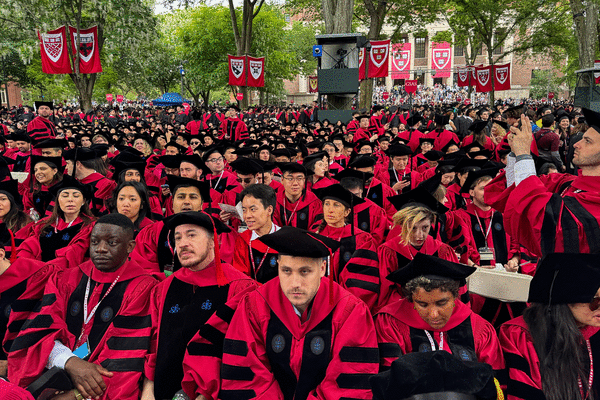
A lot of people used to think about college the way a lot of people now think about protein: good for you in any quantity, and the more the better. How times have changed.
Not only is the share of people who see college as a worthwhile investment in decline, but some smaller schools are digging into their endowments to stay afloat. Even popular and established schools like Syracuse are falling short of enrollment goals and facing a budget crisis. It is all leading to speculation that higher education is a bubble that is about to pop.
That’s unlikely. College is less like an overvalued stock about to crash than an expensive bond due for a repricing. In the meantime, it will still make payments.
American universities face many challenges. First, the numbers aren’t in their favor. In the postwar era, each generation was larger than the previous, and more people from each generation wanted to go to college. International students were also willing to come to the U.S. at almost any price. Now those sources of growth are exhausted. Enrollment in a four-year college has been steady, about 40%, for more than a decade. Future generations are smaller, and there are fewer foreign students.
Universities are not without blame. They’ve let themselves be seen as more political or even promoted views many Americans do not share. They offer some degrees of dubious value that have become a source of embarrassment. Grade inflation, opaque admissions, and other ways to cheat the system have undermined the academic worth of a college degree. And now the value of knowledge jobs is less certain. Amid all these sins, tuition for four years of university is now pushing $400,000.
And yet, none of this means education is a bubble about to pop. A growing share of Americans went to college over the last decades because they were responding to an unambiguous economic incentive to do so. For most areas of study, there still exists a significant college wage premium (although it has shrunk a bit recently). Odds are excellent, if you graduate, that you’ll earn almost $1 million more over your lifetime and experience less unemployment.
And while it may sometimes seem like college is full of people getting useless degrees, most students major in career-oriented subjects such as business or health-related fields. Humanities enrollment has been on the decline, and very few people major in niche fields that are often the subject of controversy or ridicule.
Most people still want to go to college to have some fun, learn some useful things and get a good job when they graduate — and many of them get that. Many parents, especially those who are also college graduates, want that for their children, and raise them with the expectation that college is something they should do.
That expectation is part of where things go wrong. As obscenely expensive as it is, college is still one of the best investments you can make. For a long time, that made it seem like a risk-free asset — one for which any price could be justified (sort of like low-risk longer-term bonds the last 20 years). This was especially true at prestigious private schools where prices rose the most. And like the bond market, there was plenty of government interference in the form of loan subsidies, which made prices insensitive to market forces: Universities could charge almost any price without paying attention to the service they were providing.
In this way, what’s happening in higher education is a lot like what’s happening in the bond market. Bonds were overpriced for a while, but they still make payments. There’s just less certainty of the value of those payments right now, so prices are adjusting.
Prices will take longer to fall at universities, in part because they’ve taken on debt and have lots of infrastructure to pay for. But the market has already started to speak. More students are seeking out state schools in the South that are cheaper and less politically fraught.
One reason some private schools got so expensive was they conveyed a sheen of prestige that signaled exceptional intelligence and connections. As more people go to a greater variety of schools, however, that sheen will dull, and the value of different schools will equalize. The upshot is that elite private schools will need to reform the most — both cutting costs and demonstrating their academic merit.
It is not an impossible task. Universities have changed before: Once only for elites, they learned to serve more people. Now they will need to demonstrate their value to price-sensitive customers. Ideally, the result will be more accountable universities — and less emphasis on elite institutions, which never offered a better education but still charged a premium. And a little market discipline, as any business-school class will teach you, is never a bad thing.
_____
This column reflects the personal views of the author and does not necessarily reflect the opinion of the editorial board or Bloomberg LP and its owners.
Allison Schrager is a Bloomberg Opinion columnist covering economics. A senior fellow at the Manhattan Institute, she is author of “An Economist Walks Into a Brothel: And Other Unexpected Places to Understand Risk.”
_____
©2026 Bloomberg L.P. Visit bloomberg.com/opinion. Distributed by Tribune Content Agency, LLC.














































Comments