Editorial: More cops are accused of misusing Flock cameras. This is becoming too much like Big Brother
Published in Op Eds
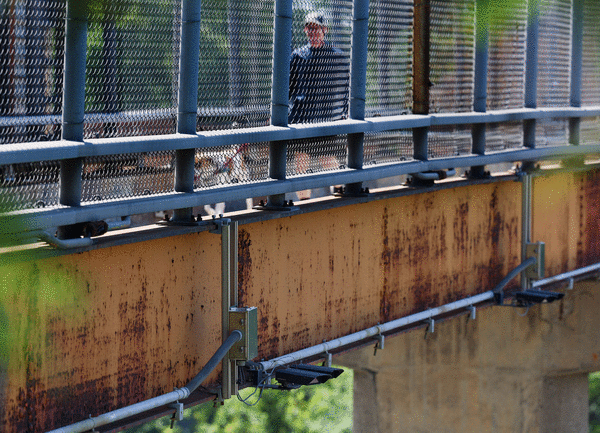
On Monday, West Chicago announced the city was reviewing its Flock camera system after discovering an officer may have been using it for “an unauthorized purpose.” Ditto Itasca, where an officer accused of misusing Flock is now out of a job.
Former Holiday Hills police Chief and Prairie Grove Officer William Copp allegedly used license plate reading technology hundreds of times for unauthorized searches of former partners and other people he knew, according to the Chicago Sun-Times.
When it comes to automatic license plate recognition, such as Flock cameras, there is a growing list of abuse. The Washington Post reported last month that authorities have charged or accused at least 50 law enforcement officers of leveraging ALPRs without authorization, sometimes using the software to stalk women.
This possibility should alarm anyone who values privacy.
“Yes, but,” ALPR supporters respond, “this technology helps solve crimes!”
We have no doubt it is much easier to track down perpetrators when you’ve been tracking vehicle movements, and we are certainly aware of the pressing need to curb crime. We’re on record as being enthusiastic supporters of what used to be known as ShotSpotter, along with other gunshot-detection systems that have proved to be effective in detecting shootings, directing police to scenes and potentially getting aid to victims.
How can you support ShotSpotter and oppose ALPR?
The biggest and most important distinction between these technologies is the extent to which the public is surveilled.
ShotSpotter uses acoustic technology to pick up the sound of gunfire.
ALPR technology, on the other hand, creates a visual record of our movement. Every time you drive by a camera. ShotSpotter offers targeted detection of a dangerous event versus technology like Flock’s indiscriminate collection of innocent people’s movements.
Flock defends its cameras, saying “they capture what anyone could already see standing on the street,” focusing on “the vehicle, not the person.”
That’s not exactly a fair comparison. Of course people standing on a corner notice cars driving by. Most of us, however, forget most of what we see. Not so with an AI-powered surveillance camera.
While it’s a relief that they say data is automatically deleted after a while — Flock recently shortened its default retention period to seven days, down from 30, though data can be preserved longer — it’s still there. And we’d also point out that cars don’t drive, people do, and whoever owns a vehicle that ends up in law enforcement’s crosshairs will have to face the consequences, not the car.
They blend into the landscape of traffic lights and electric poles. It’s easy to miss them, but once you notice them you’ll start noticing them more and more. Like small black eyes, ever-watching. It’s a tad dystopian.
Illinois has poured tens of millions of dollars into ALPR technology in recent years after Gov. JB Pritzker signed the Tamara Clayton Expressway Camera Act. That law enabled Illinois State Police to use ALPR cameras to investigate expressway shootings, with IDOT providing funding and procurement support. As of 2025, 588 cameras have been installed statewide, according to Illinois State Police, which contracts with Motorola Solutions for ALPR.
That’s a problem too. We’re not just under the watchful eye of law enforcement but also of the private companies with which they contract out surveillance services.
Some municipalities, Oak Park and Evanston, have decided to end their Flock contracts. Homer Glen announced it is suspending its program after reports of a Will County sheriff’s deputy being placed on administrative leave for allegedly misusing the software. In northwest suburban Rolling Meadows, the City Council expressed concerns over data sharing with some members saying last month that they’re prepared to end their contract.
And we can’t help but notice the strange bedfellows this issue seems to bring together. Consider: Republican gubernatorial candidate Darren Bailey and Sen. Bernie Sanders are united in opposition to Flock.
Where you fall on this issue surely depends upon how much trust you have in our government to use it wisely and responsibly. For our part, given the evidence of misuse thus far and a general understanding of human nature, we find ourselves less than comfortable.
The problems here go beyond a few bad actors and Flock as a whole needs rethinking with an eye to better safeguards. Government shouldn’t be able to build a broad, searchable history of innocent Americans’ movements simply because they drove past a network of cameras.
_____
©2026 Chicago Tribune. Visit chicagotribune.com. Distributed by Tribune Content Agency, LLC.


















































Comments