Commentary: Black liberation requires investment
Published in Op Eds
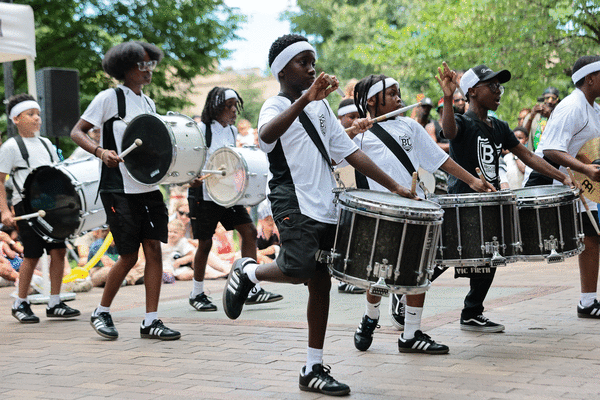
By no coincidence, Black August and Black Philanthropy Month are observed at the same time. Both are rooted in a simple truth: Our liberation is never granted; it is built, protected and sustained.
The Black liberation movement commemorated by Black August gave us the blueprint for organizing people who had been deliberately and systematically excluded to fight for a just world. Black Philanthropy Month underscores what communities have always understood — that collective action, from mutual aid networks to civil rights campaigns, is our greatest strength. But organizing requires resources, as well as people willing to put their money where their values are.
That is the heart of Black philanthropy.
I joined VOCAL-NY, the founding state chapter of VOCAL-US, in 2010, after being evicted from the rent-stabilized, one-bedroom apartment where I had lived for 12 years. VOCAL-NY had been lobbying for legislation to cap the rent for people living with AIDS. As someone living with HIV and dealing with housing challenges, I knew I needed to share my story with policymakers.
Fast forward to today: Hundreds of thousands of people in New York City living with HIV/AIDS and receiving social security now pay only 30% of our income on rent. I’m in a luxury highrise on West 42nd Street, and my moving costs, furniture and first and last month’s rent were paid for. VOCAL-NY invested in me so that I could attend the People’s Action Institute’s week-long International Transformative Training in Chicago in July 2015, and I’ve been organizing ever since. That’s the power of sustained, Black-led organizing.
Billionaires and wealthy institutions in America spend enormous amounts of money ensuring that the status quo intentionally leaves Black communities behind. They fund political campaigns, think tanks and advocacy efforts that weaken voting rights, dismantle civil rights protections and target and criminalize minorities and underserved populations while they oppose investments in public education, affordable housing, healthcare and economic mobility.
Black philanthropy is one of the most effective ways to meet this moment because it shifts power into the hands of working-class communities. Rather than waiting for institutions and politicians to decide which priorities deserve support, donors can invest directly in leaders and grassroots organizations that understand local challenges and have earned the trust of the people they serve.
The power of directing our dollars toward organizations that reflect our values cannot be overstated. Black philanthropy has never been defined by the size of a donation. Every contribution — whether it is $10 or $10,000 — helps build a movement, expand services, train organizers and create opportunities that ripple across generations.
Recently, massive federal budget cuts make those investments especially urgent. Affirmative action has been dismantled. Diversity, equity and inclusion initiatives have been rolled back across public and private institutions. Programs that sought to expand opportunity are being stigmatized and called radical. Many of the gains won through decades of organizing — like voting rights — now face renewed challenges.
Again and again, Black Americans have organized in ways that benefit society at large, despite the odds and obstacles. We have built movements under segregation, voter suppression, economic exclusion, and discrimination, and, often in the face of violent oppression. But communities cannot thrive on determination alone. Sustainable movements require sustainable investment.
Black Philanthropy Month (including Black Giving Day on Friday, Aug. 28) and Black August offer an opportunity for all people living in this country to turn the tides. Whether or not you are Black, whether you give through a family foundation or make a modest donation, your support can help sustain organizations doing the difficult work of building a more just and equitable future.
Black August reminds us that liberation has always required courage, sacrifice and collective action. Black Philanthropy Month reminds us that those values must also be backed by investment.
This month, let us honor that legacy by investing in the organizations and leaders carrying it forward.
_____
Reginald Thomas Brown is a board member of VOCAL-US living in New York City. They have been HIV+ for more than 30 years. This column was produced for Progressive Perspectives, a project of The Progressive magazine, and distributed by Tribune News Service.
_____
©2026 Tribune Content Agency, LLC.
















































Comments