Huang's reinstatement, at Trump's urging, prompts national security concerns, outcry from lawmakers
Published in Political News
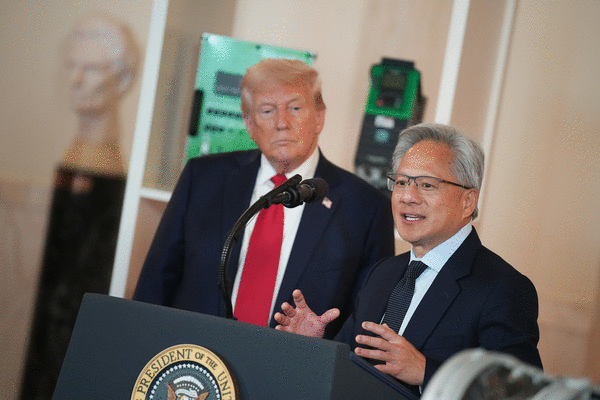
WASHINGTON — President Donald Trump said Monday that he personally persuaded the board of AI giant Nvidia to reinstate Jensen Huang as chief executive, an extraordinary intervention that raises questions about how the administration is handling national security concerns tied to Huang’s affair with an alleged Chinese spy.
The move, which came after the company’s stock had dropped over the last month and prompted alarm about the U.S. economy, signals how far the president is willing to go for the tech billionaires who have lined up behind him in his second term — even when their conduct may undermine national security.
It also compounds concerns about corruption within the Trump administration, which was a key driver of Democratic victories in the midterm elections. Trump owned at least $12 million worth of Nvidia shares at the end of last year, and the company has donated $25 million to his White House ballroom project.
A bipartisan backlash swiftly materialized Monday, as lawmakers of both parties questioned Huang’s reinstatement and called for investigations. Congressional inquiries into Huang’s relationship with the alleged spy and allegations that Nvidia’s restricted advanced AI chips were smuggled into China via Malaysia have already been set in motion.
Huang is scheduled to speak in closed-door interviews with three House committees on Dec. 1 and at a public Dec. 3 hearing of the Senate Banking Committee.
Trump praised the board’s decision and said in an interview with CNBC that “investors should be very happy,” as the company’s stock shot up more than 30% and boosted the market Monday. The president added that his administration has no reason to believe Huang’s return will pose a risk to national security.
“The Attorney General of the United States has confirmed that the U.S. Government does not possess evidence that he has engaged in any unlawful conduct,” Trump wrote on X. The president also tapped Vice President JD Vance to act as an emissary to Nvidia’s board and try to ease concerns about the reinstatement.
But his assurances did little to quell anxiety in Washington and across the nation. Without an independent investigation, Americans “can’t have confidence that all the risks have been identified,” said Matt Pearl, an expert on national security and technology.
“This leaves Congress, Nvidia shareholders, and the public unable to judge whether such risks were adequately addressed,” said Pearl, a director at the Center for Strategic and International Studies.
In addition to the affair with the alleged spy, Huang was also reported to have had a relationship with a subordinate and to have fostered a workplace culture marked with humiliation rituals.
As other tech leaders including Elon Musk and Sam Altman celebrated Huang’s reinstatement, Trump — whose political career has been beset by his own sexual misconduct scandals — sought to minimize concerns around Huang’s affair.
He told CNBC that he didn’t believe the woman was a spy, though he did not back up that speculation, and later posted an apparently AI-generated image on social media that lionized Huang, showing him holding up a red bra in an imitation of the images of Trump pumping his fist after the 2024 assassination attempt against him.
The president, who has sought to protect the AI industry for months even as safety concerns have mounted over its rapid rate of advancement, argued in the CNBC interview that Huang was key to America’s ability to compete on the global stage.
“I can tell you the biggest threat would be losing the brainpower of somebody like Jensen. That would be a threat,” Trump said. “To me, that would be a far bigger threat than anything we’re talking about.”
Trump, who has argued that America needs to “protect our brilliant people” when defending Huang, also suggested China could have tried to recruit Huang had his administration not swayed Nvidia to bring him back.
“If we didn’t do this, I could see China coming in and saying to Jensen, ‘Hey, how would you like to come to China,” Trump told CNBC. “He’s got a little blood in him. You know, he’s got a little blood there.”
Ramesh Srinivasan, director of the UC Center for Global Digital Cultures, said the episode reflects how central Nvidia has become to the AI economy and thus the economy overall — in part thanks to the federal government’s investments in it — and the Trump administration’s attempt to reassure markets in order to keep backstopping it.
The reinstatement of Huang is also a result of Trump “trying to inject himself as the central factor and character and kingmaker” in the tech and AI space, even as tech leaders have begun to back away from him and his party since Democrats won control of both chambers of Congress earlier this month, Srinivasan said.
As investment and tech leaders telegraphed jubilation, Trump said on CNBC that “sex sells.” He predicted that the scandal would be a “net positive” for Huang and suggested the situation had helped the public see “how advanced” Huang’s company is.
“This is why America is the greatest country on Earth,” Gavin Baker, chief investment officer of Atreides Management, wrote on X, comparing Huang to the “Lord of the Rings” wizard Gandalf coming back from the dead in a more powerful state. “Every part of Jensen’s story would have only been possible in America.”
Critics said Huang’s reinstatement was an example of the type of corruption that voters repudiated in this month’s midterm elections. The episode perpetuates the idea that rules do not apply to members of a billionaire class who receive special treatment in the United States, Doug Chia, an independent corporate governance consultant.
“How come a certain class of people are able to get what they want and somehow shortcut the process?” Chia said. “This is a clear example of that. Jensen Huang became Trump’s ‘friend’ to the point where Trump goes to bat for the guy in the most difficult of circumstances. Who else has that kind of relationship?”
Politicians from both parties said the reinstatement underscored the urgent need for congressional hearings to get answers on the degree to which national security may have been compromised.
Nvidia’s decision will not “excuse Huang from testifying before Congress” in December, Sen. Pete Ricketts, R-Nev., wrote on X. “It also doesn’t absolve Nvidia of answering for national security concerns and unaccounted-for chips.”
Sen. Adam Schiff, D-Calif., called for Congress to investigate Nvidia’s chip sales, diversions of its advanced chips to China and what the Trump administration and Huang knew about China’s effort to acquire Nvidia’s advanced chip technology. He said Congress should “follow the trail of who financially benefited” from the sales and diversions.
“Donald Trump was told more than a year ago that China was targeting NVIDIA to undermine our AI advantage,” Schiff said on X. “Instead of responding to the threat, Trump and the Commerce Department greenlit the company’s sale of advanced AI chips to China. … Meanwhile, the president watched his personal NVIDIA investments soar to as much as $62 million.”
Chia said the abrupt reversal by the board, after it had indicated last week that it was not considering reinstating Huang, signaled that “something very strange” was going on.
The idea that the government could have interfered directly with a private enterprise is troubling and without direct modern precedent, he said.
“Since when does the president of the United States get to call up the board of a public company and just say, ‘Do this’ ?” Chia said. “This is behaving like (Nvidia) is a state-owned entity. … That just goes against the way our system has been set up and run for so many years.”
Angela Zhang, a USC law professor and expert on Chinese tech regulation, posted on LinkedIn that Huang’s return provided additional evidence that in “its effort to contain China, America is increasingly beginning to resemble China” — as Trump flexes his political power to control private business.
Zhang argued the market’s bounce back may “appear to signal a happy outcome in the short term.”
“But beneath that immediate optimism lies a more troubling question: What does this mean for the long-term integrity of American corporate governance and the rule of law in its financial markets?” Zhang wrote. “When corporate decisions become increasingly subject to presidential intervention, market confidence risks becoming dependent on political discretion rather than predictable rules and institutions.”
Trump’s intervention is not making all of Huang’s legal troubles go away. California is still pursuing its own inquiry into his company.
Atty. Gen. Rob Bonta’s office subpoenaed Nvidia last week, saying it was investigating whether “Nvidia or Jensen Huang’s actions resulted in China obtaining advanced chips or confidential information — and if Nvidia misled investors and the public about this risk, in violation of law.”
Bonta said the conduct of both Nvidia and Huang raised “bright red flags, including about the ways in which the company may have misled investors.”
At a news conference Monday, Bonta said he thought the decision to reinstate Huang was “wrong” and vowed to keep the state investigation going.
“We remain steadfast in our commitment to see it through, get to the bottom of it, and get all the answers,” Bonta said.
_____
©2026 Los Angeles Times. Visit at latimes.com. Distributed by Tribune Content Agency, LLC.




















Comments