Xi, Trump, Putin agree to increase supply of global fuels
Published in Political News
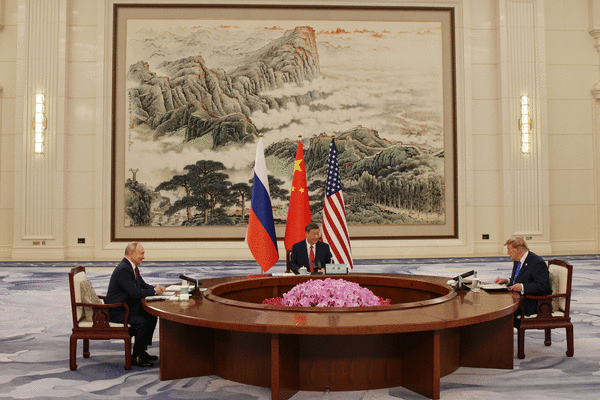
The leaders of the U.S., China and Russia agreed to boost the supply of fuels in a world that’s seen prices surge as a result of wars being waged by two of the three military superpowers.
President Xi Jinping hosted what he called a “groundbreaking” discussion with Presidents Donald Trump and Vladimir Putin Thursday in Shenzhen, China. The discussion spanned issues from Ukraine and denuclearization to the management of major-power disputes.
The unprecedented trilateral meeting had alarmed world capitals and raised concerns about carving up spheres of influence by the three military giants. For their part, the trio agreed in a joint statement to reform the United Nations, curtail the International Criminal Court and avoid nuclear war.
They also “plan to increase the production and supply of refined petroleum products for the benefit of all nations” and reaffirmed the importance of stable energy flows. The statement didn’t spell out what that would entail.
In theory, the pledge could offer some relief to stressed global fuel markets, where supplies have tightened and prices for products like diesel have surged due to disruptions caused by the wars in Ukraine and Iran. The three nations are oil-refining giants.
In practice, though, Russia’s processing capacity has been hobbled by drone strikes on its plants, U.S. fuelmakers are already going flat out, while China’s imports of crude oil, which are integral to churning out refined products, have been stymied during much of the Middle East conflict.
Making history
Brent oil traded at about $92.62 a barrel in London, little changed from where it closed on Wednesday. The premium that diesel commands over crude, a key measure of market strength, fell as much as $2.84 a barrel, and stood at $58.55 at 12:35 p.m., according to data from ICE Futures Europe.
Xi warned at the start of the meeting that major-power rivalry breeds global instability and called for regular exchanges between China, Russia and the U.S. The meeting, held on the sidelines of the Asia-Pacific Economic Cooperation summit, lasted roughly an hour and a half.
At the start of the gathering, Trump said, “We are really making history.” He added that the three have a special responsibility to maintain open dialogue, and said they would discuss issues including nuclear weapons and the Ukraine war.
“No peace was ever forged by declining opportunities for engagement and speech,” Trump said. “Together, we are choosing a different course.”
Putin highlighted that the trio all represent victorious nations of World War II, and bear the task of preserving and strengthening the system of international law established at that time. The International Criminal Court issued an arrest order for Russia’s leader in 2023.
The Russian president said the group should also should discuss food and energy security. Costs of both agriculture and energy products have soared in recent years thanks to the disruptions in trade caused by the war in Ukraine and Trump’s February 2026 attacks on Iran.
Impact unclear
The impact of the three-way agreement to boost refined products at one level is meaningful, given that it comes from two of the world’s largest oil producers — the U.S. and Russia — and the world’s biggest crude importer: China. But what exactly the three can do isn’t immediately clear.
In the U.S., crude oil processing rates are already the highest for the time of year in three decades. For its part, China issues quotas on its fuelmakers, telling them what fuels they’re allowed to export. Meanwhile Russiawould need Ukraine to stop attacking its refineries if it were to boost supplies for a sustained period.
Moscow also remains under sweeping oil-related sanctions from the U.S., Europe and U.K. in response to its full-scale invasion of Ukraine in 2022, though the U.S. recently issued waivers to those restrictions in a bid to boost the amount of fuel available on global markets. Shipments of Russian diesel have struggled to find willing buyers and there was bipartisan blowback on the easing of restrictions from both Republicans and Democrats.
Much of the world has been skeptical about the idea of the heads of the three nations being able to reduce international risks. Concerns about the optics of the meeting were all the more acute in western capitals, where Putin is widely regarded as a pariah due to Russia’s war on Ukraine, and many object to his being feted on such a global stage.
‘My friend’
Ukrainian President Volodymyr Zelenskyy has said that U.S. negotiators will debrief allies meeting in Berlin on the outcome of the talks in China.
Trump, who regularly refers to his warm personal relations with foreign leaders as driving policy outcomes, shrugged off any such concerns earlier Thursday, telling Fox News that he was meeting with Xi and Putin at the same time “because they work together, have a relationship.” He referred to the warm greeting he received from Xi on Wednesday, describing their relationship as “great,” and later called Putin “my friend.”
“It’s an honor to be with Vladimir,” Trump said at the start of the trilateral.
Both Xi and Trump raised the issue of reducing nuclear risks, though Putin avoided the topic in his remarks. The Kremlin has been resorting to nuclear saber-rattling recently among setbacks on the battlefield in Ukraine.
China’s official Xinhua News Agency said the host leader’s talking points in the meeting included a call for establishing a world free of nuclear weapons.
Nuclear risk
Trump said of such weapons that “it’s very hard to give them up as a leader of a country.” Even so, the three leaders are “uniquely positioned to discuss how to reduce the number of nuclear weapons on Earth, and also to lessen the risk that those weapons will ever be used,” he said.
The U.S. and Russia together have some 86% of the world’s nuclear weapons, with China a distant third but its numbers rising, according to the Stockholm International Peace Research Institute, SIPRI. That’s left Beijing with little incentive to engage in reduction.
Xi’s talking points included a recommendation that the three countries maintain regular high-level exchanges, and ensure smooth dialogue channels at all levels. The three nations should act cautiously and avoid crossing the other sides’ red lines. In his opening remarks, Xi called the gathering “of groundbreaking significance.”
The inclusion of language on the ICC in the joint statement follows regular blasts of that body by the Trump administration. The ICC, of which the U.S. isn’t a member, has issued an arrest warrant for Israeli Prime Minister Benjamin Netanyahu, a longtime Trump ally, based on his war in Gaza.
Yalta comparison
While the trilateral encounter has drawn parallels with Yalta in 1945, when the heads of the three dominant military powers of the day — the U.S., U.K. and Soviet Union — met to discuss the end of World War II and the post-war future, expectations of concrete results have been low.
Today’s Russia is very much the junior partner, with an economy less than one-seventh China’s size and an even smaller fraction of America’s.
Nevertheless, Putin appeared emboldened by his inclusion in the various meetings in Shenzhen. He used a speech to APEC business leaders on Wednesday to rail against “failed attempts” to isolate Russia and claiming that his nation was emerging stronger.
Putin left his bilateral meeting with Trump Thursday in “excellent spirits,” Russia’s state-run Tass news service said, citing Kremlin foreign policy aide Yuri Ushakov.
The trilateral has been called historic and unprecedented and “it really is,” Dennis Wilder, an ex-CIA official who is now a senior fellow at Georgetown University, told Bloomberg TV. “In terms of outcomes, the meeting really is the message.”
—With assistance from Alaric Nightingale and Alex Longley.
©2026 Bloomberg L.P. Visit bloomberg.com. Distributed by Tribune Content Agency, LLC.













































Comments