How Democrats' blue 'tsunami' crested in North Carolina
Published in Political News
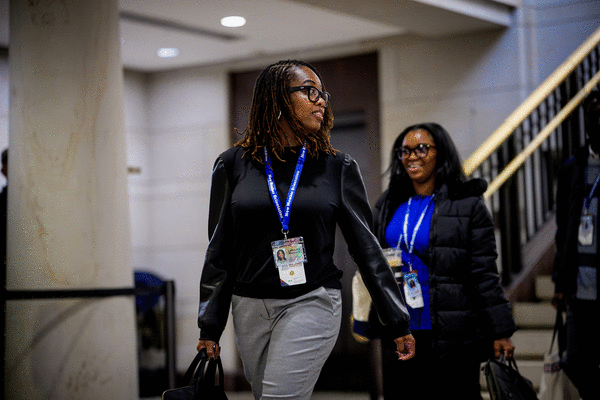
WASHINGTON — LaKesha Womack faced towering odds as an underfunded Democrat making her first run for public office in a North Carolina district that Donald Trump carried by 15 points two years ago.
But as early voting surged in mid-October, she sensed she might pull off an upset over Republican Rep. Tim Moore, the influential former speaker of the North Carolina House and a chief architect of the gerrymander that aimed to keep the 14th District safely red.
“There were a lot of pins and needles,” said Womack, a 49-year-old ordained minister who works at a Charlotte-based nonprofit. After seeing long lines at polling places extend into Election Day, she grew more confident: “People were ready to exercise their voice.”
Womack – who raised less than $60,000 to Moore’s $2.1 million – eked out a 2-point win in the district, which reaches from the Charlotte suburbs to mountain counties in the west.
Saddled with an unpopular president and broad dissatisfaction with the status quo, Republican incumbents across the nation experienced a midterm drubbing last week. As of Monday evening, House Democrats had netted 42 seats, with more races left to be called. The GOP in North Carolina, a state that Trump carried three times, was among the hardest hit.
Democrats have so far flipped five House seats in the Tar Heel State. Besides Womack, the blue “tsunami” also swept in Paul Barringer, a lawyer who founded an outdoor clothing line, and High Point Mayor Cyril Jefferson. And Army veteran Richard Ojeda, who once served in the West Virginia Senate, defeated Rep. Richard Hudson, the chairman of the National Republican Congressional Committee.
Democrats also won two races that had been seen as competitive for much of the cycle. Farmer Jamie Ager flipped an open seat in the state’s mountain west, while Rep. Don Davis held on to his Eastern North Carolina district, which Republicans had redrawn in their favor.
Meanwhile, in the state’s hilly northwest corner, 11-term Republican Virginia Foxx, the chairwoman of the powerful Rules Committee, is fighting for her political future: As of Monday afternoon, former journalist Chuck Hubbard led her by 99 votes in the 5th District, though The Associated Press had yet to call the race.
That was also true in the neighboring 10th District, where GOP incumbent Pat Harrigan had a 1-point edge over Democratic physician associate Ashley Bell. Also uncalled were a pair of contests in Eastern North Carolina, where Republican Rep. Greg Murphy clung to a 233-vote edge over Democratic former state Rep. Raymond Smith and GOP Rep. David Rouzer led Democratic social worker Kimberly Hardy by less than a point.
“Nobody could have predicted this,’’ said David Wilson Brown, who leads the Democratic Party in Gaston County near Charlotte and has lost two bids for the House, including to Foxx in 2020. “It’s a watershed moment.”
Engineered for Republicans
The Democratic rout in the midterm elections was powered by victories in states with new GOP-favored maps, including Texas, Ohio and Florida.
But Democrats’ success in North Carolina was especially striking given the steep structural disadvantages the party faced. Since Republicans flipped the state legislature in 2010, and with it control of the redistricting process, no House GOP incumbent had lost a general election in the Tar Heel State until last week.
This year’s congressional map – the state’s sixth in seven election cycles – was engineered by the Republican-led legislature to help the party capture 11 of the state’s 14 House seats.
But the Democratic surge was so big that it easily overpowered the GOP’s built-in edge. Democratic candidates were also lifted by former Gov. Roy Cooper, whose 20-point Senate win provided the underticket with powerful coattails.
“In order for them to gerrymander our state in the way that they did, they were spread very thin,” Brown said, referring to state Republicans. “So they were kind of ripe to be defeated that way.”
The repeated rounds of redistricting may have also erased some of the advantages of incumbency, according to Peter L. Francia, a political science professor at East Carolina University. “If you carve up a district every two years, you’ve taken away some of that [advantage]. And I think that that came back and hurt Republicans in this cycle.”
Doug Heye, a GOP strategist and a former spokesman for the Republican National Committee, said redistricting “ticked off a whole lot of voters, and really activated the Democratic base.”
On the Republican side, voters were “less motivated because they were unexcited about Trump,’’ Heye added.
Republican incumbents accustomed to winning by comfortable margins weren’t prepared for a political environment driven by anger over the war in Iran and angst about the rising cost of living.
“Clearly, a lot of those Republicans didn’t take their elections seriously,” Heye said. “They won last time with 18 points. They weren’t on anyone’s radar screen, so they didn’t think they had to do anything.”
Womack credits her win to a grassroots campaign centered on economic issues. While her race wasn’t on the national radar – Moore, after all, won by 16 points in 2024 – and her campaign didn’t have money for ads, she was out in the district doing events every day.
“There are a lot of working families right now who are in the missing middle,” she said in an interview. “They make too much money to get help, but they don’t make enough money to get ahead. … Someone who can be working a full-time job, but still doesn’t have enough money to buy groceries or to afford their medications or to have access to health insurance.”
Womack said her own struggles have shaped her approach to politics. This week, she’s slated to appear in court on a felony charge for allegedly failing to return a rental car in 2019. The incident wound up in one of Moore’s attack ads.
“There are so many people who [understand] what happens when you’re down on your luck and you don’t have enough money to make good financial decisions,’’ she said. “Most people don’t want those bad decisions to be a definition of their character for the rest of their life.”
Far from the battleground
Early in the midterm cycle, Democratic opposition research group American Bridge prepared detailed dossiers on Republican House incumbents in North Carolina.
“Someone like Virginia Foxx, she’s been on the Hill forever,” said Pat Dennis, the group’s president. “She was somebody … who under the radar could be vulnerable. So we started really early.”
American Bridge’s political arm spent $340,000 on ads targeting Foxx. One spot featured a man who identified himself as a Trump voter expressing anger at the government’s response to Hurricane Helene, which devastated the mountain communities of Western North Carolina two years ago.
Other Democrats scoffed at the group’s decision to spend money targeting entrenched Republicans far from the main House battleground.
“There was a lot of reluctance from people to really believe that that data was correct, but it was,’’ Dennis said. “Then over the summer, we saw her numbers collapsing, so we put paid media behind it and it really paid off.”
Hubbard ran against Foxx two years ago and lost by almost 20 points.
“I kind of had a notion I was going to do this again,’’ he said in an interview Saturday while en route to Washington for freshman orientation. “I don’t like to lose at checkers, much less a congressional race.”
After a court-drawn map resulted in a split North Carolina delegation after the 2022 elections, state Republicans won back control of the map-making process and went on to win 10 of the state’s 14 House seats under a new map two years later.
At Trump’s urging, Republicans made further tweaks to the North Carolina map last year, but the original gerrymander finally came back to bite the GOP in 2026, according to Hubbard.
“North Carolina is one of the most severely gerrymandered states,’’ he said. “And what happened was they had to steal from Peter to pay Paul. It’s been referred to by political scientists as a dummymander.”
As the vote count in the 5th District continues, Foxx, whose campaign declined to comment for this story, has requested the presence of nonpartisan election observers.
They “will serve as important, watchful eyes to ensure that this sacred process is not impeded and that all legal votes are counted in a consistent, thorough manner,’’ she posted on social media.
But even before the final races are called, Republicans are already looking to the next election.
Heye, who expects North Carolina to remain a purple state in 2028 and beyond, cautioned the Democrats who won last week not to get too comfortable in Washington. He invoked Fred Heineman, the former Raleigh police chief who rode the 1994 “Republican Revolution” to Congress – and lasted a single term.
“Some of them will lose, and some of the people who lost may run two years from now and get their seat back,’’ he said.
One GOP operative, who requested anonymity to speak candidly, offered up a similar assessment.
Trump “didn’t keep his promises” and that “just got voters very angry and suppressed the GOP base from coming out because, in a midterm election it’s a base turnout contest,’’ the strategist said.
“But these Democrats are renting these districts for two years.”
©2026 CQ-Roll Call, Inc., All Rights Reserved. Visit cqrollcall.com. Distributed by Tribune Content Agency, LLC.
















































Comments