Trump, Congress set to clash over economic costs of tariffs
Published in Political News
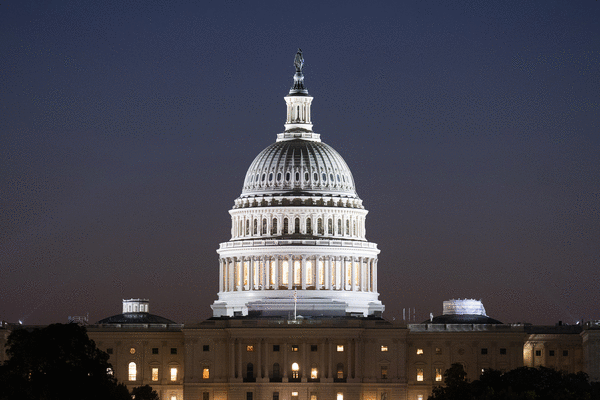
WASHINGTON — Hakeem Jeffries, the leader of House Democrats, promises to “stop the stupid Trump tariffs jacking up prices on Americans.” Ron Wyden, incoming Senate Finance Committee chairman, says he’ll reassert congressional authority over trade policy. Even Sen. Ted Cruz, the Texas Republican, lamented that “tariffs have made everything too expensive.”
But curbing President Donald Trump’s tariff powers won’t be easy or quick, and there’s a risk any efforts to do so in the incoming Democratic-led Congress will spur infighting in both parties.
While the president tempered his policies ahead of Tuesday’s election, he has several potential trade barriers in the pipeline. Trump could announce a new set of duties linked to excess industrial capacity that would hit imports from more than a dozen economies — even before Democrats take control in January.
“The administration will continue correcting long-standing trade imbalances that incentivize companies to invest and build in America and that protect American workers and their families,” the U.S. Trade Representative’s office said in a statement Thursday.
‘Very Difficult’
There’s also new tariff authority given to Trump in a bipartisan Russia sanctions bill, despite concerns from some Democrats and trade lawyers about how broadly the administration could deploy it.
“The new majority next year will want to focus on rolling back tariffs or passing some kind of tariff reform,” said Blake Harden, managing director at EY’s Washington Council practice. “And I think that is very difficult.”
One reason: Lawmakers within each party aren’t necessarily aligned on which tariffs to repeal, or what authorities they’d want to rein in, Harden said in an interview. Another is that tariffs are increasingly seen by both parties in Washington as a potent policy tool.
The last time Democrats had the opportunity reverse Trump’s tariffs, the Biden administration actually expanded them in a bid to target China. And while Republican and Democrats alike disapprove of the ongoing trade war with Canada, support for a tough approach with China is bipartisan.
It’s also unclear whether all Democrats would rebuke tariffs. For example, Democrat Sherrod Brown, who is set to return to the Senate after winning an Ohio seat in Tuesday’s election, has previously spoken out against free trade. He’s criticized some of the White House’s tariff policies, but the historic exodus of manufacturing jobs from his home state as a result of global trade makes any decision to walk back duties more complicated.
“There’s always somebody, once the tariffs are imposed, who wants them to continue because they’re benefiting from them,” Harden said. “So whoever is in power, it makes it really difficult potentially to unwind those.”
Schumer’s Goals
There’s also the math problem: To pass legislation that walks back the White House’s trade policy, both chambers would need a supermajority to stiff-arm a presidential veto.
According to a Bloomberg tally on Thursday, Democrats held 54 seats in the Senate and 243 seats in the House. That means if all Democrats voted for a piece of legislation, they would need some 13 Republican senators and almost 50 Republican House members to join them.
Senate Minority Leader Charles Schumer of New York, speaking to the New York Times, said that he doesn’t expect to face challenges to be majority leader and that cutting tariffs will be a priority for Democrats.
“He can veto it, but yes, but I think we’ll get good Republican support for that,” Schumer said when asked if he was going to try to remove Trump’s tariffs through legislation.
While some free-trade voices in the GOP like activist Grover Norquist believe their allies will vote to override such a veto, others are more skeptical that lawmakers fearful of a primary challenge will buck the man who for now still leads the party.
Investors cheered to shift to divided government and signaled confidence about a softer touch on trade broadly.
Japan’s Toyota Motor Corp. and South Korea’s Hyundai Motor Co. gained following the election results, partly on speculation Democrats would roll back tariffs. Shares of companies with exposure to Trump’s solar and polysilicon tariffs including the U.S.’s First Solar Inc. and South Korea’s Hanwha Solutions Corp. also advanced.
What industries and trading partners should expect is more scrutiny from the next Congress on the administration’s enforcement of laws like the Uyghur Forced Labor Prevention Act, said Kit Conklin, chief strategy and global affairs officer at supply chain AI company Exiger.
“There will be Congressional oversight on tariffs, but there is a surprising amount of bipartisan support for trade restrictions that target core structural challenges” with China, said Conklin, a former senior adviser to the U.S. House Select Committee on China. “Chinese industrial capacity and illegal transshipment threaten jobs in both red and blue states.”
While some U.S. trading partners celebrated the midterm result with cautious optimism, Trump’s trade war has shaken the global economy. Several nations have formed new trade alliances without the U.S., or taken protectionist turns themselves. The European Union, for example, is planning planning steps to better protect its single market after facing a flood of Chinese imports that threaten key industries.
China, Indirectly
Trump has been focused on stability with China since Beijing retaliated and weaponized its rare earths dominance after he drastically escalated his trade war with the world’s No. 2 economy in 2025. He’s set to meet China’s leader Xi Jinping for the third time this year in a couple of weeks, ahead of the January expiration of a U.S.-China trade truce.
Bloomberg Economics’ Chris Kennedy said he expects Trump will continue to have a less direct approach with China, but he doesn’t think the administration will pull back on its trade agenda significantly.
“Look for continued expansion of a web of sectoral tariffs, country-specific actions, content rules and negotiated exceptions,” Kennedy said. “That means headline volatility should remain lower than early in Trump’s second term, and U.S.-China trade may prove more stable than America’s relationships with some other partners.”
That’s complicating the ongoing review of the U.S.-Canada-Mexico Agreement as officials including U.S. Trade Ambassador Jamieson Greer seek a more comprehensive approach to addressing Chinese content in imports.
While a bipartisan bill on trade is certainly possible, it’s unlikely to be quick. The negotiation of USMCA during Trump’s first term took a lot of work across the aisle with intense negotiations between the administration and lawmakers — something that the White House hasn’t been eager to do during Trump’s second term.
“We’re a long way from knowing what the long-term tariff policy will be,” EY’s Harden said. “But they are likely here to stay and I don’t believe a flip in Congress is going to have a significant impact on the tariff levels.”
_____
—With assistance from Abhishek Vishnoi and Erik Wasson.
©2026 Bloomberg L.P. Visit bloomberg.com. Distributed by Tribune Content Agency, LLC.














































Comments