Race to replace Pelosi enters the AI group chat
Published in Political News
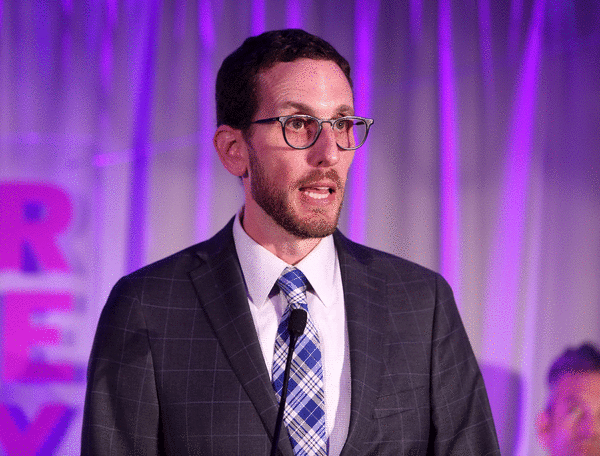
LOS ANGELES — A parody AI chatbot designed by California congressional candidate Scott Wiener's campaign to mock the record of his opponent attracted the attention politicians crave and criticism most loathe.
The short-lived experiment stirred controversy over the use of artificial intelligence in campaigns ads and drew sharp criticism from former House Speaker Nancy Pelosi, who has endorsed Wiener's opponent for the coveted San Francisco congressional seat. Wiener quickly pulled the plug.
Candidates on both sides of the aisle have been testing the waters by integrating generative AI into campaign ads. It comes as no surprise to political sociologist Mindy Romero, the director of the Center for Inclusive Democracy, who said candidates have long used all tools at their disposal to reach voters, from the invention of the radio and TV to social media.
"Using AI is just part of the progression," Romero said. Generative AI is particularly useful for political candidates since it allows them to subconsciously influence viewers by putting words in their opponents' mouths, she said.
Even as political campaigns experiment with more outlandish applications of the technology, many have already been using AI in quieter ways, including to compose tailored mailings and participate in digital chat rooms, Romero said.
GOP gubernatorial candidate Steve Hilton on July 24 released three cinematic ads made using generative AI, the first of which features fictional portrayals of Kamala Harris and Gavin Newsom, shown sharing a lavish meal.
The ad also depicts a fake Xavier Becerra, his Democratic rival in the governor's race, who is heard saying, "I believe all the things that Newsom believes." The ad ends with Hilton facing off against a massive red-eyed robot meant to represent the "Democratic machine." An AI disclaimer appears in the last five seconds of the two-minute and 29-second video.
"Campaigns have always adopted new technology, from television to the internet to social media," Hilton campaign spokesperson Hector Barajas said in a statement. "Generative AI is the next step, and we believe it would be irresponsible not to use every lawful, ethical, and innovative tool to communicate with California voters."
Spencer Pratt, who unsuccessfully ran for L.A. mayor, in May reposted on X a viral Batman-inspired AI-generated video that depicted Mayor Karen Bass as the Joker, the clownish supervillain. Charles Curran, the filmmaker who made the fan video in support of Pratt, appears to now be working with Hilton's campaign in a more official capacity, with his X account tagged on several campaign social media posts.
"I view this as the evolution of political satire," Curran said, referring to his AI videos, in an interview with the Washington Times. "Like Mark Twain. Like Tammany Hall." Curran did not respond to interview requests.
"We're on the bleeding edge right now," said Sacramento political consultant Tim Rosales, who ran Republican John Cox's 2018 gubernatorial campaign. He said he anticipates that campaigns will more fully understand and use AI to its full extent in the next two election cycles.
California campaigns have long been at the forefront of adopting new technologies. In the 1980s, the late political strategist Clint Reilly was among the first political consultants to use voter roll data to segment and target pivotal voters for turnout and persuasion.
Rosales said that because campaigns in California are more expensive and raise more money than those in other states, "You have a lot more tools in your tool box and more toys you can play with."
Lynn Vavreck, a political science and communications studies professor at UCLA, said the persuasive effects of Hilton's AI videos are likely "limited" as they are most likely being watched by supporters. The videos, she said, are more akin to "content creation" than to ads.
Romero said AI technology can be beneficial for campaigns, particularly those with limited funds, that may use it to create outreach lists, assist with analysis or generate creative and campaign materials.
But AI-generated video, images and audio are a "double-edged sword," Romero said. While effective at drawing attention, they may have the unwanted effect of making viewers uncomfortable by blurring the lines of reality — even if the AI use is disclosed. As a result, political campaigns must make a "strategic calculation" when they opt to use them, she said.
Those perils surfaced last week when the campaign of Wiener, D-San Francisco, who is running for the congressional seat held by the outgoing Pelosi, unveiled an AI chatbot that could be accessed on the ConnieChan.ai website.
The site referred to itself as "Connie, the world's first AI trained to say no to anything you ask." The footer included a note that the site is not affiliated with or endorsed by Chan, is meant as parody, and is paid for by Wiener's campaign.
"Bring me an idea and I'll explain why it can't, shouldn't, and won't happen," the site said, followed by a box encouraging users to type in a query. The chatbot would then produce a snide response parodying Chan.
When The Times entered the word "housing" into the text box last week, its response came seconds later.
"I built my career opposing new housing in San Francisco," the chatbot's response read. "I aggressively defend the status quo, and I'm fine with exploding rents and mass displacement." It then rattled off examples including Chan's opposition to Wiener's state law to streamline housing projects.
Wiener campaign spokesperson Joe Arellano said Wednesday that he came up with the idea of making a chatbot ad shortly after the June primary election, when he saw a video showing a group of people putting up parody tech and AI advertisements in the New York City subway.
"I thought, this is an opportunity to do this right in the heart of innovation here in San Francisco," Arellano said. "San Francisco right now is having this moment around AI and the billboards. ... The overall craze around the industry has become a cultural moment."
The chatbot cost $5,000 to make, a sum that includes the cost to secure the domain, host the site and obtain the pro version of Anthropic's Claude AI model, plus staff time, according to Arellano. The campaign spent an additional $20,000 to rent two billboards in San Francisco promoting the bot.
The idea was to highlight Chan's "record of obstructing progress" through a "chatbot that essentially says no to any kind of policy that you're proposing," Arellano said.
Chan's campaign and her allies saw it differently.
"[It's] never a good idea for a man to put words in a woman's mouth — especially when they are falsities fraught with racist and sexist undertones," Ian Krager, a spokesperson for Chan's campaign, said in a text message. The chatbot, Krager said, showed Wiener was "bought and paid for by Big AI."
Chan's campaign shared several screenshots of interactions with the chatbot with The Times, including one in which the chatbot was asked if it was "from China." (Chan was born in Hong Kong.)
According to the campaign's screenshot, the chatbot replied that its "origins are classified under about seventeen different committee review processes."
Then, it pivoted: "But I'd love to help obstruct something *else* you're curious about! Here are some of my favorite topics," and spat out a menu of topics to choose from, which included "blocking housing" and "derailing public transit."
Wiener's campaign said the chatbot was created with "strict guardrails" and designed to ignore controversial and malicious prompts and pivot back to Chan's policy record.
Pelosi, who has endorsed Chan in the race, released a statement Thursday criticizing Wiener's campaign for the chatbot, calling its use of AI to "fabricate a woman's voice for ridicule or attack" a "gross misuse of technology."
At first, Wiener defended himself, writing on X Thursday evening that his rival's campaign inundated the chatbot with "malicious questions" about her accent, race and citizenship that the chatbot refused. The next day, Wiener reversed course.
"[Our] use of an AI chatbot clearly missed the mark," Wiener said in a statement Friday. "The conversation became about the tactic instead of the issues that actually matter to San Franciscans."
Wiener's campaign on Friday took the chatbot offline and announced plans to take down the billboards.
Romero said experts began to have widespread discussions about how AI could be used to sway voters and affect democracy in the lead-up to the 2024 election when a company sent deceptive phone messages that used AI to mimic President Biden's voice and discourage people from voting.
Since then, there have been several efforts by California lawmakers to rein in AI-generated advertising.
Gov. Gavin Newsom in September 2024 signed several AI-related bills. They include AB 2839, which banned the distribution of materially deceptive content that could harm a candidate's reputation or electoral prospects, with exceptions for satire and parody, and AB 2355, which requires a committee that creates a political ad to disclose if it was generated or substantially altered by AI.
U.S. Sen. Adam Schiff, D-Calif., and Rep. Ro Khanna, D-Fremont, have renewed an effort to update the Federal Election Campaign Act of 1971 to clarify that existing bans on "fraudulent misrepresentation of campaign authority" and the "fraudulent solicitation of funds" also extend to AI-generated content.
"Fraudulent AI advertising has already proliferated in races across the country, and if Congress does not act, this runaway challenge will only get worse as AI becomes increasingly capable of blurring the lines between fact and fiction," Schiff said in a statement.
Elena Kuhn, a spokesperson for Schiff, said the proposed legislation applies to material that attempts to "speak on behalf of other candidates," meaning Hilton's AI-generated cinematic clip of himself fighting a robot would be not be banned — contrary to the Republican candidate's claims that it would be.
©2026 Los Angeles Times. Visit at latimes.com. Distributed by Tribune Content Agency, LLC.

















































Comments