Artificial intelligence becomes ripe target for taxes
Published in Political News
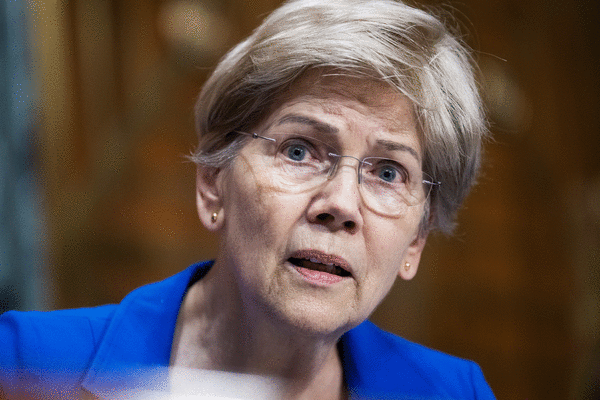
WASHINGTON — Some progressives are floating various plans to spread the wealth of the AI boom in the run-up to the midterm elections this fall, with proposals ranging from taxes on AI tokens to an excise tax on the energy used by data centers. But other stakeholders are urging a more cautious approach, and artificial intelligence companies themselves are seeking to weigh in.
Sen. Elizabeth Warren, D-Mass., proposed an excise tax on data center energy usage in a Time op-ed column last month, where she also pitched wealth tax and corporate minimum tax proposals as ways to address the economic disparities caused by AI.
“Here’s what I see clearly: if we overhaul our tax code and tax AI, we can use that money to build a country that works for everyone,” Warren wrote. “A country where health care is treated as a human right, where every American is guaranteed a good job, and where education isn’t a privilege reserved for the wealthy. That’s what I believe taxing AI promises.”
Democratic Rep. Greg Casar of Texas, chair of the Congressional Progressive Caucus, is calling for a tax levied against tokens, which are the units of data processed by an AI model. Democratic state Sen. Mallory McMorrow of Michigan has also called for such a tax on commercial uses of AI to fund apprenticeship programs.
And Sen. Ron Wyden of Oregon, the top Democrat on the Senate Finance Committee, is also interested in taxing tech companies to create a wage-security program for employees whose jobs are cut due to AI, according to an aide.
Some in the tech sector are also backing a new tax on the technology. Anthropic CEO Dario Amodei, for example, wrote in January that he sees a need for policy action to address the economic inequalities spurred by AI.
Amodei said the “extreme levels of inequality” he predicts could arise as a result of AI “justify a more robust tax policy on basic moral grounds.”
He added that he “can also make a pragmatic argument to the world’s billionaires that it’s in their interest to support a good version of it: if they don’t support a good version, they’ll inevitably get a bad version designed by a mob.”
But consensus on regulation of these systems remains an elusive hurdle. And Republicans are treading more cautiously.
Sen. Mike Rounds, R-S.D., who co-chairs the Senate Artificial Intelligence Caucus, said he sees AI as spurring economic growth “at a pace that we’ve never seen before.” The argument against taxing AI, he said, is that such a move could slow U.S. development of artificial intelligence models.
“If you start to tax it, you slow it down, and it goes elsewhere, or it does not move as fast as it will in other parts of the world. That’s not good for America,” Rounds said. “I’d rather have those decisions being made here at the forefront rather than in China.”
But not all Republicans are dismissing the tax option.
Sen. Josh Hawley of Missouri, for example, has already been an outspoken critic of AI companies and called for further guardrails. When asked about the push to tax the companies, Hawley said the effort was “not bad.”
“We’ve got to take steps to ensure, No. 1, that there are guardrails around these companies, so that working people have a say in how AI is adopted, have a say in whether data centers are coming to their towns and are protected from rate increases,” Hawley said. “And I think we should think about other ways to make sure that these companies are actually working for the public good.”
Uncertain impact
Still others are urging a more pragmatic approach, saying AI’s impact on the job market is not yet clear.
“This all makes sense if you believe that AI is the broadest technological disruption since the World Wide Web,” Andrew Lautz, director of tax policy at the Bipartisan Policy Center, said of the raft of progressive proposals to tax AI.
“We don’t know if it’s going to be the broadest disruption since the World Wide Web,” Lautz added. “But it does have this potential.”
The debate comes as lawmakers and industry experts alike have been sounding the alarm about the ways that AI could reshape the economy, especially with regards to entry-level and white-collar jobs. However, in recent months, some of that worry has been walked back, at least on the industry side.
Sam Altman, CEO of the juggernaut OpenAI, said in late May at a virtual appearance during a Commonwealth Bank of Australia conference that the “jobs apocalypse” he had feared looks less likely and the actual impact of the technology has been less substantial than anticipated.
Alex Muresianu, senior policy analyst at the center-right Tax Foundation, said AI critics’ most dire predictions about the state of the labor market “haven’t really materialized” – and their absence would likely move the debate “to a more prudent place in terms of continuing with core tax policy principles.”
“The alternative is not to do nothing, but it is to sort of stick to those that are sound reforms, regardless, that would also maybe be particularly relevant in some of these extreme AI scenarios,” Muresianu said.
Push toward regulation
Artificial intelligence guardrails at the federal level would appear far off, and extensive concerns remain. Like with many other emerging technologies — social media platforms and cryptocurrency, to name a few — Congress has yet to make substantial progress on regulations.
Lawmakers have introduced dozens of bills focused on AI during the 119th Congress, ranging from those aimed at establishing a regulatory sandbox to those looking to impose a moratorium on data center construction until legislative regulations are in place.
But the proposals aren’t seeing much momentum, and some lawmakers are still getting up to speed on the issue, even as the White House is also weighing its path forward.
The administration in March proposed a framework for a national AI policy that broadly preempts state laws, and President Donald Trump earlier this month signed an executive order providing AI companies with the option to give the federal government voluntary oversight abilities for advanced models.
Trump earlier this month also said he would be meeting with AI companies “in the very near future” to discuss the possibility of federal government stakes in the firms.
For progressives like Warren, Casar and Wyden, taxing AI in the near future is a no-brainer, with lawmakers citing its wide-reaching impact on Americans and the ways AI was trained based on human work.
That urgency isn’t shared by everybody, however, partly because many AI companies aren’t yet profitable.
”If there’s a broad, nationwide entry-level struggle to get jobs that’s connected to AI, I think that could throw fuel on this fire,” said Lautz, of the Bipartisan Policy Center. “And then, to the extent AI companies do start turning strong profits and they become very, very profitable, that could be another signal for policymakers to get involved.”
©2026 CQ-Roll Call, Inc., All Rights Reserved. Visit cqrollcall.com. Distributed by Tribune Content Agency, LLC.


















































Comments