Editorial: How Republicans' attempt to rig congressional elections backfired in South Florida
Published in Op Eds
As expected, Republicans held onto power in Florida, but their plan to expand their control by manipulating congressional maps backfired — and should be a lesson that trying to predetermine election results is a bad move and an uncertain bet.
Months before Tuesday’s elections, Florida’s governor and lawmakers redrew four U.S. House districts to give Republicans an advantage. But redistricting could not make up for voter discontent with President Trump and increased Democratic enthusiasm in parts of the state. In Miami-Dade and Broward counties, Democrats held two of those districts.
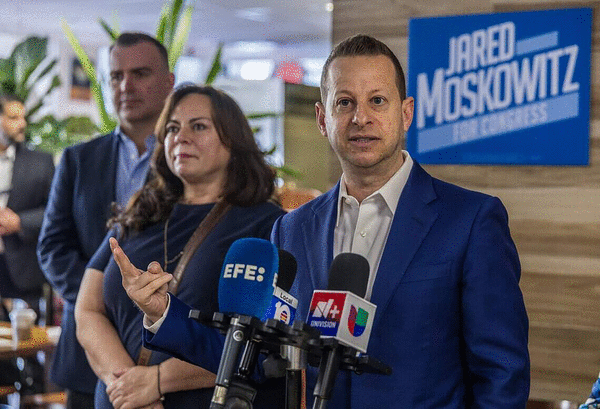
In District 25, stretching from Miami Beach to Delray Beach, U.S. Rep. Jared Moskowitz won reelection in one of the country’s most expensive congressional races, beating former Boca Raton Mayor Scott Singer. Pia Dandiya won District 22, a ridiculously reshaped district running from western Broward to Marco Island on the West Coast. She beat Republican Casey Askar.
In the two other districts redrawn to lean red in the Tampa area and Central Florida, Democratic U.S. Rep. Kathy Castor won and Democratic U.S. Rep. Darren Soto was leading Tuesday evening.
States usually redraw congressional maps once a decade to account for population changes in the U.S. Census. That’s appropriate. But, at Trump’s urging, Florida and other GOP-led states embarked on mid-decade redistricting in hopes of helping the GOP keep the U.S. House, which Democrats are projected to flip. Some blue states reacted with their own gerrymandered districts.
In Florida, redistricting left Republicans with an advantage in 24 of 28 House districts. But here’s the catch: the GOP advantage in South Florida was based on 2024 results, when Trump easily carried Florida and won Miami-Dade.
Although Trump won Moskowitz’s district by nine points, Joe Biden carried it by five points in 2020, according to Sabato’s Crystal Ball, a political analysis newsletter. Dandiya’s district also went for Biden, then for Trump. Neither district was going to be a safe bet for Republicans in a year when Democrats were expected to perform better. Castor and Soto ran in districts that voted for Trump in 2020 and 2024.
DeSantis and other Republicans were careful to avoid saying publicly that their intent was to help their party because, in 2010, voters banned lawmakers from drawing districts to benefit a particular party. DeSantis said reconfiguring the districts — drawn by his own staff in 2022 — was necessary because of a U.S. Supreme Court ruling that allowed states to dismantle districts meant to protect Black representation, and because he claimed the 2020 Census short-changed Florida.
But DeSantis and Republican lawmakers’ poorly-veiled intention was obvious: to let parties determine who their voters were going to be. Voters responded by showing up at the polls. Republicans still carried other GOP-held congressional districts in Miami-Dade and Florida’s U.S. Senate and governor seats, but they couldn’t engineer more victories simply by changing the maps.
It’s gratifying to see this attempt to rig elections go awry. We hope it’s a lesson that politicians should let the electoral process run its course — even when it doesn’t benefit them — without interference.
___
©2026 Miami Herald. Visit at miamiherald.com. Distributed by Tribune Content Agency, LLC.














































Comments