
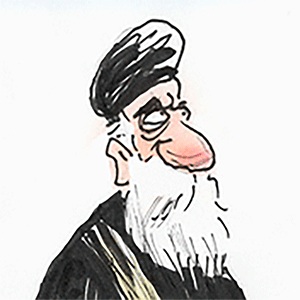
Ayatollah Khamenei's Miscalculation
It was a minor story in American newspapers when a riot broke out in the Iranian city of Tabriz in February 1978.
A UPI story that ran on page 11 of the Miami Herald carried this headline: "Calm Restored to Iranian Town After Riots."
"Armored cars and soldiers armed with machine guns Monday patrolled the streets of Tabriz, battered by a weekend of riots that left more than 125 persons dead or injured," it reported.
"Fighting broke out after leaders of an opposition religious group -- condemned by the government as 'Islamic Marxists' -- called for a general strike," it said. "Its members waged a 12-hour street battle with police Saturday and ventured back on the streets Sunday for another round of demonstrations."
A year later, revolutionary forces overthrew the regime of Shah Mohammad Reza Pahlavi, and the Ayatollah Ruhollah Khomeini became "supreme leader" of Iran's new Islamist regime. When Khomeini died in 1989, he was succeeded by Ayatollah Ali Khamenei.
On Feb. 17, Khamenei gave a speech celebrating the anniversary of the Tabriz riots -- and fatuously predicting the incapacitation of the U.S. military.
Eleven days later, when the United States and Israel launched a joint military action against Iran that resulted in Khamenei's death, the top posting on Khamenei's English-language website was a transcript of this speech. It ironically carried this headline: "Strongest military in the world may be struck so hard it cannot get up again."
"I will ... say a few words about the US," Khamenei said at the beginning of this speech, which included many words about the United States.
"It's a system that is truly in decline. It's an empire that's heading toward collapse," he said.
"As for the crumbling US empire, it truly is crumbling," he said. "They have problems in their economy, problems with their policies, and problems in their society."
"The problem we have with the United States is that they want to devour Iran, and the Iranian nation is preventing them," said the ayatollah.
He then suggested the U.S. military would be struck down and that his Islamic Republic would survive.
"They don't realize they've come to a dead end," he said. "In their opinion, and the US President keeps saying this, that they have the strongest military force in the world. The strongest military force in the world may at times be struck so hard that it cannot get up again. They constantly say that they've sent a warship toward Iran. Of course, a warship is a dangerous piece of military hardware. However, more dangerous than that warship is the weapon that can send that warship to the bottom of the sea."
As this speech sat at the top of Khamenei's website, a military offensive launched by the United States and Israel resulted in his death and the targeted destruction of Iranian military assets.
Khamenei's legacy is that of a tyrant -- who supported terrorists.
The most recent State Department report on human rights in Iran described a government that denied its citizens their fundamental freedoms. "Authorities did not permit individuals to publicly criticize the country's system of government, supreme leader, or official religion," it said. "Security forces and the judiciary punished those who violated these restrictions, as well as those who publicly criticized the president, supreme leader, cabinet, or parliament."
"The government remained a major source of funding for Hamas, Hizballah, and the Houthis, all of which espoused antisemitic ideologies, including explicit calls for the killing of Jews," said the report.
Khamenei's website also featured a speech he gave last Nov. 3 -- to mark the anniversary of the day in 1979 when Iranian "students" took control of the U.S. embassy in Tehran and began holding Americans hostage.
"From a historical perspective, there is no doubt that in our country's future, this day will be a day of honor and victory for the nation," said Ayatollah Khamenei. "It's the day our youth dared to confront a power that the politicians of the world feared. Those youth showed courage, they weren't afraid, and they stormed that embassy based on a rationale, for a certain reason, and for a cause which I will explain. It's a day of honor."
The State Department's latest country reports on terrorism, which covered 2023, stated that "Iran remained the leading state sponsor of terrorism," including through its support of Hizballah.
"Hizballah," says the website of the director of national intelligence, "has been involved in numerous anti-US terrorist attacks, including the suicide truck bombings of the US embassy in Beirut in April 1983, the US Marine barracks in Beirut in October 1983, and the US Embassy annex in Beirut in September 1984, as well as the hijacking of TWA 847 in 1985 and the Khobar Towers attack in Saudi Arabia in 1996."
On May 2, Secretary of State Marco Rubio addressed two fundamental questions about the U.S.-Israeli military action in Iran: What is its purpose, and why is it being done now?
"The United States is conducting an operation to eliminate the threat of Iran's short-range ballistic missiles and the threat posed by their navy," said Rubio. "That is the clear objective of this mission."
"Why now?" Rubio said. "Well, there's two reasons why now."
"We knew that there was going to be an Israeli action, we knew that that would precipitate an attack against American forces, and we knew that if we didn't preemptively go after them before they launched those attacks, we would suffer higher casualties and perhaps even higher those killed, and then we would all be here answering questions about why we knew that and didn't act."
Had the United States waited, Rubio explained, Iran's response would have been far more damaging.
"Why does Iran want that ballistic missile capability?" Rubio said. "What they are trying to do and have been trying to do for a very long time is build a conventional weapons capability as a shield where they can hide behind, meaning there would come a point where they have so many conventional missiles, so many drones, and can inflict so much damage, that no one can do anything about their nuclear program."
"You see the attacks they're conducting right now," said Rubio. "They're attacking airports. They're attacking hotels."
"Imagine a year from now or a year and a half from now the capabilities they would have to inflict damage on us," said Rubio. "It's an unacceptable risk, especially in the hands of a regime that's run by radical clerics. The ayatollah is a radical -- was a radical cleric."
When the Framers of the Constitution took up consideration of the war powers clause, as this column has noted before, the initial draft gave Congress the power "to make war." But then, as James Madison recorded in his notes on the Constitutional Convention, he and Elbridge Gerry "moved to insert 'declare,' striking out 'make' war; leaving to the Executive the power to repel sudden attacks."
Rubio essentially makes an argument that this is what President Donald Trump was doing in taking action -- without congressional authorization -- against the Ayatollah Khamenei's Iranian regime.
This is a sounder argument than claiming a president can unilaterally start a war without congressional authorization.
To find out more about Terence P. Jeffrey and read features by other Creators writers and cartoonists, visit the Creators webpage at www.creators.com.
----
Copyright 2026 Creators Syndicate, Inc.


























Comments