
You’ll never guess how Canada would fight a Trump invasion
PARIS – If you grew up anywhere near the Canada-U.S. border, you know that picking up a hockey stick and heading to the nearest frozen pond or cul-de-sac is just part of life. But did it ever occur to you that it might also be your best basic military training? Well, Canadians can now thank Trump for evoking the possibility.
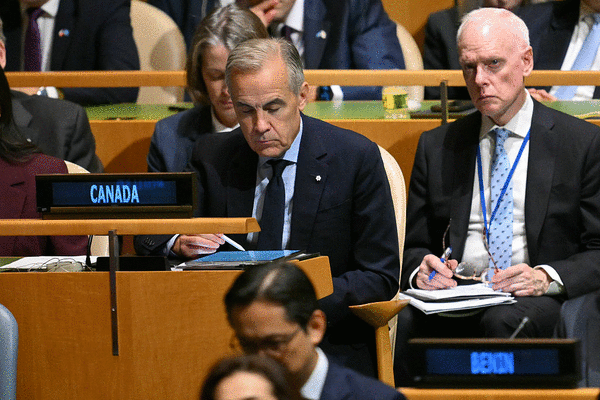
Canadian Prime Minister Mark Carney was asked in a wide-ranging New York Times interview last week about Trump’s threats to grab Canada by the assets without its consent. Carney confirmed that he considered an actual invasion to be low risk, but not zero. So contingency planning involved war-gaming out some scenarios. Carney was tight-lipped on the details. Probably just as well, given that he was talking to a flagship publication of the hypothetical invader.
But because Carney wasn’t into blabbing top secret military secrets for consumption by the folks that he’s just admitted to prepping for war against, we’re left perched on the edge of our seats wondering how a U.S.-Canada war might look. One former Canadian defense minister isn’t thrilled that Carney would even bring the topic up, saying that he should get his behind back to the bargaining table. How boring. It’s much more fun to imagine how a punch-up along the Canada-US border might transpire, using evidence that’s already floating around.
The most controversial idea would be for Canada to just get some nukes of its own already. Countries with nukes get messed with far less. Seems like a good enough reason to get them. Until now, Canada could rely on the U.S. nuclear umbrella, but since Washington isn’t going to nuke itself if Trump invades Canada, it needs its own now. Kind of like when you rely on a friend for your carpool, but then you have a falling out and now you need to get your own car. Especially when your friend keeps threatening to run you over with his if you decide to just walk to work instead.
Canada could feasibly rely on French nukes. Maybe put some in Saint Pierre et Miquelon, the French territory right off of Canada’s East Coast. Carney and French President Emmanuel Macron just met up there a few days ago. Seems like as good a place as any.
But then the question becomes whether Canada looking to acquire nukes near the U.S. border would be the perfect pretext for an invasion. It might be worth it just to watch all the neocons, who denounce Russia’s invasion of Ukraine because Washington was loading up that border with weapons, argue that the U.S. needs to urgently deliver democracy to Canada.
Granted, nukes are complicated. So let’s move on to conventional weapons. Obviously Canada is outmatched by the U.S. on this front. Even more so when considering that it buys American fighter jets that depend on U.S.-controlled software, mission-data systems, logistics, supply, and tech support. Canada has also built much of its broader defense procurement and supply around its American ally. So even without a literal “off switch,” Washington has considerable leverage over Canadian military capabilities — and Canada can’t diversify to European suppliers overnight. Seems like it would be best just to forget about these altogether rather than deal with the headache.
But how about NATO’s conventional weapons? Would an invasion of Canada trigger Article 5 of the collective defense treaty requiring all members to come to Canada’s rescue? The provision has been invoked exactly once: after the September 11 terror attacks on America. Given the wide discretion, what's more likely is that any European response to a hypothetical U.S. attack on Canada would be like watching a couple of neighbors punching each other at the local pub after a few too many pints, and encouraging them to sleep it off and work it out in the morning.
So that leaves us with the most obvious possibility: guerrilla warfare. After the original conventional shock-and-awe campaign that Washington excels at, it would need to actually hold territory. Granted, the Canadian population is mostly right along the shared border, so they wouldn’t have to go far. But what chance would American soldiers have against a country whose military doctrine has already imagined active resistance in populated areas, backed by citizens who could potentially provide intelligence, surveillance and other forms of support? And if the situation ever reached the point where civilians actually took up arms, Canadian military literature has that covered, too.
The scenario pops up in a 2024 Canadian Army Journal article, “Urban Warfare Challenges,” discussing a civilian “popular resistance force” functioning alongside conventional troops. It’s hardly a secret plan. It’s just not one that’s promoted in Canadian forces recruitment adverts. “Come join the Canadian Forces and help recruit guys with a decent slapshot and a penchant for punch ups from the local arena.”
Defense contractors don’t want to hear this, but this is the level on which wars can be won or lost these days. Just ask the Taliban, now back in charge in Afghanistan after being driven from power. Or Syria, where the government is now led by al-Qaeda associates. Or the Houthis in Yemen, currently driving Trump crazy in the Middle East to the tune of billions of dollars of American weaponry, all from the comfort of their board shorts and Crocs.
You don’t have to beat a superpower at its own game if you can just make any occupation prohibitively expensive. Which makes you wonder why war is always made to be so pricey and clunky. Why is the most expensive defense option always the one pursued when the most useful one might be available down the street at the local Source for Sports supply shop?
Maybe Canada doesn’t need another billion-dollar weapons system – just a few more hockey sticks and a good dose of patriotic mischief.


























Comments