
Trump’s Canadian problems keep getting worse
PARIS — U.S. President Donald Trump has a talent for finding political landmines like a pig sniffs out truffles. Then promptly blowing himself up with them. Repeatedly. He keeps picking fights with Canada that inadvertently create more leverage against himself.
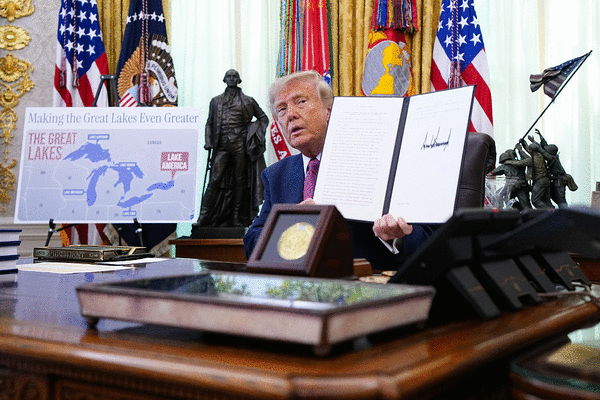
Trump reacted to Canada walking away from his generous offer of vassalization and economic annexation that would have given the U.S. first dibs on Canadian natural resources and a say over the deals that Canada makes with other countries by issuing an executive order renaming Lake Ontario to Lake America.
Trump seemed primarily interested in getting back at Ontario Premier Doug Ford — the conservative populist mirror image of Trump who runs the most populous Canadian province. One that also happens to supply bordering U.S. states with electricity, especially critical at times of peak demand, alongside the neighboring Francophone province of Quebec. (Don’t worry, Trump found a way to show his gratitude by messing with them, too.)
Trump had said that the failed deal would result in a 50 percent tax on imported Canadian-built cars, parts, and steel starting in January — even if the automaker is American-owned. After Trump called him a "flunky" and compared him to his more "charismatic" dead brother, Ford told Trump to “kiss my a**.” Which then led to Trump signing off on the name change for the lake that shares the name of the province that Ford runs.
Except that the name just happens to be Aboriginal.
So now Trump finds himself messing with the Native American lobby. Whoops. The President of the Seneca Nation has called it blatant disrespect of native heritage.
The band would have a plausible basis for seeking judicial review of the executive branch’s action, particularly if it can establish that the federal government’s implementation of Trump's order interferes with treaty-protected or other legally recognized tribal interests under the Treaty of Canandaigua of 1794. Historical facts that no doubt keep Trump up at night in deep reflection.
All this comes at a time when native groups in North America have been asserting treaty and land rights that can affect freehold properties and their modern leaseholders/homeowners, creating headaches for the courts. Does Trump really want to pick a fight with these folks? With his luck, they’ll win in court and end up taking a couple of states with them — like a parent seeking full custody after the other went off the deep end.
Meanwhile, Canada could decide to toll the Canadian waterways that represent the only means into and out of Lake Ontario for the U.S. Then Trump could enjoy some nice flashbacks from his ongoing adventures fighting Iranian tolls on the Strait of Hormuz.
Look, back when Vancouver 2010 Winter Olympic mascots were unveiled, I wrote for a British newspaper at the time that they looked way too Aboriginal to be fully inclusive — that not everything had to be native, all the time. The tsunami of lobbying against the take by the native-industrial complex was relentless. I ended up having to write about how it was so overwhelming that it made me “want to toss my dreamcatcher across my wigwam.” But what Trump is doing here is on a whole other level of rage-baiting.
His team had also sought to have Canada mess over Quebec on language and cultural protections in any trade deal. Because it’s such a hassle to have to take the French language into consideration. You think Canada doesn’t know this? It’s not like the issue didn’t lead to terrorism and kidnappings in the ’60s and ’70s or anything — courtesy of the radical separatist FLQ during the broader period of political and social upheaval known as the “Quiet Revolution.”
And one of their rallying cries going back to the 1960s was, “On est maîtres chez nous.” Or “we are masters in our own home.” Quebec’s p remier at the time, Jean Lesage, said exactly this when campaigning to nationalize the province’s electricity. And now, decades later, when Canadian Prime Minister Mark Carney announced that any deal with Trump would have effectively been signed in pencil, he also said, “On est maîtres chez nous,” when evoking the attempt to harm Quebec interests, and then suggested that the electricity that Canada provides the U.S. is probably something that they appreciate. The message was coded but clear: Would be a shame if something were to happen to that electricity. And that Canada has Quebec's back.
The same French folks who came over to North America to help the U.S. fight the Brits for independence — who are largely responsible for the fact that the U.S. isn’t a French-speaking country itself — have spent the past several decades demanding a little respect and recognition. They found it in Canada.
But if Trump could convince the Canadian federal government to toss Quebec under the bus, it would reopen historical wounds that would then make the resource-rich province ripe for exploitation by Washington in the same way that Trump’s State Department officials have reportedly been attempting to do with an insurgent separatist movement in the oil-rich province of Alberta.
And there’s potentially money in that for Trump. In the same way that there was personal benefit in trying to keep the new Canadian-funded Gordie Howe Bridge closed to the benefit of the $1 million Trump campaign donor who owns its competitor, the Ambassador Bridge, as CBS News reported.
Or in Pentagon procurement contracts going to his kids. Or in getting foreign nations to invest in his family cryptocurrency schemes.
Seems that Trump came for the attempted annexation, but is now hooked on the drama with America's northern neighbor and ally — and determined to step on every Canadian-made landmine along the way for our collective entertainment.






















Comments