
Trump is turning Iran into an anti-globalist superpower
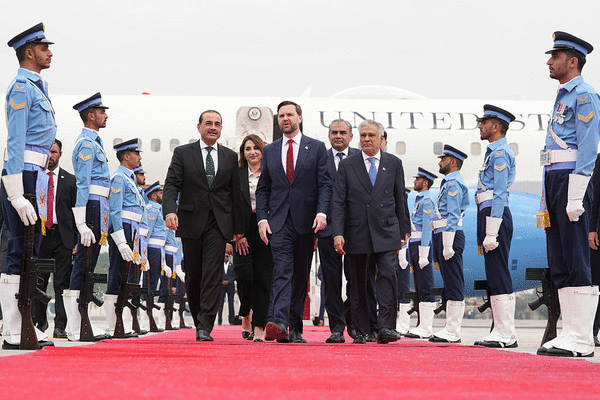
PARIS — If Team Trump has dragged itself to the negotiating table with Iran, it’s not because the U.S. is winning this war. One side of these talks features top Iranian brass. The other, two real estate agents (Steve Witkoff and Jared “Gaza Riviera” Kushner), Vice President JD Vance who’s fresh off complaining about meddling in Hungarian elections while over there doing some himself, and a top Pentagon official sufficiently problematic to have escaped recent firings by a war secretary who keeps evoking Holy War.
To even get to the table, Iran demanded a release of billions of U.S.-held funds under sanctions, and for Israel to stop bombing Lebanon under its usual pretext of striking terrorists, who routinely just always happen to be hanging out on land that it’s long wanted to expand into.
We’re a long way from Trump’s longstanding whining about how Obama “gave” Iran $6 billion of its own money back that had, in fact, been held under U.S. sanctions in American banks.
“Obama gave them $1.7 billion in cash – green, green cash, took it out of banks from Virginia, DC and Maryland, all the cash they had, flew it by airplanes in an attempt to buy their respect and loyalty but it didn’t work. They laughed at our president,” Trump said in a primetime address earlier this month. Guess they’re laughing even harder now.
Not only have any longstanding U.S.-Israeli objectives for Iran been frustrated, but they’ve virtually evaporated.
First, there’s everything that Iran has maintained. It still has its enriched uranium, despite what Iran qualified as a failed Pentagon operation to take it while pretending to stage a personnel rescue.
But now it enjoys the added bonus of not being under any official obligation to abide by inspections either, since Trump unilaterally ripped that treaty up.
It’s also under no compulsion to open the Strait of Hormuz and let through oil tankers that fuel the world. A problem that didn’t actually exist until Trump unilaterally created it. But since the opportunity presented for Iran to close it under the pretext that missiles were flying around overhead, why wouldn't they seize that leverage?
Now, the strait sits at the center of negotiations between the two sides. Not only has the U.S. lacked any leverage to compel Iran to open Hormuz, but they’ll also have to find some additional consideration to get Iran to give up the tolls that it recently imposed on ships passing through. And good luck trying to settle this one quickly, since Iran has also said that, “Oh yeah, by the way, we can’t find some of those land mines that we scattered underwater to prevent trespassing ships.”
Guess that’ll conveniently take awhile to resolve, all while they collect tolls at the purported rate of $2 million per ship.
Tehran seems to have no end of weapons to adequately defend its territory from attacks, all while Britain’s Royal United Services Institute think tank reports “a strategically ruinous cost-exchange ratio that the West’s industrial capacity is not prepared to sustain” despite the astronomical cost billed routinely to Western taxpayers in order to avoid such things.
So toss the myth of western military omnipotence onto the mounting pile of ripoff schemes that have aged badly. Who knew that an attempt to ruin Iran's navy and army would result in the demilitarization of the West? Not the brainiacs in charge, apparently.
Iranian governance continuity doesn’t seem to have missed a beat, either, despite Trump’s avowed regime- change attempts. And when Trump issued his Churchillian ultimatum last week for Iran to “Open the F--kin’ Strait, you crazy bastards, or you’ll be living in Hell,” and threatened that “Tuesday will be Power Plant Day, and Bridge Day, all wrapped up in one,” the same Iranians whom Trump had previously promised to liberate before bombing them, flooded Iranian cities to protect their own infrastructure from their self-styled savior.
Meanwhile, under pressure from their own citizens, blowback from U.S. allies is intensifying against Trump and his sidekick, Israeli Prime Minister Netanyahu. European countries have denied military access to their airspace for the purpose of any attacks. Several European nations, and the European Commission itself, are now talking about suspending the bloc’s economic association agreement with Israel. “Israeli strikes killed hundreds last night, making it hard to argue that such heavy-handed actions fall within self-defence,” said the EU’s chief diplomat, Kaja Kallas, of Tel Aviv’s attacks on Lebanon.
It’s all rapidly shaping up to be a prelude to anti-Israeli sanctions, all while Iran heads in the other direction with negotiation and rapprochement with European nations in exchange for passage through Hormuz.
And for Team Trump’s deal with Iran to achieve a peaceful outcome and unscrew the global economy, they’ll have the added bonus of being stuck permanently babysitting loose-cannon Israel. Which is a markedly different relationship from the previous arrangement of backing Israel as a proxy against Iran while shrugging and promoting Tel Aviv’s sovereign right to self-defense.
Back home in the U.S., calls for cracking down on the kind of Israeli foreign interference in American politics that led Trump into this useless but totally counterproductive war are emerging. Hardly surprising when the average American citizen is being fiscally mugged by the consequences of double standards that have long been at play, with Israeli entities not only exempt from registering as foreign agents, but exceptionally blessed to freely interfere in American political life.
At this point, Iran is looking less like a rival to the average Westerner, and more like an ally of the America First anti-globalist movement, successfully dismantling the illusion that exorbitant and self-indulgent Western foreign policy serves anything more than outdated narratives.




























Comments