
The Trump-Xi-Putin ‘peace’ declaration isn’t fit for an outhouse
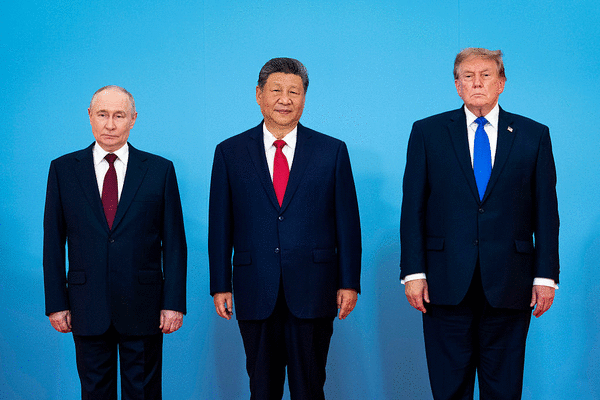
VANCOUVER, British Columbia — I’ve seen better statements scribbled on bathroom walls. The so-called “China-Russia-U.S. Heads of State Declaration toward Peace” is a perfect fit for our times. Like three mob bosses convening a summit on law and order to brainstorm criminal justice reforms.
So how exactly do US President Donald Trump, Chinese President Xi Jinping, and Russian President Vladimir Putin plan to secure world peace? Primarily by making sure that it doesn’t apply to them, despite wielding disproportionate power over the system itself.
First off, they want to “reform the United Nations.” Apparently, by divvying up the world into three pieces — one for each one of them to manage, like militarized hall monitors.
In his 2025 U.S. National Security Strategy, Trump laid out an explicit proposal for American primacy in the Western Hemisphere, and for other countries to take the same kind of responsibility for their respective regions. Sounds like a new system of international order that no one actually signed up for.
International law has a lot of flaws, but if it were totally useless, these guys wouldn’t go to such great pains to talk about it nonstop and attempt to shoehorn their actions into it for the sake of optics. But would they even have to bother doing this if their new system of three major global rulers came to fruition? Probably not.
One of the main flaws of international law is probably one of the few things that they actually appreciate about it. Even when a finding is made by an international court, these three permanent members of the United Nations Security Council can veto any attempt to enforce it — which they’ve proven to be particularly keen on doing in relation to themselves and their buddies.
They can already veto enforcement measures against themselves or their pals, in cases where they haven’t opted out of a treaty entirely or where reservations conveniently limit the obligations that they’ve accepted, allowing them to avoid certain consequences.
And that’s when the violations are egregious. But the fog of war is only getting thicker, as technological capabilities and access to information make scrutiny of military operations increasingly possible.
Everything’s now about misdirection or covert operations. Case in point: Even as commentators pontificated about Trump and Putin being embroiled in their own wars, and Xi Jinping appearing relatively magnanimous by comparison, the International Court of Justice handed down its historic ruling that Myanmar committed genocide against the Rohingya during its 2017 military operations. China had spent years blocking UN action as the Rohingya were being slaughtered, but everyone still thought Xi looked amazing on the very same day the international court made its first ever finding of state responsibility for genocide and his country stood out on the world stage in furiously objecting to it.
And who had been recklessly supplying the weapons to Myanmar? China, Russia, Ukraine, Israel, and North Korea, according to a 2019 UN report finding that they ought to have known that their transfers would have foreseeable adverse consequences for human rights.
But it’s Myanmar that’s on the hot seat — not the powers that egged it on and exploited a poor country. The same could be said of Ukraine, where outside powers have pursued their own strategic interests while Ukrainians bear the consequences of a war with Russia.
Will any of these three superpowers use their position to veto efforts to enforce the judgment against Myanmar for reasons that aren't entirely self-serving? Or will it be hung out to dry? I guess we're about to find out whether its usefulness to the major powers has run its course.
The joint declaration also makes it clear that these three amigos don’t want anyone bothering them personally: “The three heads of state recognized that the principle of state consent and respect for immunities of state officials are of paramount importance, and concurred that the International Criminal Court…must not abuse their jurisdiction.”
International law already recognizes functional immunity for official acts by state officials. Still, you can’t commit a serious crime that violates a jus cogens norm (one of international law’s brightest blood-red lines), then hide behind a government badge. If these guys consider that to be an abuse of jurisdiction , then whose jurisdiction would work for them, exactly? Perhaps the three of them expect to be permitted to settle things over a few pints at the pub?
Look, I’m all for world peace — whether in Ukraine, the Middle East, or anywhere else. But for the average person, first and foremost. My concept of how it can be achieved doesn’t depend on swallowing or propagating the narratives of any government elites or cronies with a financial interest in perpetuating them, or in avoiding any resolution that doesn’t favor their own self-interest.
No one in any conflict is all bad. They're primarily concerned with themselves. Secondarily, their own people. Their vision of what peace entails may differ from yours or mine as a result. That's fine. Own it. But don't pretend that you're doing it for the whole planet.
This meeting between the leaders of three countries currently involved in fueling various glaring militarized tangos — either overtly or covertly — wasn’t about peace per se. Unless peace is now synonymous with total acquiescence to power. And no government has ever proven itself worthy of such trust.











Comments