
Ask the Builder: Outdoor kitchen tips
You may be dazzled by the outdoor kitchens you see on home improvement TV shows. Designers work hard each year to create trends of every type. You see it in clothing, paint colors, new cars and trucks, etc. This is done to pry dollars from your savings account. New products of every type fuel the economy.
I’ve been in the industry long enough to remember when interlocking concrete bricks were the cat’s meow. People used their driveways to share how cool they were. Many of these are the same folks you see on social media showing off what they just did, what they just bought, or any other news that puts them at the forefront of what’s cool.
The family that lives next to my son invested many tens of thousands of dollars in creating an outdoor patio oasis that has an outdoor kitchen. It also has a large human soup bowl. They call it a hot tub. A fire pit surrounded by four chairs is on a lower level of the patio. The large outdoor kitchen dominates the upper patio area.
Their stainless-steel barbecue is almost 6 feet wide. Fire up all the burners, and you could cook for a party of 20 or 30 people. The only thing missing in this setup is an outdoor sink. It would be quite easy to install one, although you’d have to use a point-of-use heater to get hot water.
I spent a few days a week ago with good friends who live in Southern California. They had just finished a full remodel of their in-ground swimming pool area. The entire pool was repiped and coated with a delightful granular coating. They also added a new human-soup bowl in one corner of the shallow end of the pool.
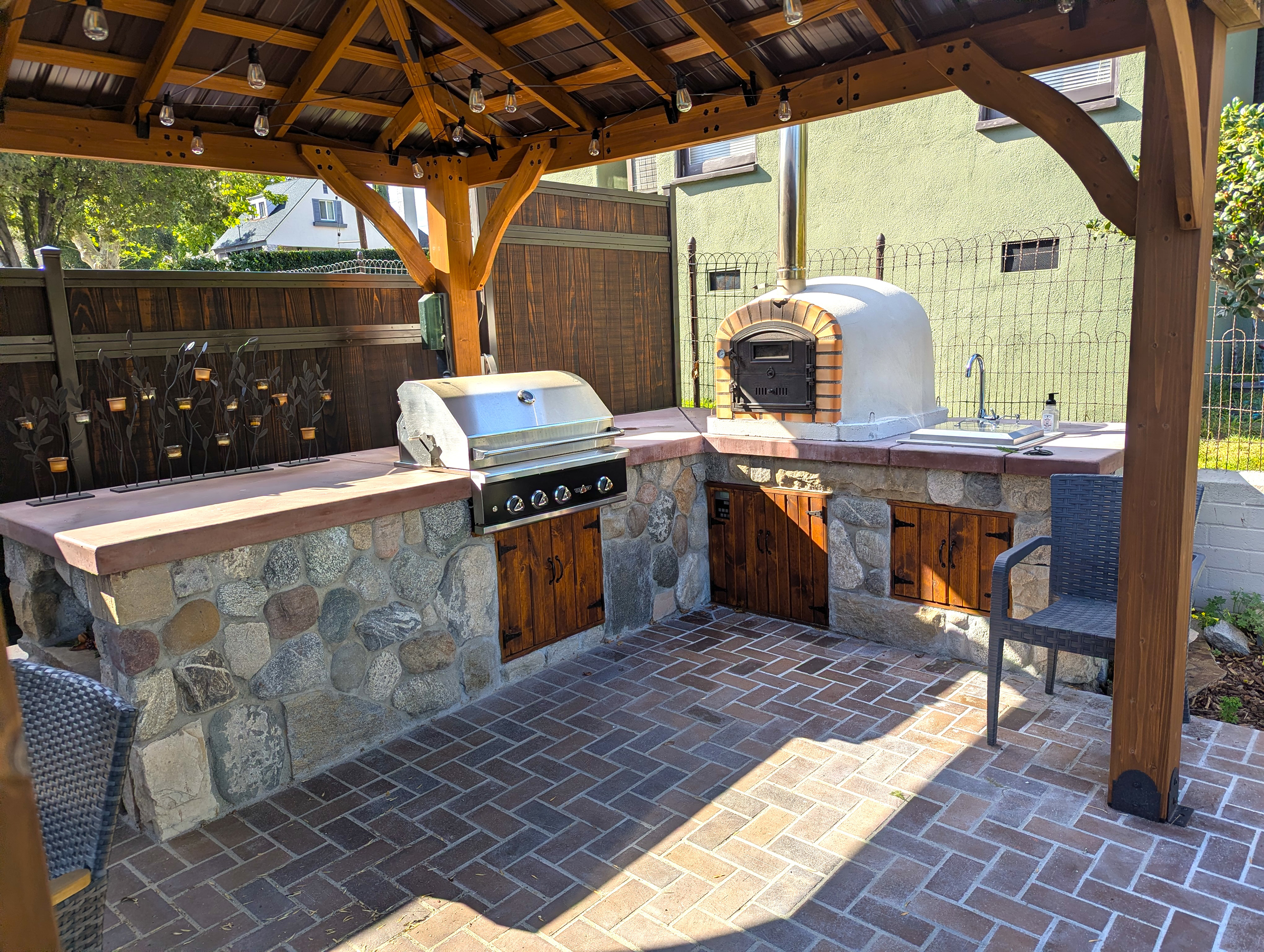
The centerpiece of the pool project was a magnificent outdoor kitchen. An open timber-frame structure keeps part of this outdoor kitchen dry from rain showers. A wind-driven rain will get everything wet for sure. Rain in Southern California is not a nuisance as it is in many other parts of the USA.
This kitchen had a great design. It was L-shaped with a domed pizza oven in the corner. The heat required to bake a pizza was supplied by a wood fire or an electric heating element. The firewood was stored in an arched nook at the far end of the kitchen counter. It was a clever use of space.
The gas-fired stainless-steel barbecue was placed three feet away from the pizza oven. There was just enough space for a person to be flipping burgers and bratwursts and not bump into a person checking on how brown the cheese was on the pizza. You must think about these conflicts when developing your plan.
A large stainless steel kitchen sink was next to the pizza oven. There were 16 inches of counter space next to the right side of the sink. I’m willing to bet my friends will discover they could have made this leg of the kitchen counter at least 3 feet longer.
The base of the entire kitchen was made from native rocks. The mason did an extraordinary job of picking an assortment of small granite and other metamorphic rocks. The colors and textures blended together creating a striking rustic appearance.
Storage cabinets were built into the stone base under the barbecue, pizza oven and sink. The wood doors with rustic hinges and handles matched the stone base to a tee.
Countertop construction is critical. You need everything to be waterproof. My friends went with a 4-inch thick colored concrete top. It was troweled smooth as silk. All of the edges were rounded, creating a very smart appearance. The top had a 2-inch overhang past the front surface of the stone walls.
Planning an outdoor kitchen requires more thought than one inside a home, in my opinion. Weather extremes should be at the top of your list of concerns. Ice and snow can cause severe damage to the kitchen components when the kitchen is out of service in the deep winter. Water will cause any unprotected steel or iron to rust. All metal should be stainless steel or brass to prevent issues.
What about the blazing sun? You may already suffer when using your stand-alone barbecue grill when out on your driveway. I’m thinking you don’t want to be drenched in sweat while grilling in your new outdoor kitchen. How will you shade yourself?
Utility connections are very important. All electrical work must meet the latest requirements of the National Electrical Code. Shock hazards are real in these outdoor kitchens.
Sink plumbing is also critical. How will you dispose of the gray water from the sink? How will you drain your water pipes if you live in a cold climate? You need to make it easy to winterize the supply and drain piping.
You may be able to extend natural gas to your new barbecue grill. I did that many years ago in my last home. I never again had to worry about running out of propane halfway through a meal. Remember, you can’t bury an iron gas pipe. All gas lines must meet the National Fuel Gas Code.
It’s wise to look at lots of photos of outdoor kitchens before you start to plan. Look at each kitchen with a critical eye. Think about counter space. Consider how multiple people may bump into one another when cooking is in full gear. What about refrigeration?
Ask vendors for photographs or videos of kitchens they’ve installed. Once again, think about the spacing of appliances, the ease of cleaning things, and how you’ll stay comfortable while using the kitchen.
Subscribe to Tim’s FREE newsletter at AsktheBuilder.com. Tim offers phone coaching calls if you get stuck during a DIY job. Go here: go.askthebuilder.com/coaching
©2026 Tim Carter. Distributed by Tribune Content Agency, LLC.



























Comments