As AI stakes its claim in higher education, colleges and universities across Chicago aim to embrace it
Published in Lifestyles
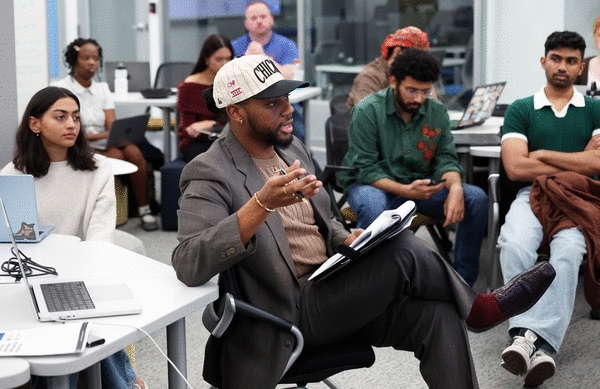
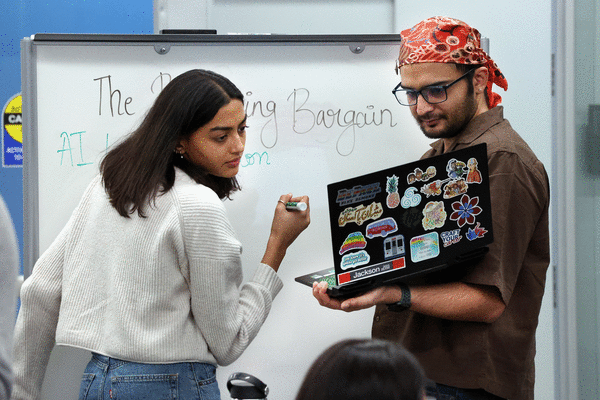


CHICAGO -- At DePaul University, roughly a dozen students routinely wrestle with how much artificial intelligence should and could influence the human experience. They spend hours at the Responsible AI Systems and Experiences, or RAISE, Lab on the university’s Loop campus, exploring how AI affects daily life.
Like many higher education institutions, DePaul has grappled with AI integration on campus in recent years. The school is faced with how to manage, embrace and integrate AI use while weighing the opinions of campus stakeholders, from faculty, administrators and students.
To help the university community get a handle on AI, DePaul recently released “Guiding Principles on Artificial Intelligence,” a tome calling for academic integrity, intellectual honesty, transparency and human-centered use of the technology.
The principles were born out of the school’s 26-member Provost’s Advisory Committee on Artificial Intelligence, which worked for over a year to develop them. It meets monthly to discuss policy, practices and how AI is used in the classroom.
DePaul’s AI principles, published last month, go beyond issues of academic integrity, according to Jay Cunningham, RAISE Lab creator and assistant professor of computing. Cunningham’s goal is to help students understand that AI is a tool that attempts to model human behavior, human interactions, and human decision-making.
“Our job as humans is to wield the tools in ways that serve us best,” Cunningham, who launched the lab in 2025, said.
Over the past half-decade, Cunningham has seen more fields demand that workers understand AI, creating a need for students to learn the technology as it progresses.
DePaul published a statement on AI in 2023 – but in this age of rapid transition, that’s like 100 years ago, said Professor of English John Shanahan.
While some of his faculty colleagues worried about AI’s implications for higher education and others thrived in the new technology, Shanahan brought them together as chair of the university’s Advisory Committee on Artificial Intelligence. The committee created a communal space for faculty across disciplines, from acting to computer science, to talk about the new programming.
“Launching this committee was a chance to both get a sense of what’s going on out in the units, provoke discussion so that faculty are talking about what they’re hearing from students, and also as a way to vet good ideas about what we should be doing moving forward,” Shanahan said.
Other Chicago campuses are undergoing similar efforts. They’ve formed committees to examine how to integrate AI into higher education, launched AI classes and majors and pushed for AI literacy among students and faculty.
Several schools, including the City Colleges of Chicago and Northwestern University, now offer AI-related programs and degrees. Nationwide, schools are considering how to inform students about AI use and best practices through websites, classes, and training.
Their approach, however, depends on the institution.
At the University of Chicago, a new master’s degree in applied AI will launch in fall 2027; meanwhile, the law school prohibits note-taking on electronic devices in some classes. This fall, Northwestern University launched an undergraduate major in AI and an AI webpage of tools and resources that “enable students, faculty and staff to use generative AI effectively and responsibly,” according to the site.
Across the schools of City Colleges of Chicago, which serves more than 73,000 students a year through its network of multiple public community colleges, AI is being considered widely. The system introduced its first AI degree program at Wilbur Wright College this fall, and students can now earn an Associate of Applied Science degree in Artificial Intelligence and Machine Learning Development.
The degree is applicable and relevant across all disciplines, from history and law to transportation and distribution, City Colleges’ Provost and Chief Academic Officer Mark Potter told the Tribune. He added that before the new program, City Colleges created a district-wide AI steering committee that helped hone and articulate the school’s position on AI: Preparing students for an AI-enabled workforce and society is essential.
“We cannot shy away from this technology. We can’t bury our heads in the sand or anything like that,” Potter said. “We need to ensure that our students have AI competencies, and part of that is responsible use of AI and ethical use of AI, and so that’s the position that we started out with, and that we are still carrying forward to this day.”
Ideally, Potter said he hopes people recognize City Colleges as a place where they can cultivate their AI knowledge, learn skills and build careers in the field.
City Colleges’ Associate Vice Chancellor of technology sector strategy, Ayoka Noelle Mota Samuels, shares a similar vision. The school system is intended to be a space where people can afford to learn AI skills, Samuels told the Tribune, adding, “We’re here to teach people, and people can learn AI in a responsible way and know that it’s not just transactional.”
It’s important that City Colleges be a recognizable and trusted place for people of all backgrounds to learn about AI, Samuels said. Beyond that, being part of the larger educational conversation around AI means more people will have access to the field than before, she said.
“If you don’t have the education community that is a part of being in leadership around AI, then you do run the danger of different folks being left out,” Samuels said. “I can see already that CCC makes sure that people are included at whatever level, at whatever stage of your understanding and interest with AI, and so people are with us to go along the journey with us. I think that’s really important for higher ed.”
Back at DePaul, there’s been a growing recognition over the last two years that AI does not necessarily have to be feared, Shanahan said.
While the evolution of AI has brought a mix of enthusiasm, excitement, skepticism and fear, Shanahan said the advancements have benefited the institution, while acknowledging: “We’re at the beginning of this.” Overall, the university is having conversations and being proactive about meeting the challenges of AI integration, he said.
“AI is not going to go away, so I think it’s this recognition [of] then how do we negotiate our place with it? What’s it mean to be a creative person, a thinker, a writer with AI kind of next to you all the time?” Shanahan said. “There will be times when it’s useful to use, and there will be times when it’s better to think your own thoughts and write your own sentences. It’s both.”
©2026 Chicago Tribune. Visit at chicagotribune.com. Distributed by Tribune Content Agency, LLC.


















Comments