How Hmong Americans revived Minnesota's roller pigeon scene
Published in Lifestyles
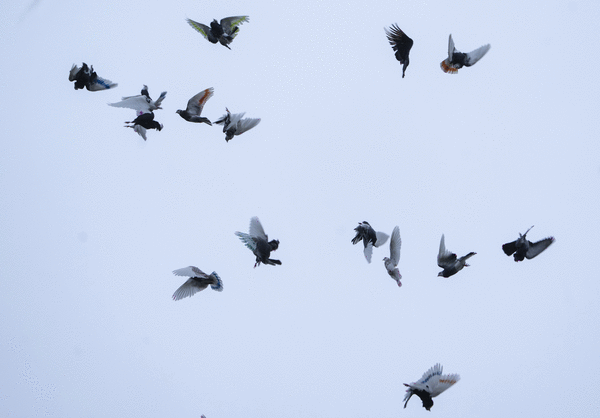
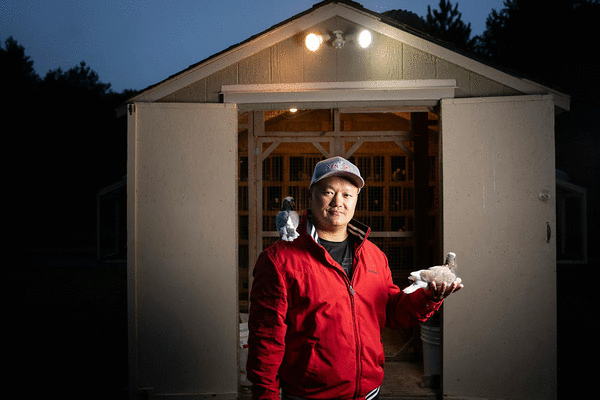


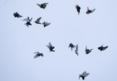

BETHEL, MINN. — Looking up at the cloudy sky as 19 of his pigeons flew in a tight formation dozens of feet in the air on an October afternoon, Ma Lee recalled the first time he caught a pigeon.
That pigeon wasn’t of the same breed as the hundreds that he raises now. It was a city pigeon that he snuck up behind and caught when he was 12 years old.
It was a common activity for Lee and his band of friends — most of whom were also young Hmong boys living in St. Paul’s low-income housing project, Mt. Airy Homes.
“Pigeons were one of the things that kept us out of trouble,” Lee said. “We stuck with pigeons once we got older and we all banded together and raised pigeons.”
Now 47, he breeds a special variety of pigeons for competition. Known as Birmingham Roller Pigeons, they perform “tumbles,” falling several feet as they execute backward flips in midair before recovering and rejoining the group.
On this fall day, Lee is competing in a regional contest for a shot at winning another national title in the National Birmingham Roller Club’s championships.
The three-time national pigeon roller champ owns the largest flock in the state. He is also credited with being one of the men who started the subculture of pigeon husbandry in Minnesota’s Hmong community, said Tou Yang, who formerly served as the NBRC’s public relations officer and is also Hmong.
Minnesota has some of the nation’s youngest pigeon roller participants, according to Tou Yang. That is in part because of the work Lee and his friends have done to grow the sport’s community in the state. Yang estimates that two thirds of the state’s paying NBRC members are of Hmong descent.
Breeding and caring for pigeons came naturally to Lee, said Jay Vang, who grew up chasing pigeons with Lee and is now the NBRC regional director of Minnesota and northern Wisconsin.
Hmong families, who immigrated to Minnesota in the mid-1970s, often came from agrarian backgrounds and were used to raising poultry and pigs in addition to growing rice. Growing up, it was common to see pigeons bred on Hmong-owned farms and Twin Cities’ urban landscape. Catching city pigeons was considered naughty by their parents, Vang said.
The two, along with another friend, continued their passion by raising pigeons in adulthood. In the early 2000s, they started competing in roller pigeon competitions.
“The elders coming to America, they were more focused on making sure they had a stable job to feed their kids,” Vang said. “Ma and us were that first-generation group of Hmongs that came to America, or were born here, that raised [roller] pigeons.”
Pigeon tumbling has ancient roots in many regions around the world, including South America and the Middle East along with England, where the Birmingham Roller Pigeon originated, according to the NBRC.
Flying tumblers found their way to the United States in the late 1880s. Today there are about 1,200 registered pigeon rollers in the NBRC, according to Tou Yang. Some raise as many as 500 pigeons.
While pigeon rolling has been on the decline for years, Minnesota is among the nation’s top hubs for it along with Fresno, California and Los Angeles, Tou Yang said.
The competition
Outside his home in Bethel, Lee kept his eyes on his birds the entire time while judge Ying Yang (no relation to Tou Yang) evaluated their performance. Judges travel to each competitor’s home to score the pigeons’ performance.
If the pigeons performed well, they’d move on to the national tournament. A score of 100 would likely suffice to reach nationals.
At least five pigeons have to roll in the air to score points. The more that roll in sync during a 15-minute time frame, the higher the score, said Ying Yang.
The rolls happen high in the sky and happen quickly. It can get especially chaotic when Ying Yang judges the 20-bird event (there’s another one for 11 birds).
“I have to really focus to count all the points,” Ying Yang said.
Lee’s group of pigeons, known as a kit, were struggling and weren’t working well together.
Lee’s highest score ever was 870, and the record for the NBRC is 3,000, he said. It was unlikely he would see a record-setting score out of his pigeons for the regionals.
But Lee’s joy doesn’t come from competing, he said. It comes from raising the birds.
“My dad just passed away and these pigeons are what kept me going,” he said, gazing up at his birds trying to count their synchronized somersaults. “It took things off my mind.”
By the end of the week, Lee found out he landed the top spot at regionals with a score of 156 and would be moving on to the national competition.
Raising pigeons
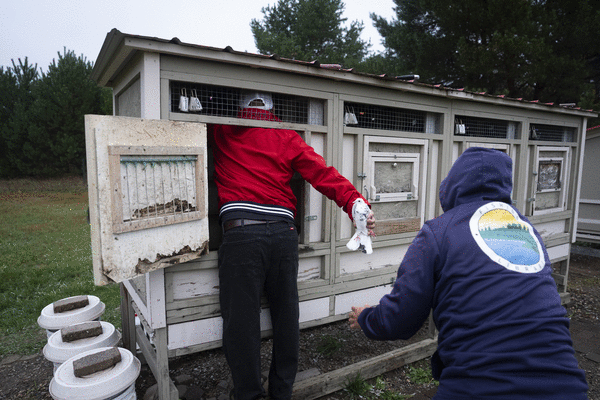
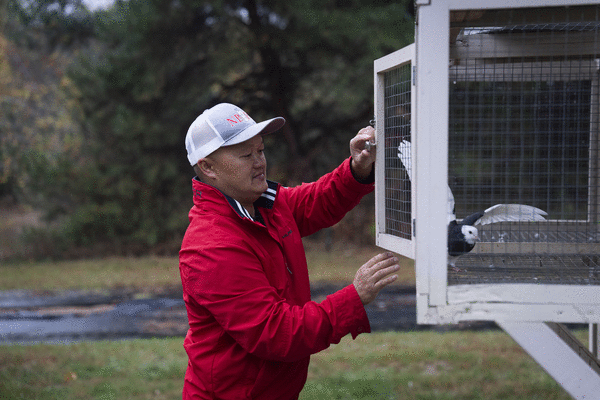
Lee keeps the pigeons that he breeds in about a dozen coops outside his home. Some are blue and green. Others have a nice tan coloring.
The pigeons aren’t trained to somersault in the air. Instead, the behavior is hardwired into their genetics.
The key to a good kit comes down to personality and breeding, Lee said. A bird who rolls too much could create too much confusion and chaos among its peers. Lee studies his birds every day, trying to understand which ones work best together.
There is a heartbreaking side to keeping pigeons. Out of Lee’s 250 birds, he estimates he loses around 100 every year. Even though a majority of his pigeons return to the coops after a flight in the sky, some get lost and can’t find their way back. Others are hunted down by hawks.
For that reason, he doesn’t name them. Still, he knows them. His oldest is 15 years old and continues to be one of his best, genetically, he said.
Ying Yang, the judge, has about 150 in his home in Fresno, California. Despite living in different parts of the country, sometimes thousands of miles apart, pigeon roller participants share some tendencies, he said.
“A lot of these guys, we see the same trend,” Ying Yang said. “Once you get married, you buy a home and you get more stabilized. Then you buy a little area and you build your kit boxes.”
©2026 The Minnesota Star Tribune. Visit at startribune.com. Distributed by Tribune Content Agency, LLC.





















Comments