'This is a calling': Chicago college launching midwifery degree program
Published in Lifestyles
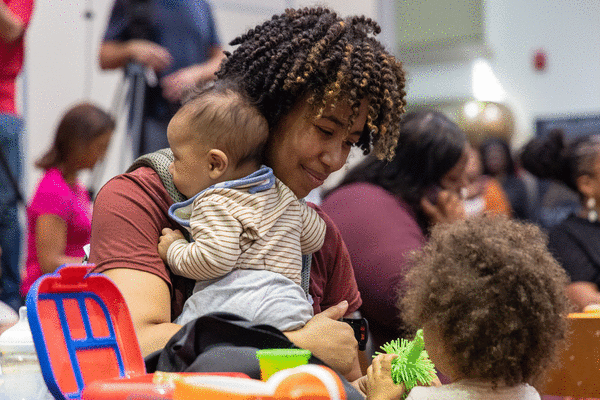
CHICAGO -- Ashli Watts’ gaze drifted between her children, attention split between her toddler in the chair in front of her and the three-month-old in her arms. They were part of the reason she sat in an academic building in Englewood Tuesday morning, listening intently, then smiling at the announcement she hopes will help her change the lives of mothers across the city in a few short months: the new midwifery program at Kennedy-King College.
The school, part of the City Colleges of Chicago, launched the new Licensed Certified Professional Midwifery associate’s degree program in partnership with the Black Midwifery Collective, a South Side nonprofit that aims to transform maternal outcomes. Midwifery offers a holistic approach to pregnancy and giving birth – for example, facilitating non-medicated births at home or in birthing centers and other monitored environments with a licensed midwife.
Beyond that, it is also seen as a potential way to combat prevalent maternal health crises, especially for Black women in Illinois, who, according to a 2025 Illinois Department of Health report, are more than twice as likely to die from any pregnancy-related condition and three times as likely to die from pregnancy-related medical conditions than white women.
The program is slated to teach students interested in midwifery over six semesters, including a new simulation lab complete with a home birthing center, before they apply for a state license to practice as a midwife, according to a news release. The Black Midwifery Collective worked with Kennedy-King and City Colleges of Chicago to develop programming to combat the need for maternal healthcare options in the city, the collective’s Executive Director and Founder Star August Ali told the Tribune. The program serves as “one way that we would be able to access this life-giving training to be able to come back to serve our communities,” she said.
The program’s location is intentional, too, Ali said, adding that she strategically chose the South Side for its predominantly Black community. One of her biggest hopes is that the program will not only produce midwives of color who will then practice on the South Side, but also serve as a replicable model for other states that lack accredited midwifery programs, she said.
“This is a very huge one, and not only for Black and brown midwives, but for midwives all across the world, all across the country, because it’s setting up what will be the blueprint for the rest of the country,” Ali said. “It’s going to have a huge impact…because it is centered in communities that need it the most.”
Classes begin in spring 2027 and the program is currently accepting applications for its first cohort, which Watts hopes she will soon join.
While she has yet to take her first class towards earning an associate’s degree, Watts’ presence in the maternal healthcare sphere took root years ago.
She currently works as a doula, a non-medical professional who offers physical, emotional, and educational support throughout a person’s pregnancy and postpartum period. Her passion for the work began when she and her sister had challenging experiences during their own pregnancies. It’s what led Watts to have a doula for the birth of her second child and to pursue the practice herself.
Becoming a certified midwife would take those practices a step further, she said, including addressing the needs of women who live in what are known as obstetric or maternal health deserts, or areas where women-centered health and pre- and postnatal care are scarce.
“I am very much interested in taking it up a notch, being more hands-on during the process of children coming into the world,” she said.
Tuesday’s launch served not only as an announcement of the new program but also as a celebration of the work it took to get there.
Much of that effort began as underground midwifery practices by Ali and other organizers who worked to offer holistic birth options and combat the deaths of Black birthing people, according to Earline “Mekazin” Alexander, co-founder and executive director of Chicago-based reproductive justice organization BA NIA Inc.
Overall, the new program will offer people a path to learn midwifery, prepare to become certified midwives, and practice that care on the South Side of Chicago and other vulnerable communities, Alexander said. For her, it’s a calling.
“Who better knows the community than those who live in the community, than those who work in the community, than those who serve in this community?” Alexander said. “…The program at Kennedy-King is a declaration of our autonomy.”
For hopeful cohort member and applicant Emmaline Jones, that calling is echoed throughout her family tree.
Jones’ ancestry includes multiple midwives, healers and wellness practitioners — a path that has become clearer and more desirable to her as she’s aged. Coupled with the traumatic modern birthing experiences that some members of her relatives have endured, Jones is hoping to gain entry into the program and continue not only her family’s tradition, but the larger midwife community’s.
“I’m from this neighborhood, and for me, why it’s so important to be a part of this, is holding onto a legacy of being able to provide wellness to our community, as well as safe options for Black women,” Jones said. “…For me, it’s to be able to hold on to my ancestral lineage, to reconnect with that, but also to bring forth even more wellness and healing for the next generation, and really, it’s about protection of our spiritual knowledge and legacy.”
©2026 Chicago Tribune. Visit at chicagotribune.com. Distributed by Tribune Content Agency, LLC.














Comments