Heidi Stevens: Five final marathon lessons, now that it's in the rearview mirror
Published in Lifestyles
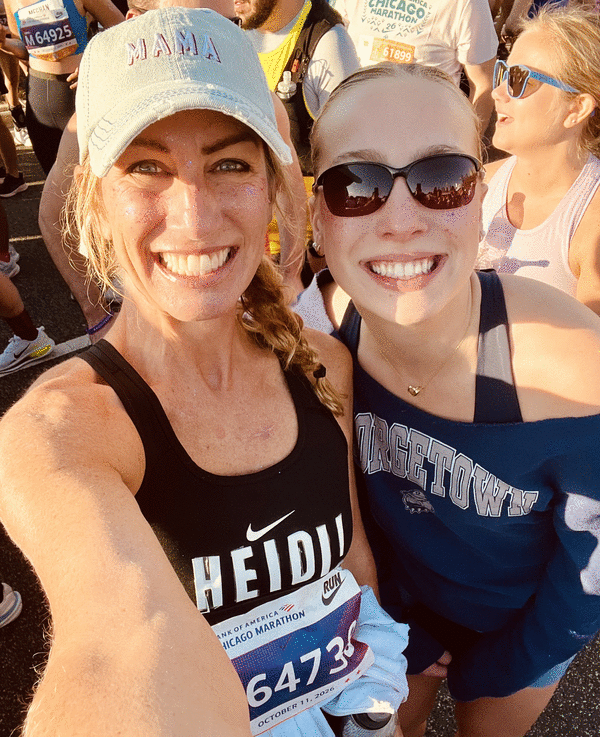


When I committed to running the Chicago Marathon this year, I also committed to learning a new life lesson from each of the 16 weeks of training.
I wrote about a few of them in earlier columns, hoping they’d resonate with some of you since they aren’t really about running as much as they’re about perspective and persevering and gratitude.
On Oct. 11, my daughter and I completed the marathon together — a 26.2-mile exercise in sweat, joy, community, humanity, pain management, heat management, clock management and, around mile 14, expectation management pushing aside the clock management thanks to the aforementioned pain and heat. We crossed the finish line holding hands.
Now that it’s all in the rearview mirror, I have a few final lessons. Thank you for indulging me.
Competing emotions don’t cancel each other out. Crossing the finish line with my daughter’s hand in mine was one of the best feelings ever. And I’ve rarely felt worse. We gutted through nausea and exhaustion and red-level alert conditions to get there. Everything hurt. Everything felt amazing. Especially my heart.
I think sometimes we try to shush an uncomfortable feeling with a happier one. I think sometimes we try to talk other people out of their pain by reminding them of all that’s good in their lives. I think the truth is that life can be painful and amazing at the same time, and one feeling doesn’t dull — and may even sharpen — the other.
We get to reinvent ourselves. It would be hard for me to put a finer point on this one than my friend John Duffy, who also ran the marathon and wrote about it in his Substack. At the end of Duffy's race, the woman handing out finisher medals called him a warrior. He burst into tears.
“I was not brought up to be a warrior,” he wrote. “Scratch that. I was actually told, time and again, in myriad ways, that I was not in fact a warrior. The bit in my family when I was a kid was that I was fragile. I was glass. I was weak. The weight room wasn’t for me. Nor the gridiron. Nor the diamond. I don’t know why this narrative was chosen for me as my story, but I believed it fully.”
He continued: “I want you to think about the messaging about you that feels as if it has forever defined you. And whatever those labels are, I want you to ask yourself if they’re true. Or do you get to decide, organically, who and what you are?”
You get to decide. And you should. Training for a marathon gives you a million opportunities to meet a new version of yourself. But so does life.
Let people cheer for you. It’s scary and embarrassing and culturally frowned upon to try big, bold, public endeavors. It makes you seem full of yourself. Extra. Plus, what if you fail?
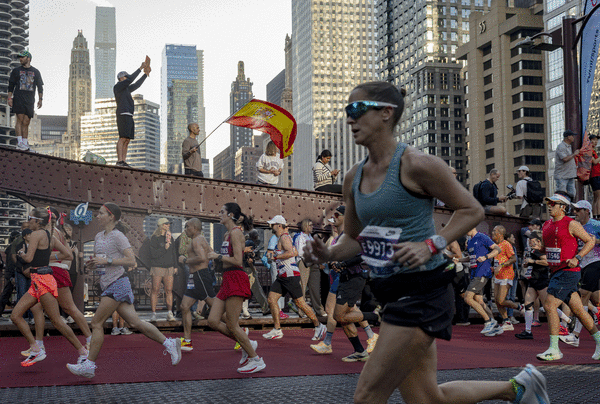
But 1.7 million spectators show up for the Chicago Marathon. And their energy, their signs, their dancing, their music, their offerings (cups of pickle juice at mile 11!) their belief and investment in a whole bunch of strangers? It shows you that plenty of people really, truly, want other people to thrive.
It changes your calculus about humanity when you see a million-plus people get up in the morning and go find joy — genuine joy — in someone else’s big day. It also reminds you that every hour of every non-marathon day, that same dynamic is playing out in smaller, no less monumental venues. At a breakfast table. At a book club. At a high school performance of “Hamlet.” Any place a human puts their whole entire heart on display and asks someone else to take good care of it. Tuning into that changes you.
Pay attention to the people helping you. You become highly attuned to who’s helping you during a marathon — the volunteers handing you water, the medics ready to heal you, the course officials keeping trash and bikers and pedestrians out of your way. You notice them. You search for them, actually.
It got me wondering: What if we did that all the time? What if we made a point to notice the people, daily, who quietly, competently, efficiently, make our big moments possible? Who anticipate our needs and fix our problems and clear our obstacles? My list is long. Maybe yours is too.
Do something hard with your kid that has nothing to do with school. So many of the endeavors we sweat and struggle and hold our kids’ hands through end in a grade. Or a test score. Or an acceptance letter. Or a rejection letter. So much of the productive struggle is measured and made meaningful by the outcome.
If you get the chance, do something hard together that doesn’t get graded. That stays with them. That changes their self-understanding. That shapes how they approach big challenges.
And that gives you a chance to be blown away again, anew, at their singular, spectacular existence. And your singular, delighted proximity.
Not that you needed it.
©2026 Tribune News Service. Distributed by Tribune Content Agency, LLC.



















Comments