At Chicago's Pride South Side, LGBQT+ festival offers 'a place where I can be myself'
Published in Lifestyles
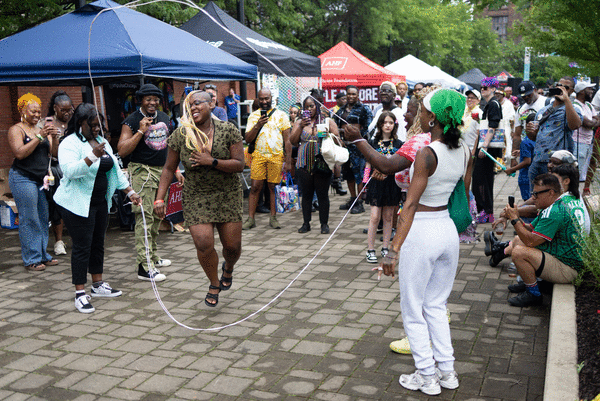
CHICAGO -- The pride flag poking out of Jordan Scott’s backpack fluttered with every step.
As he danced to a DJ’s tunes Sunday at Pride South Side, he felt something he couldn’t feel anywhere else.
“I skipped Pride events on the North Side in favor of this,” the Beverly resident attending for a second year said. “I just love the vibe, the atmosphere and the people.”
The South Side festival focusing on Black and Brown LGBTQ+ Chicagoans celebrated its eighth year with music sets, drag performances, panels and tours at Washington Park’s DuSable Black History Museum.
The party creates a much-needed shared space that makes Pride festivals more accessible to South Siders, said Chris Huerta, community health program manager at the LGBTQ+ resource center Brave Space Alliance.
“It creates that community and puts it in our backyard,” she said. “The festival being at this museum adds in this other piece of POC joy.”
At his table, artist D. Little had laid out a dozen embroidered landscapes, which he called “little worlds,” along with a giant tapestry of science-fiction writer Octavia Butler.
It was Little’s first time at the South Side celebration. Although vendor fees can be high at bigger pride events on the North Side, Little said he could afford to sell at the DuSable Museum gathering.
The Bronzeville resident said he didn’t attend the city’s Pride parade this year.
“I don’t feel seen there,” he said. “This feels like my pride and a place where I can be myself.”
Oriana Koren, of Edgewater, said he saw “the entire spectrum of Chicagoans” while vending at the festival.
“It’s a good reminder that we are less separated than we’re constantly being told we are,” he said.
Koren had stacked books on his own table. The Edgewater archivist began collecting Black art in 2016, fearing the then newly elected President Donald Trump would censor it.
Sharing Black art allows for the knowledge it contains to be passed down, person to person, even if it is suppressed, he said.
“We’re a group of people who have survived forced illiteracy,” Koren said. “We can look to each other to find that information that is important to protect.”
The vendors were part of Adrienne Irmer’s vision for the South Side festival, which she co-founded after a 2018 study by the Chicago Department of Public Health showed higher rates of new HIV infections on the South and West sides.
“These are historically the most under-resourced communities, some of our more vulnerable communities,” she said. “We know that cultural festivals speak to folks in a culturally relevant way. We thought, ‘Why not blend that with healthcare?’ ”
An array of healthcare groups were slotted in among stereos and sellers throughout the festival.
Jordan Braxton, a community empowerment manager at Vivent Health, stood by a table distributing pins, Narcan, rubber ducks and pamphlets about HIV testing and prevention. She said she had barely had time to set up the tent before people came by to pick up materials.
One of the goals of Vivent’s presence at the event, she said, was to show that their care is “culturally sensitive” and that Black and queer people work there, too.
“A lot of people in the Black queer community don’t trust the medical field,” she said. “We’re out here trying to regain that trust.”
Braxton also stocked the table with voting resources, which she said was a response to the Trump administration’s proposed budget for next year cutting $1.6 billion in funding for HIV prevention and research.
Federal attacks on queer healthcare were also top of mind for Ken Remé, marketing director for the AIDS Healthcare Foundation-affiliated Impulse Chicago. He urged Chicagoans to call on Congressional representatives to protect access to lifesaving medications like PrEP.
But there are many ways to get involved, Remé added. He found his own Sunday, standing next to a dunk tank, nudging festivalgoers to sign up to receive healthcare information.
As he waited for a friend to perform on stage, he noted the “textbook way” of getting people information about queer health doesn’t always land.
“Finding spaces where people look like you is super key,” he said. “There’s a brotherhood here, there’s a camaraderie here that I think is so important to my own development as an adult. I think it’s something everyone should experience.”
Paulo Colby headed toward the festival’s fitness section after watching Antonio King, the city’s first-ever director of LGBTQ+ affairs, speak. There, festivalgoers practiced pilates and played volleyball.
It was yet another subtle push to get attendees to focus on their health, said Colby, owner of Fulton Market fitness studio Continuum.
“If the communal belief system is around taking care of yourself, you’re going to take care of yourself,” he said. “We’re stirring that conversation, so we’re not just hoping it happens.”
North Side pride events aren’t always accessible for everyone, he said. Some people might struggle to get to another part of town, while others might not feel accepted there, he said.
But on Sunday, in a mix of books and yoga classes, blaring music and food, “an enclave of people that get to freely exist as themselves,” emerged, he said.
“It’s needed,” he said. “Even if it’s only for a moment, a day, weekend.”
©2026 Chicago Tribune. Visit at chicagotribune.com. Distributed by Tribune Content Agency, LLC.

Comments