These Mahjong clubs are hot, young -- and play by different rules
Published in Lifestyles








DENVER — The smell of sauteed shrimp wafted across the event hall behind Hot Shot Coffee in north Denver. Cody Peeler, standing behind a rice cooker and hot plate and next to trays of condiments, worried the aroma would offend the cafe’s clientele.
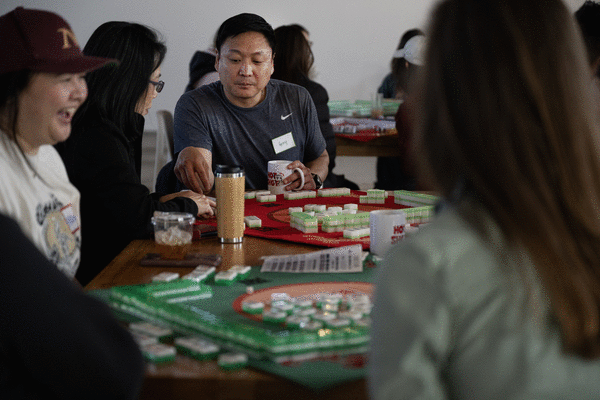
But to the dozens of people who’d gathered on a Saturday morning in January to play mahjong, it was a most welcoming sign. It meant Peeler’s mapo tofu gumbo station was open.
Food is a central component of the free monthly mahjong meet-up, the Honour Tile Society. Peeler and his partner, the club’s founder, Tiffany Leong, are both chefs and now run the food pop-up, named Magnolion, at their mahjong events. The club’s first meeting was in March of last year. Leong said she can consistently count on 40 to 60 people to attend each month now.
“Games move really quickly,” Leong said. “You do have to frontload a lot of rules into your brain, but once you get going, it’s really fast-paced, and it’s not like some long, arduous tabletop game.”
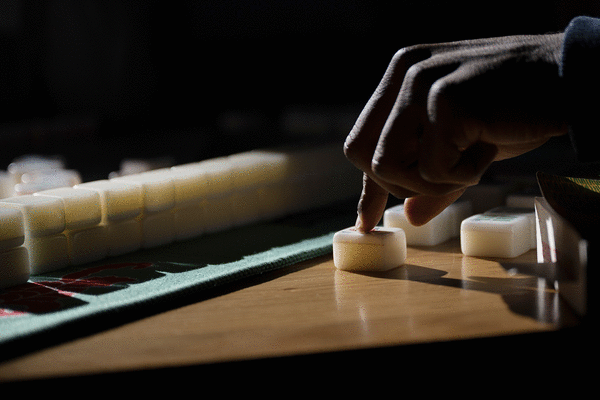
The click-clackety game of mahjong — where players draw, stack and discard tiles elegantly carved with Chinese symbols or characters — has exploded in popularity across the U.S. in recent years. In Denver, neighborhood or pay-to-play organizations have given players new outlets (although there are plenty of old ones as well), depending on what rules they want to follow.
Honour Tile Society events stick to old “Hong Kong rules,” Leong said, with 14 tiles drawn in a counter-clockwise direction. Across town, members of the Cherry Creek North Neighborhood Association play an entirely different style, one regulated and revised annually by the National Mah Jongg League and American Mah-Jongg Association.
Denver’s distinct cultures surrounding mahjong are a microcosm of the game’s global expansion since first emerging in China in the 19th century. Though they differ in demographics, exclusivity and price range, local clubs offer many an opportunity to learn and bond over a game that may have a personal connection spanning generations and continents.
As the original game developed and diversified in Asian countries, an American businessman in Shanghai began shipping units to the U.S. with a simplified set of rules. In 1937, the National Mah Jongg League standardized the American variant. More recently, a climactic scene in the 2018 rom-com “Crazy Rich Asians,” where a bride-to-be plays mahjong against her future mother-in-law, renewed interest in the game in the U.S., said Christine Voncannon, founder of the Cherry Creek North group.
The club meets weekly at the Ross-Cherry Creek Branch Library. There’s no cost to play, though residents pay a nominal fee to the neighborhood association each year as dues, she said.
Voncannon, 54, first learned the game in Texas from her mother-in-law, Wanda Voncannon, in 2018. She developed a zeal for it, finding others who wanted to play on Nextdoor, the neighborhood social media site.
She started hosting games at her house after moving to Denver from Golden in 2024. In addition to the weekly association meetups, she plays with other parents at the Kent Denver School in Englewood, where her daughter attends. (The students started their own club that meets occasionally during lunch, she said.)
Enterprising players of American mahjong have formed new companies with their own set of tiles and scorecards, rivaling the National Mah Jongg League, she said. Vacation packages and cruise lines advertise mahjong play. Celebrities — she highlighted Julia Roberts, Sarah Jessica Parker and Kelly Ripa — have evangelized about the game.
The play can get intense and competitive, but some people are more interested in the social component of mahjong, being next to neighbors and exchanging stories or game tips. So Voncannon likes to make room for both chit-chat and serious play.
“I’ve only known some of these women for a year in October, but I know about their families. I know about their surgeries. I know about their vacations,” Voncannon said. “That growth of friendship is super important to the game.”
At the Honour Tile Society event in January, younger players of Asian descent, like Leong, made constant connections between mahjong and their older family members, friends and neighbors.
“My mom and my grandma have always played. My grandma would play every week with her friends,” she said.
Leong, whose Chinese family emigrated to the U.S. from Vietnam, was inspired to learn the game after reading a story in the New York Times about Green Tile Social Club, started after the COVID-19 pandemic by friends who’d attended the same college. So were some of her other Asian American Pacific Islander (AAPI) friends from the service industry. They watched YouTube videos and checked out a book from the library to get comfortable.
Their initial potluck and learning session turned into the monthly gathering it is today largely through their strong followings on social media, she said. (Honour Tile Society posts about meet-ups and shares registration links on Instagram. ) The Society now draws from all crowds, including many people learning mahjong for the first time.
A table in one corner of the event space was sprinkled with some more experienced players. Adam Pham, 39, cupped his hand over a tile and drew it up to his face so others could not see.
Pham’s game included 27-year-old Audrey Kent, 36-year-old Adam Wedgewood and 37-year-old Kevin Chen. The play was fluid and quiet. Once or twice a game, someone would clarify a move or tile, something Chen and Pham agreed is common, given that house rules, along with what Chen called “auntie rules,” vary greatly.
“The real Chinese or Taiwanese aunties that play are very intense. I’m afraid of that,” Chen said, eliciting agreement from Pham and Kent. “You’ll get yelled at if you’re taking too long.”
Luck, too, can give a beginner an edge.
Nick Dalton, chef of Brasserie Brixton, was at his first Honour Tile Society event playing another game at the same table. He hesitantly announced his hand. “I think I won,” he said.
A learned player looked over each of the tiles in his hand, laying each one down with its characters facing up. He had indeed won.
©2026 MediaNews Group, Inc. Visit at denverpost.com. Distributed by Tribune Content Agency, LLC.























Comments