Heidi Stevens: 'Please tell your own story.' How Gloria Steinem's final request reflects her legacy
Published in Lifestyles
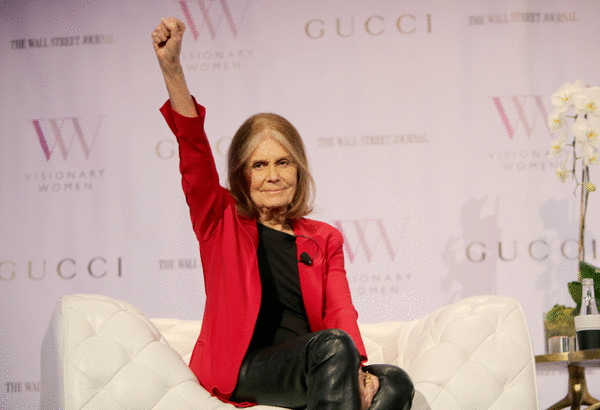
I don't know how you begin to sum up the impact of Gloria Steinem's life, except to say that almost every moment I’ve walked through the world as a woman has probably been paved, in some small or enormous way, by her advocacy.
Steinem lived a remarkable 92 years before her death on Sept. 2. She co-founded the National Women’s Political Caucus, campaigned tirelessly for social justice, launched Ms. Magazine, led generations of marches and ignited countless life-changing epiphanies.
If you haven't read her 2015 memoir, "My Life on the Road," now is a great time.
She wrote about learning to read by sounding out street signs. She lived an itinerant childhood and didn't go to elementary school; her dad rarely had steady work and moved the family from town to town. Her mother, prone to anxiety attacks, rarely joined them.
“The culture had told me, and I believed well past 50, that if you were on the road, you didn’t have a home, and if you had a home — especially for women — you didn’t go on the road,” she told me during a 2015 interview. “Over the course of writing the book, I discovered that we all need both.”
She wrote about becoming radicalized at Martin Luther King Jr.’s 1963 March on Washington speech. She was standing next to a Black woman named Mrs. Greene, a clerk in segregated Washington during the Truman administration, who pointed out that there were no women on stage that day, save for Dorothy Height, head of the National Council of Negro Women. And Height wasn’t even asked to speak.
“Where is Ella Baker?” Greene wanted to know. “She trained all those young people. What about Fannie Lou Hamer? She got beaten up in jail and sterilized in a Mississippi hospital when she went in for something else entirely. That’s what happens — we’re supposed to give birth to field hands when they need them, and not when they don’t.”
Steinem was riveted.
“I hadn’t even noticed the absence of women speakers,” she wrote. “Also, I’d never thought about the racial reason for controlling women’s bodies. I felt some gear click into place in my mind.”
She wrote about the wisdom she gleaned from Florynce Kennedy, the great civil rights activist and lawyer, on dealing with detractors. The two women would lecture on college campuses together in the '70s, and the crowds invariably included a heckler or 20. Kennedy told her, “Just pause, let the audience absorb the hostility, then say, ‘I didn’t pay him to say that.’” The jeers, after all, underscored why the two women needed to be there in the first place.
Steinem was 81 the first and only time I interviewed her. It was the same week Playboy announced it would no longer feature nude photos in its magazine — a topic that felt ripe for her input, given her 1963 undercover stint as a Playboy Bunny.
In her attendant Show magazine expose, Steinem took issue with Playboy’s male-centric approach to the sexual revolution and the paltry pay and hostile working conditions the Bunnies were subjected to.
I asked Steinem for her take on the magazine’s pivot away from nudity. She wasn’t impressed.
“For Playboy to stop publishing nude photos of women is like the NRA saying it’s no longer pushing handguns because machine guns and assault weapons are so easily available,” she said. “Playboy would have to change its title, heart and brain cells in order to express the full humanity of men or women.”
It always struck me that she said “full humanity of men or women,” not just “full humanity of women.” If you study Steinem’s words and work carefully, you notice that it’s rooted in a deeply held conviction that no one thrives fully until we can all thrive fully — across gender, race, socioeconomics and all the other categories so often used to divide and conquer us.
Steinem recorded a confidential 2025 interview with Netflix’s “Famous Last Words” executive producer Brad Falchuk, which she understood would be released after her death. At the end, she turned to the camera with an ask.
“Please tell your own story,” she said. “This is the most important thing we can do for each other, to know each other through stories.”
Her words transported me back to 2022, when I sat on a stage with Anne Lamott, who was touring for her then-new book, “Dusk, Night, Dawn: On Revival and Courage.” Lamott is known, above all, for taking her (and our) fears and frustrations and sorrows and joys and mistakes and absurdities and weaving them into sentences that help people make sense of the world.
She’s known for telling her story, in other words.
I asked Lamott how she got that way — how she found not just the language, but the courage. She said that it began with a realization that the only way to heal from anything is to tell the truth. Out loud. To each other. Some diseases are terminal. Mothering is exhausting and, occasionally, joyless. We (Lamott included) sometimes do brutal battle with substances. Humans fail and covet and contradict our better angels.
She also talked about Ms. magazine sparking that realization.
She talked about gathering with friends to devour each new issue when it launched in 1972. Most magazines aimed at women focused on homemaking and beauty trends. Ms., Lamott said, told readers the truth, finally, about their lives and their bodies and the forces conspiring to harm or please or control or liberate them. That felt world-changing, she said.
Maybe it’s a stretch, but I wondered if Lamott’s 20 books would exist without Steinem’s magazine. It’s impossible, I suppose, to know which sparks ignite a lasting flame and which ones flicker out over time. Maybe Lamott’s words would be lighting our way regardless.
But it does lend Steinem’s final request — that we tell our stories, that we get to know each other through our stories — an urgency and a poignance when you think about what our stories can set into motion. And how courage is contagious, as Steinem’s life and work demonstrated so well.
©2026 Tribune News Service. Distributed by Tribune Content Agency, LLC.















Comments