A Twin Cities teen pursued State Fair poultry glory. Hundreds of rural birds stood in her way
Published in Lifestyles
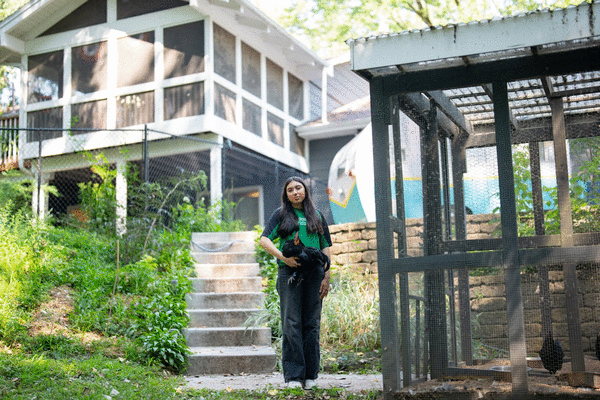
MINNEAPOLIS -- Ellianna Hink stood at attention inside the Minnesota State Fair Sheep and Poultry Barn, hoping her feisty, biting bird Hydrangea wouldn’t ruin her chance at victory in the Westminster dog show of youth chicken competitions.
Occasional cock-a-doodle-doos punctuated the muggy air as the judge circled the ring of finalists.
After 20 minutes, competition judge Zeb Skow turned his attention to Hink.
Breaking her cadet-like posture, Hink lifted her black-and-green-plumed bird to display different parts of his feathered body. Skow fired off questions, like: what’s the longest feather on the bird’s tail? (the greater sickle feather). His questions also touch on industry: what state in America produces the most eggs? (Iowa).
The annual event effectively crowns the best youth bird handlers in Minnesota, an agricultural state where chickens outnumber humans. And Hink, of Minnetonka, was the only 4-H teen from Hennepin County to reach the grand finale out of more than 100 youth.
As a youth program ambassador, she gets to advocate for metro-area agriculture, Hink said, and “there isn’t a lot of urban representation.”
Hink doesn’t come from a multigenerational farm family, yet she’s unbothered. The competition is friendly, a testament to Minnesotans’ love of animals and farming that’s present among urban and rural dwellers alike.
Then judge Skow began reading off the results, listing his top 10 in descending order. Halfway through, Hink’s bib number hadn’t been called — meaning she could either be among the very top finishers or not rank at all.
But not before a last-minute handwriting error — was that a 2 or a 6? — generated confusion among the volunteer staff while the young chicken handlers stood at their birds’ cages, doing the mental math on whether they still had a chance.
“It’s just a lot,” Hink said of the intensity of the fair’s competition.
Visiting Minnetonka
In Minnetonka, Hydrangea’s life is far less stressful. The five-month-old cockerel (baby male rooster) was roaming the Hink backyard on a recent Tuesday, nine days before the fair began.
It was a field trip for the young chicken, who stays for most of the year at a friend’s rural house. Minnetonka does not allow people to keep roosters in backyards.
Hink personally grooms and feeds her baby hens daily. Her father, who grew up in St. Louis County, Minn., and took part in Minnesota 4-H, said the program has remained largely the same for decades.
“These kids are learning how to talk, how to represent themselves — how to advocate for whatever interests them,” John Hink said.
The poultry competition on the first day of the fair consists of interviews in the morning testing participants’ knowledge and manners, a midday best-in-show contest evaluating the quality of the birds, and — if they impress the judges enough — a showmanship competition in the evening where participants are tested on their “whole package,” a judge said.
Only a few dozen participants out of hundreds across all age groups make it that far.
Hink is a veteran, having participated five times. This year she brought the only birds raised in Hennepin County. And Hink, whose mother Maria was born in India, was among the only youth of color in the poultry barn.
Hydrangea hatched in Ellianna’s bedroom incubator in the spring as one of two roosters. Disaster struck when a spring thunderstorm caused one of them to apparently have a heart attack and die, she said.
“That was some fun experience,” she said with her characteristic poker face.
Hydrangea, a biter, had become Hink’s best shot at victory.
Competition time
By 8:30 a.m. on the fair’s first Thursday, the poultry barn was already swarming with young competitors sporting jeans and shoes from cowboy boots to Crocs.
The first stage of contests didn’t faze Hink. But for the newbies, it looked like a high-stakes job interview.
Roughly 100 spectators in bleachers were watching these conversations amid the swirl of people, animals and equipment.
Hink said the key is to stay “cool and collected.” Helping keep the interviews proceeding in order with another 4-H ambassador, the pair exchanged at least three 6-7 jokes.
“Our job is just to lighten the mood,” the friend said.
When her volunteer duties coordinating the interviews wrapped up, Hink returned to the middle of the building, where all the birds’ cages are kept.
“It just gets crazy,” Hink said about the poultry building. As she spoke, the slow flow of fairgoers snaking between hundreds of cages in the barn made it difficult to move more than a few feet at a time.
Hink was grooming Hydrangea and two other birds for their show set to begin a few hours later, brushing their feet with a toothbrush.
Hydrangea tried to bite her — behavior that could ruin chances at glory if it continued.
“It’s kind of hard when it attacks the judge — probably minus points,” she said.
What is perfection?
Ahead of the show’s 1 p.m. start time, children, parents and members of the public packed the bleachers alongside the rings of competition cages. To see the competition, one child sat ten or so feet high on big blocks of bedding in the building’s corner.
Hink’s competition — which included Hydrangea and two young female hens she also raised — was one of the first up.
Standing by the cages, Hink assumed her sentinel-like ready position. Like the other participants, she angled her body like a rotating fan to face judge Skow as he walked around the ring.
For this second competition, which was all about the birds’ appearance, the judge compared each chicken to the archetype of a perfect bird laid out in a one-pound book called “American Standard of Perfection.” Points are deducted for abnormalities like a missing point from the vibrant red comb on the bird’s head.
Skow, a military veteran, slowly circled the ring of cages to inspect the birds. When he wasn’t looking, Hink whacked Hydrangea’s cage when the bird was misbehaving, quickly reassuming her position.
After a few minutes, Skow arrived at Hink’s cages.
He grabbed the birds one at a time, feeling their feathers, inspecting their wings and studying tails that looked like bouquets. He apparently liked what he saw, as a volunteer a few minutes later stapled on a paper indicating Hink and her birds had made it to the showmanship competition that evening.
She returned with the birds and her father to their homebase cages, where her mom kissed her on the cheek. Hink wiped that off with a brief smile.
The big moment
The poultry barn had calmed down by the evening. Attendees in the bleachers scrolled on their phones. One boy rested his head on his mother’s shoulder in the crowd.
But for the participants, this was the climax of their long day. Hink had changed from her Adidas into blue-and-brown cowboy boots to make a better impression. This competition, Skow would say later in an interview, is more about the handlers than the chickens they raise.
Only one bird per finalist participates in this multispecies contest, and for Hink, it’d be Hydrangea.
A problem struck the moment she stepped on the competition floor. A goose screeching every few seconds had monopolized the table space. Volunteers scrambled to set up another table with bedding and cages for chickens, and Hink held the bird for a few agonizing minutes before setting Hydrangea down in his cage.
It felt like the competition was starting without her, Hink said later, but her stoicism never cracked.
This competition took much longer than the 1 p.m. event: the participants stood rigidly for 30 minutes in a test of endurance. Hink was among the last to face Skow.
Her performance was solid and victory seemed attainable, but her bib number still hadn’t been called.
Perhaps, she fretted, she hadn’t placed at all.
Then, finally, her bib’s four numbers were read out: the third-best teen bird handler in the state of Minnesota was a Twin Cities girl.
She said she doesn’t go “fishing” for compliments, but hearing praise afterward from Minnetonka high schoolers and 4-H participants alike made her glow. To help her Twin Cities friends understand her 4-H sideplot, she tells them: “It’s Girl Scouts, but make it country.”
©2026 The Minnesota Star Tribune. Visit startribune.com. Distributed by Tribune Content Agency, LLC ©2026 The Minnesota Star Tribune. Visit at startribune.com. Distributed by Tribune Content Agency, LLC.



















Comments