Heidi Stevens: It's never been easier to unearth family secrets. A new book explores what happens after the reveal
Published in Lifestyles
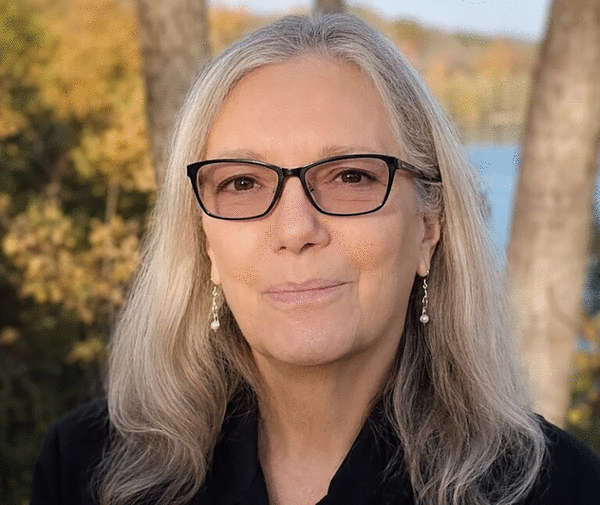
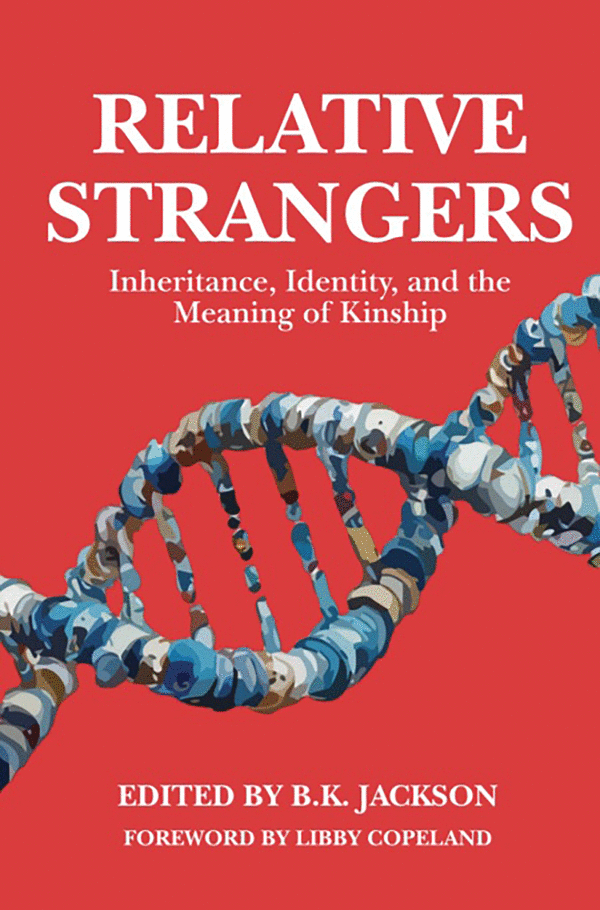

Kate Jackson’s mother took off when Jackson was an infant, leaving her 9-month-old daughter and 4-year-old son with an overwhelmed father and a lifelong search for equilibrium.
“He was a loving and nurturing father,” Jackson writes in "Relative Strangers,” the new anthology she edited, “but affection and attention couldn’t give my brother and me what we also needed — the truth about our mother.
“It’s a misconception,” she continues, “that what you don’t know can’t hurt you. Unknowing can be bewildering, isolating, shame-inducing, and deeply disquieting.”
Well into adulthood, Jackson happened upon her mother’s obituary, which referenced six surviving children, none of whom was Jackson or the brother she knew. A few years after that discovery, a DNA test revealed that the man who raised Jackson and her brother was not her biological father.
“In a heartbeat, the yearning, the ache, and the grief doubled back,” Jackson writes. “I lost my bearings. I was like a pilot flying blind in the fog. My compass was off kilter, and my touch points had disappeared.”
“Relative Strangers” is, in part, her attempt at a roadmap. As the founder and editor of Severance, a magazine devoted to people who’ve been separated from their biological families, Jackson, 72, learned quickly that while her particular story was unique — and uniquely painful — she was far from alone in her role as the bewildered child of a complicated, cryptic family.
About 1 in 5 Americans have taken a DNA test, and 25% say the results uncovered a close relative they didn’t know about. One third say there was a result that surprised them. The advent of social media and a growing number of states opening adoption records, meanwhile, have made it easier than ever to track down family members who may have been lost to history in previous eras.
Jackson is writing a memoir, but she also felt compelled to produce a collection of stories that reflected the ubiquity and complexity of family secrets and surprises.
"Everyone's story has something incredibly profound about it that another person’s doesn’t,” she told me by phone. “And one thing that’s clear is how desperate people are to tell their stories, and how desperately people want to hear these stories.”
For “Relative Strangers,” she gathered 28 of them, written by a collection of Severance contributors and other emerging writers who answered Jackson’s public call for stories.
On a recent Sunday afternoon, I was invited to moderate a conversation with three of the contributing writers — Christine Wolf, Sarah Leibov and Michèle Dawson Haber — at The Book Stall in north suburban Winnetka, Illinois.
In front of a standing-room-only crowd, each of the three women shared pieces of their life stories with generosity and grace, walking us through identity-rupturing discoveries: a biological father’s hidden death by suicide; a half-sister who bore the same first name as a sister lost to an overdose; a teenage pregnancy and secret adoption.
Toward the end, when it was time for audience questions, a woman asked the gathered crowd to raise a hand if they discovered a life-altering family secret at any point in their lives. More than half the hands went up.
“Almost without exception,” Jackson told me, “people look at me a little puzzled when I tell them what the book is about. And then they say, ‘That happened to me too.’ Or, ‘That happened to my Aunt Sally.’”
Journalist and author Libby Copeland wrote the book’s introduction:
“The American family isn’t what it used to be,” Copeland writes. “The truth is, it never was. If there’s one thing this era is teaching us — this moment when family secrets are being exploded by a perfect storm of technology and curiosity — it’s that our families are not and never have been as tidy and conventional as our culture claimed.”
And if there’s one thing that Sunday taught me, it’s that in and among the grief and shock and confusion of the stories — the living them and the telling them — is room for joy. Relief. Community. Gratitude — for new family members gained, for answers to nagging questions, for language to name a disquieting feeling.
I was moved by the writers’ courage, and I was even more moved by their laughter.
Jackson wasn’t at the event, but I told her about the palpable joy in the room when I interviewed her by phone a few days later.
“Standing in your own truth, maybe for the first time, is powerful,” she said.
So is sharing that truth with readers and friends and strangers, where it gets a chance to shape and inspire and illuminate even more lives.
©2026 Tribune News Service. Distributed by Tribune Content Agency, LLC.












Comments