He gives pies away on Tuesdays because 'pizza is just an excuse to love people'
Published in Lifestyles

PITTSBURGH -- Pizza means a lot of different things to different people.
For most of us, it’s a beloved comfort food that brings instant, cheesy joy when delivered piping hot to your doorstep for dinner or a late-night snack.
When crafted from long-fermented dough and topped with high-quality, locally sourced ingredients, it can make us feel like we’ve gone gourmet — especially if it is baked in a wood-fired or brick oven.
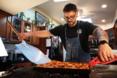
For aspiring pizzaiolo Jesse Wisinski, mixing, kneading, tossing and baking the 16-inch pizzas in his Beaver County, Pennsylvania, kitchen on Tuesdays is a tasty opportunity to do a good deed.
On July 25, the software engineer and father of two raised more than $2,000 for “Pie it Forward,” a national hunger-relief campaign by New York-based Slice Out Hunger that delivers free pizzas to people in need. One of 32 participating pizza makers across Pennsylvania, he baked 59 pizzas over about nine hours in his Brighton Township garage. Customers donated $15 per pie to the cause.
Relatively new to the community pizza scene — he only perfected his thin-crust, East Coast-style pies for friends and neighbors in March 2025 — Wisinski said the experience was both exciting and mildly nerve-wracking.
“I’ve been doing it for about a year on a smaller scale, so I knew what I was getting into,” he says.
It was the traditional gas oven he got for $50 on Facebook Marketplace that caused concern. If it somehow failed, well, “that would have shut the operation down.”
Luckily the second-hand oven performed spectacularly, despite being cranked up to 550 degrees for nearly an entire day. (Keeping his garage door open helped cool things down.)
Even with his wife, Allison, and new friend Matt Melbert lending a hand throughout the day, it was quite the operation.
In addition to running between his kitchen (where he prepped the pies) and garage (where he baked them for around nine minutes each), Wisinski spent around three hours making eight batches of dough three days before the event. It’s a task, he jokes, that would take a practiced pizza maker about 20 minutes per batch.
Then, he spent several more hours cutting the yeasty mixture into grapefruit-sized balls that were placed in plastic proofing boxes to rise very slowly in the fridge over 90 hours.
‘Positive energy and vibes’
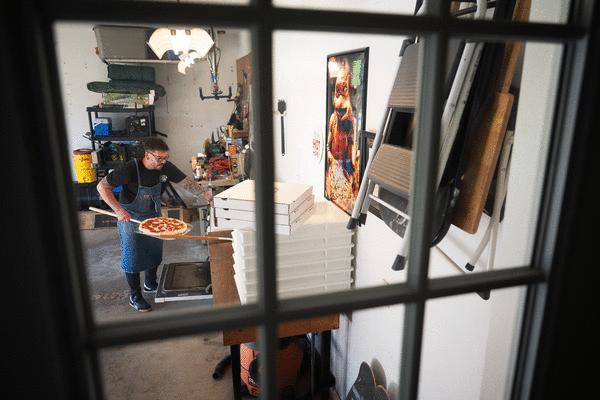
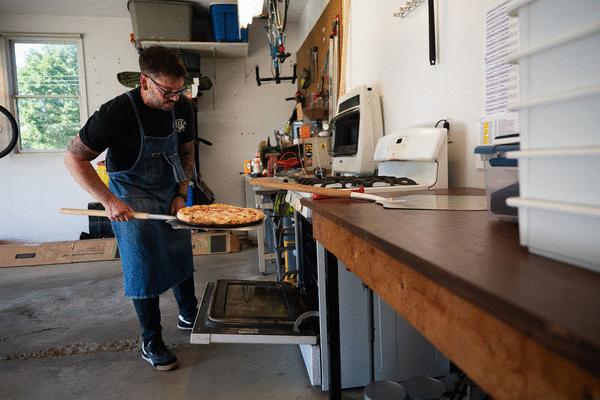
With the first pickup scheduled for 11 a.m., Wisinski had to start early at around 7 a.m., taking the dough out of the fridge so that it could warm to room temperature before baking. Pies were tossed and topped in the kitchen, put on a peel, whisked around the corner and down three steps into the garage for baking — his Alexa device kept time — then whisked back into the kitchen to be sliced and boxed.
In all, he says, he spent more than 11 hours on his feet making pizza. But on the flip side, nearly all of the ingredients were donated.
The only misstep (and it was minor) was that he didn’t have quite enough room in the fridge for all the dough, so the balls just sort of “grew into each other” instead of staying nice and round.
“But it went really well, and we hit it off,” he says of Melbert, an Imperial resident who volunteered after learning about the sold-out event on Wisinski’s social media posts.
“It was just a positive experience with a lot of positive energy and vibes.”
Perhaps more exciting: Wisinski got to talk with Scott Wiener, a New York City pizza expert and historian who founded Slice Out Hunger in 2009. He picked the veteran pizzaiolo’s brain and chatted about Wiener’s Guinness World Record for the largest collection of unique pizza boxes (595 as of October 2013).
Seeing all those smiling faces and meeting so many people, “I can’t imagine a scenario where I wouldn’t do it again,” Wisinski says of the event, which has raised more than $2 million to fund the nonprofit’s hunger relief efforts across the U.S. since its inception.
Born in Maine in a Coast Guard family, he lived all around the country before moving to the Pittsburgh area at age 14. That’s when he first got into pizza-making with his parents, John and Jeanne. He enjoyed it so much that while he was studying graphic design at the Art Institute of Pittsburgh in the early aughts, he got a job at Anthony Jr.'s, his favorite neighborhood pizza joint in Monaca.
“It was part of our family every Friday night,” he says.
‘thebestpizza.shop’
He admits their first attempts were “barely edible” because they didn’t really know what they were doing. But as the son of two native New Yorkers, “I experienced fantastic pizza whenever we went to visit family,” he says.
Those early misfires suggested to Wisinski that restaurant-quality pizza was unattainable at home unless one owned a pizza oven. As evidenced by his many followers on social media and YouTube — his handle is @thebestpizza.shop — “I’ve proven that wrong.”
The catalyst, he says, was a road trip in May 2025 with a buddy from New York during which they talked about pizza for three hours straight. Inspired, and having some spare time between jobs, he started exploring how to make great pizza at home by reading books and watching videos. Before long, he was posting about his pizza-making journey on Instagram so others could follow along and learn, too.
He also started experimenting, so much that he made too many pizzas for his family to eat.
“So we decided to start giving them away to people in the community,” he says. They’d be offered on Tuesdays.
Pizza, he says, was always his go-to meal when hosting guests for dinner or feting a friend’s newborn. But with this project, “I really went off the deep end.”
To be more efficient — he’d be cooking after his day job as a software designer with Navy Federal Credit Union — he created a form so people could request a pizza (or pizzas) for someone having a tough time and arrange by text for pickup. And if those ordering wanted to make a $15 donation to help offset the cost of ingredients or order a pizza for themselves? Awesome!
Wisinski also purchased the aforementioned oven, and outfitted it with a metal peel so he could cook the pies at higher temperatures, shortening the bake time and creating the slightly charred, crispy-yet-chewy crust New York-style pizza is celebrated for.
It allows his 550-degree oven to reach 625 degrees so he can bake like a pro.
Since starting last May, Wisinski has consistently made up to 20 pies each week. The process has evolved a bit, he says, but between donations and free pies, he usually breaks even, even while using quality wholesale ingredients like whole milk mozzarella from Grande Cheese, Rosa Grande pepperoni and organic Bianco DiNapoli crushed tomatoes, which he buys by the case.
For a local, gourmet touch, he garnishes the crusts with a generous swirl of extra virgin olive oil from Beaver-based Two Rivers Olive Oil Co.
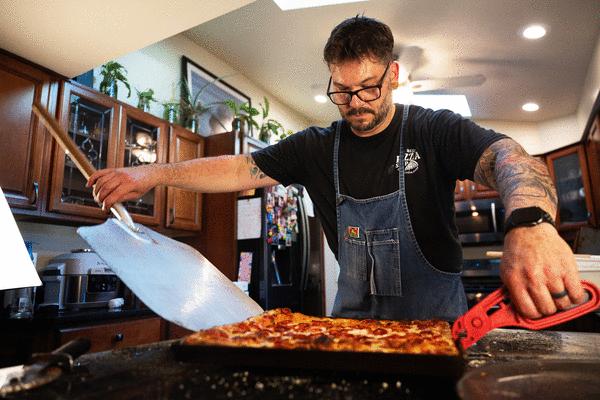
Pizzas are available in thin crust or thick — Sicilianesque “Grandma” style with a crust that rises all day in the pan “with a lot of oil.” Fans can choose between regular, pepperoni or, in a somewhat unusual twist, topped with his family’s recipe for vodka sauce. If asked, he’ll also make a gluten-free pie using one-for-one King Arthur GF flour.
Much of Wisinski’s success lies in his ability to make a great crust. A long fermentation allows for deeper flavor, better browning and an airy yet chewy texture — pizza that tastes like a slice of cheesy, tomatoey heaven.
At a time when many are hurting, pizza lovers also appreciate the charitable aspect of Pizza Tuesday.
“My philosophy is simple,” he says. “Pizza is just an excuse to love people.”
Grabbing a slice
As he aptly demonstrated on a recent Tuesday, Wisinski has his process down to a science.
Everything is neatly lined up on the kitchen counter when he ties on his apron at around 4 p.m. — pans of puffy dough, plastic containers of vodka and red sauces, piles of sliced pepperoni and grated pecorino Romano and shredded and fresh mozzarella cheese. A tall stack of pre-folded pizza boxes marked with pickup time, name and style sit waiting on another counter, and the garage door is cranked open for customers.
A regular pie takes 7-8 minutes, a Grandma 8-10 minutes and a Detroit-style gluten-free pie 10-12 minutes. Because the heat inside the oven goes up or down depending on how many pizzas are being baked, Wisinski often has to move one onto a wire screen set on top of a pizza stone to keep it from burning. But no worries: Alexa help keeps track of the time with polite reminders.
Normally he bakes until around 7:30 p.m. But on this hot and sunny evening, Wisinski wants to catch the first half of his son’s first football scrimmage. So he only accepted 10 orders the previous Friday, which should get him out the door by 6 p.m.
Brian Steffey, who ordered three pizzas for a friend whose husband is currently deployed overseas, is the first to arrive. He’s driven all the way from Bessemer, Lawrence County, to pick them up.
New York-style pies are often tough to find, he says, and since he’s originally from New Jersey, “they’re the type I was raised around.” So when his wife saw Wisinki’s story on social media a while back, well, they were in.
“She said, ‘I think this guy makes the kind of pizza we like,’” Steffey recalls. They’re now repeat customers.
Ironically, he used to live around the corner from Wisinski. “But it’s probably a good thing [that he moved} because if I still lived here, I’d be twice the size,” he jokes.
‘Moody about pizza’
Lauren Ionadi, who went to the same high school as the pizza maker, is the next to walk through the open garage door and break into a smile at the scent of baking pizza. She first heard about it when her brother Anthony, a sergeant in the Center Township police department, shared a post about pizzas Wisinski had donated. She ordered a thin pie with vodka sauce and a red pie with pepperoni.
“I’d be here every week if I could,” she says. “There’s not many places that can give you a thin, crispy crust, and I’m moody about pizza.”
What’s especially great about his handiwork, she adds, is that the pepperoni is “the good kind that puffs up” and forms a crispy, grease-trapping cup when it’s baked. A Grandma pie is on her bucket list.
Joe Campbell, who grew up in Chippewa but now lives in Denver, picked up the last of the night’s orders. In town to visit his parents, he’d seen Wisinski’s posts and thinking the pizza looked incredible, became a follower. When he learned he was going to be in town on a Tuesday, he reached out “and he squeezed me in” for two pies.
“And I couldn’t be more excited. He took care of me. I’m a fan for life.”
Turning his small suburban home into a commercial pizzeria each week, Wisinski says, is as taxing as it is messy. So he makes sure everyone is out so he can “trash the house making pizza all night.”
While his charitable work is important, Wisinski also hopes to inspire other wannabe pizza makers to follow in his footsteps by sharing all of his recipes and hands-on experiences on YouTube.
“I’m trying to build a pizza learning platform,” he says. “There are no secrets.”
He was just accepted into Ooni Pizza Oven’s affiliate program, and hopes it will help him build a new career.
“I burned a lot of pizzas until I figured out Alexa,” he admits with a laugh, sometimes filling the house with smoke. “It’s embarrassing.”
©2026 PG Publishing Co. Visit at post-gazette.com. Distributed by Tribune Content Agency, LLC.






















Comments