I rode around in a Tesla Robotaxi. Here's what I learned
Published in Lifestyles
TAMPA, Fla. — Years from now, it might not be so common to be the one controlling the steering wheel in your own car.
Or at least that’s what Elon Musk thinks.
“Ten years from now probably 90% of all distance driven will be driven by the AI in a self-driving car,” Musk, the Tesla co-founder and CEO, said this May.
Musk’s unmanned vehicles are chauffeuring drivers around in six different cities. One of the latest additions is Tampa.
The cars, which arrived in the city last month, are equipped with cameras that feed information into AI-based software, allowing them to operate without a human driver.
They are available within a specific grid of the city, covering areas of West Tampa, Tampa Heights and Egypt Lake. Passengers can hail a ride through the Robotaxi app.
I decided to put Musk’s thinking to the test: Will these cars become as commonplace as he says? Or is it best to stick to human hands on the steering wheel?
Here’s what I learned from my first ride in a Robotaxi.
The wait
First, I needed to be in the Robotaxi’s area of operation, so I made my way to Armature Works in Tampa Heights, where I planned to have the car pick me up.
If you try to order outside the grid the cars operate in, you’ll be shown a map in the app and a notice that you’re too far out of reach.
I logged on to the app to order my ride, ready to take the term “passenger princess” to a whole new level.
Tesla had different plans for me. “High service demand,” a simple message taunted me on the screen for nearly two and a half hours, providing no information on when a ride would be available or how much longer I may be waiting.
It may have been a good thing after all, I thought to myself as I watched the rain pour down that Thursday afternoon. Tesla’s vehicles operate on a camera-only approach that feeds into AI-based software, which might be a challenge in extreme weather, such as rain or fog, one expert told me.
I gave it another shot about two weeks later. Even before checking the app, I felt more optimistic: The sun shone brightly, and no rain clouds were in sight.
I returned to the app to order a ride, and it was almost instantaneous.
“A ride can arrive in 7 min,” read the message. Hallelujah.
The car
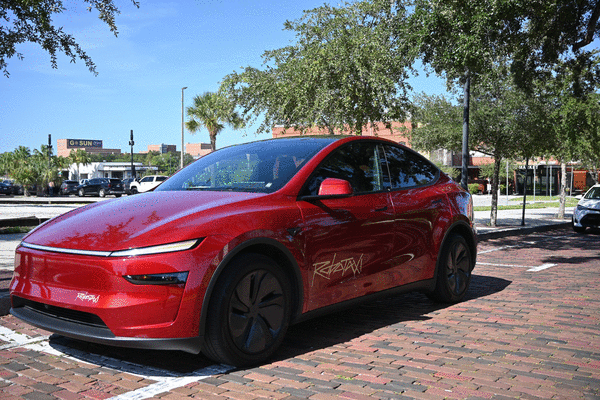
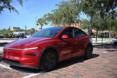
The hot-red car rolled up the street. Besides the “Robotaxi” gold decal on its side, one might not be able to tell that it functions without a driver.
There are no bulging sensors on the hood or roof. Instead, there are well-hidden cameras on the bumper and near the doors. There are brakes, pedals and a steering wheel, much like any other car.
The hazard lights flashed at me as I rounded the Tesla, inspecting it. Robotaxis allow for a 7-minute grace period as the vehicle awaits its rider before leaving you in the lurch.
“Welcome, Camila,” the screen read as I stepped inside.
I sat in the backseat and buckled in. I clicked the “start ride” button on the screen, and we were off.
The ride
I set the drop-off location for Trip’s Diner on North Florida Avenue, a relatively easy 12-minute drive from Armature Works that cost $9.44.
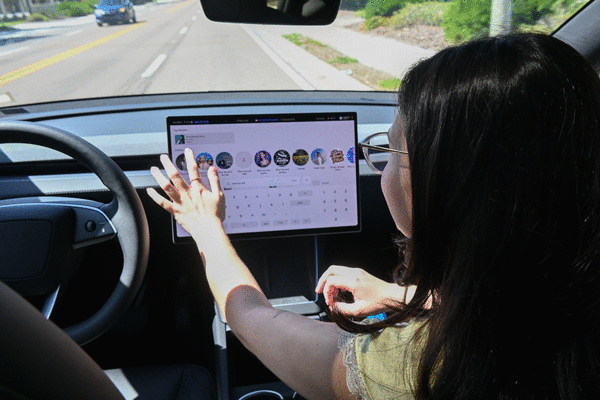
The vehicle allows you to control the air conditioning and play your own music, but I was so consumed with the ride that it slipped my mind.
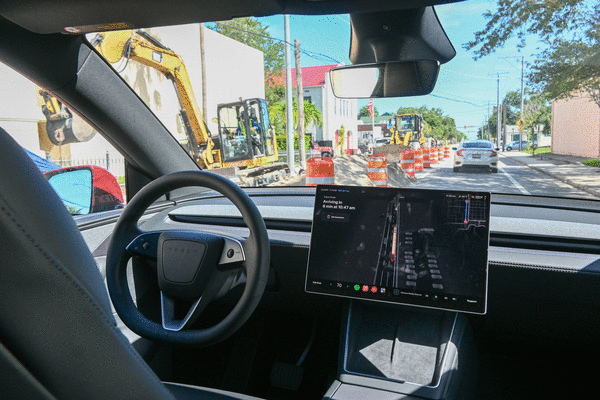
I watched as the steering wheel eased itself into making a turn. I counted the seconds as the car rolled up to a stop sign. Exactly five seconds.
I waited with bated breath as the car neared another vehicle at a red light.
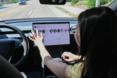
A screen in the middle of dashboard shows the GPS route the car takes, adding in small icons of other cars, bikers and pedestrians, which is standard in human-driven Teslas, too.
When I heard a loud honk at one intersection, I looked back wondering if the Tesla had committed an infraction. But no, a manned car had driven into the wrong lane.
The Tesla weaved through road closures and traffic barrels with ease. The suspense at every turn felt a little like being on a roller-coaster.
Before we made it our destination, I conducted my own experiments.
What would happen if I took off my seatbelt? A beeping alarm told me to buckle back in or the car would pull over.
What if I opened the car door at a red light? The car will only move once the doors are closed again.
What if I tried turning on the windshield wipers? The screen warned me not to touch the steering wheel.
What if I asked the car to stop the ride? The vehicle will guide itself into a safe place to pull over and call a support agent if I don’t resume the ride. When I heard a human voice over the speakers, I sheepishly asked to just resume the drive.
The car dropped me off safely at Trip’s Diner. I later ordered another Robotaxi to take me back to Armature Works.
Experiments need to be replicated in order to reach a scientific conclusion, I thought to myself. This time, I sat in the front seat of the jet-black car. The ride back cost $10.99.
With the novelty of the drive wearing off, I remembered I could play my own music. Rihanna’s “Shut Up and Drive” seemed like a fitting choice, followed by Charli XCX’s “Vroom Vroom” and Daddy Yankee’s “Gasolina.”
The conclusion
Wait time and safety — those are the factors I weigh the most as I think back on my rides.
My drive was uneventful, but videos of unmanned vehicles driving into construction zones or blocking each other on the streets are easy to find online. Was my boring and safe ride the norm or just a fluke?
At the same time, as a woman who is hyperaware of every report of a rideshare driver assaulting a female passenger, there was a sense of assurance in the self-driving car. The Robotaxi has no ulterior motives, just a task to finish.
There’s also the two-and-half-hour elephant in the room. An Uber or Lyft will tell me how long I may need to wait during a high-demand period. A Tesla Robotaxi doesn’t grant me the same courtesy in the app.
So, what am I willing to put myself at the mercy of: a stranger or AI-based software? It might take a few more rides to figure out.
©2026 Tampa Bay Times. Visit at tampabay.com. Distributed by Tribune Content Agency, LLC.
















Comments