Heidi Stevens: It's tempting to shrug off ex-NBA players trying to join the WNBA. But division and discord are the last things this debate needs.
Published in Lifestyles
I don’t consider myself an acolyte of “Let Them,” a theory popularized by self-help guru Mel Robbins that invites you to protect your own peace by letting other people behave however obtusely they’d like — no skin off your back.
It’s a little reductive for my taste. A little conflict-avoidant. Healthy, probably, at times. Bordering on emotionally lazy at others.
But darn if I haven’t found myself muttering “let them” every time I read a story about the former NBA players demanding to be eligible for the WNBA.
They want to fight for inclusion in a league where fewer than half the teams have their own practice facilities? Let them.
They want to demand eligibility for a draft where the No. 1 pick made a base salary of $500,000 this year? Let them. Compared to the NBA, where this year’s first overall pick will make $69 million across four years? Let them.
They want to play on a court where players have to duck sex toys being tossed at their feet? Let them.
They want to use their time and talents to fan the flames of a culture war? Let them.
They want to help contribute to some of the WNBA’s best ratings in 30 years? Let them.
But I realize it’s not that simple. (More on that in a second.)
First, backing up: Former NBA players Enes Kanter Freedom and Royce White have spent the last couple of weeks publicly demanding inclusion in the 2027 WNBA draft, which takes place next spring. Their inspiration appears to be a roiling debate over the WNBA’s inclusion of transgender athletes. Although, to be clear, no known transgender woman has ever played in the WNBA and no transgender woman is attempting to join the league.
Unless you count White, who recently told Fox News, “I’m a woman. I identify as sometimes identifying as a woman for purposes of basketball.”
White, who recently lost Minnesota’s Republican primary for the U.S. Senate, says he’ll take legal action if he’s denied eligibility.
Freedom, meanwhile, has filed paperwork to enter the WBNA draft and says he knows other ex-NBA players who plan to join him.
“If simply declaring who you are is all that’s required, then I meet every single requirement necessary to compete in the WNBA,” Enes Freedom wrote on X Aug. 7. “My team and I have carefully examined the WNBA’s eligibility criteria and governing framework surrounding self-identification and inclusion.”
Why is any of this an issue in the first place?
The WNBA doesn’t have a policy governing eligibility of transgender athletes. The most recent collective bargaining agreement simply states that “only players who are women are eligible to play in the WNBA.”
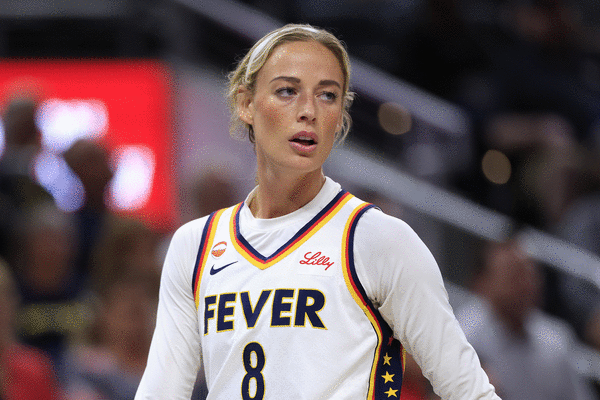
But Indiana Fever guard Sophie Cunningham — one of the WNBA’s biggest stars — recently told ESPN that she supports barring transgender girls and women from girls’ and women’s sports, saying “biological men” shouldn’t compete against women. Her comments sparked some backlash, with demonstrators staging rallies in support of transgender rights outside Fever games.
And because transgender athletes, like all transgender individuals, tend to be treated more like scapegoats and political pawns than humans, a culture war was born.
A WNBA task force, made up of team presidents and general managers, met to discuss the issue a few days after White and Freedom declared their intent to play in the league. They didn’t arrive at new eligibility rules, but they did release the following statement.
"Today’s meeting covered a wide range of topics, including ongoing discussions on transgender athletes and the continued hate and vitriol directed at players online. We will continue to engage all league stakeholders in the coming weeks and months. We will approach these important conversations thoughtfully and in alignment with the values of our league.
Maybe these are important conversations. And maybe they wouldn’t be happening without some of the antics of the past couple of weeks. Maybe “let them” has its place in this particular instance.
But the statement continued:
“There are no immediate eligibility matters affecting the WNBA and we strongly denounce the bad-faith efforts to use these topics to demean or marginalize others."
And it’s the demeaning and the marginalizing that matters here. It’s the demeaning and the marginalizing that makes this more consequential than a shrug-off-the-stunts situation.
Because the more our conversations around transgender athletes and transgender rights are filled with red herrings and misplaced grievances, the less we’re talking about what truly deserves our attention.
Like the fact that about 26% of transgender students attempt suicide every year, according to the Centers for Disease Control. And roughly 40% face bullying at school. And transgender youth report higher rates of housing instability and homelessness. And transgender people are four times more likely than cisgender people to be victims of violent crime.
And as long as we’re mostly talking about transgender people as some kind of sinister threat to women’s sports, rather than a community of humans deserving of dignity and rights and understanding, we’re missing the point.
Which is that pitting us against one another might win an election or a culture war or, I suppose, a WNBA contract, but it will never take us in a better, healthier, safer, kinder, more inclusive, more inventive, more just, more equal direction.
If it’s a victory, it’s a hollow one.
©2026 Tribune News Service. Distributed by Tribune Content Agency, LLC.






















Comments