Heidi Stevens: Message received: Visit is proof that card-writing campaign matters
Published in Lifestyles
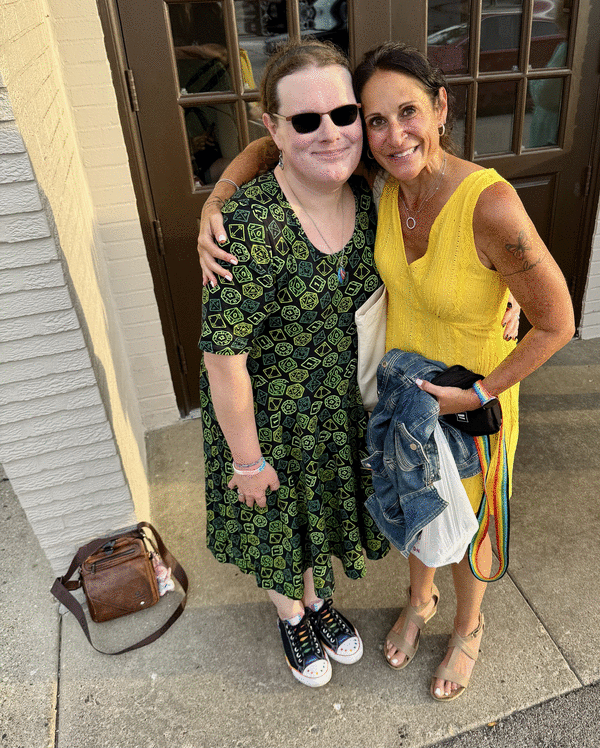
It was a Thursday afternoon in early July, and Carolyn Pinta was home alone when she heard a knock on the door. She hesitated before she answered, unsure about her unexpected guest’s intentions.
The intentions, it turns out, were lovely.
Standing at Pinta’s front door was Katie Benn, an air defense officer in the U.S. Army. Benn was visiting Chicago and decided to track down the Pinta Pride Project headquarters in nearby Buffalo Grove using the return address on dozens of postcards and holiday cards and other missives she’d been receiving, reminding her she’s loved and supported and worthy of both.
Benn, who has served in the Army for 13 years, is transgender. When President Donald Trump ordered a ban on trans service members, Benn was placed on administrative absence and hasn’t returned to duty.
“The Army has been my family since I first enlisted,” Benn told me.
Being separated from them plunged her into a dark period, she said. At points, she considered suicide.
Cards from strangers convinced her otherwise.
Those cards originated with Pinta, who launched a campaign in 2022 to send holiday cards to people in the LGBTQ+ community who’ve been shunned by their families. Pinta hosted card-writing parties and spread the word on social media and through my columns and, all told, sent out around 2,100 cards that year.
Four years later, the campaign has gone global, with folks sending and receiving cards in all 50 states and a handful of countries.
“People start reaching out, I’m not kidding you, in August,” Pinta told me last December. “‘Are you doing that card-writing thing again? I want to participate.’”
Companies across the country host card-writing days. Alpha Phi sorority at Miami University in Ohio gathered to write dozens of cards. Families weave card-writing into their Thanksgiving celebrations and text Pinta the photos.
Folks who receive the cards also send Pinta photos — of their tables covered in cards, their refrigerators covered in cards, their mailboxes stuffed with cards.
Benn’s cards arrived at a critical time. So she went looking for Pinta to tell her.
“I wanted to assure her that there were real humans on the other end receiving these messages, and that the effort was greatly appreciated,” Benn said. “ I didn't want her to think that she was sending these letters off into the void to no effect. I'm obviously only speaking from my personal experience, but she touched at least my life in a meaningful way.”
Pinta and her husband, Bob, treated Benn to dinner that night.
“It’s very easy for people to be pessimistic,” Benn told me. “It’s very easy for people to be jaded. And sometimes we forget the simplicity of reaching out to other human beings. There is real power at looking at someone who feels unloved and telling them, ‘You are loved.’”
Benn made clear that her opinions don’t represent the Department of Defense or the U.S. Army. She’s speaking as an individual, she clarified. But she’s speaking from experience.
“I’ve been to many different places in the world and seen many different situations,” she said. “And every single person I’ve met, no matter their language or background, they want to feel connected to another human being. I don’t think we should ever sell that short.”
Before they went to dinner, Pinta called me to tell me about Benn. I’ve written about the card campaign every year since the beginning, and Pinta wanted me to know the impact.
But I’m just writing a column. You all, so many of you, are writing the cards. You took Pinta’s audacious idea and turned it into something life-changing. You saved lives.
“For a lot of us,” Benn told me, “we’ve been disconnected from our birth families for various reasons. I had found comfort with my Army family, so this experience the last year of being separated from them made me feel alone for a very, very long time.”
Which is exactly what Pinta set out to solve.
“This project helps people like myself, like others, know that someone out there is willing to put pen to paper and tell you you’re loved,” she said. “And there’s power in that.”
Benn keeps the letters and cards she’s received in a drawer in her kitchen.
“I open that drawer and read one or two of them whenever I'm struggling,” she said. “I'm thankful for every person that has sent me a letter to fill that drawer with.”
I am too.
©2026 Tribune News Service. Distributed by Tribune Content Agency, LLC.















Comments