The Kid Whisperer: How to teach your kid about the world through rough and tumble play
Published in Lifestyles
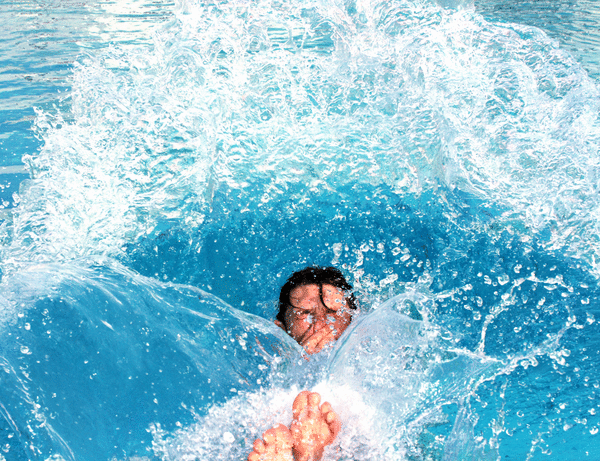
I was recently, and mercifully, on vacation.
The hotel pool was packed with people, many of whom had their children of all ages in the pool with them. Teenagers threw footballs, toddlers were swimming with floaties, and kids were swimming and jumping into the pool
I was the only parent in the pool wrestling with his kid.
My daughter and I have been doing this in some form or fashion since she was very small. After she learned to swim, these matches continued in the pool.
I couldn’t help but notice that several parents looked at us askance: I’ve found this reaction to be common, but it always surprises me. Maybe it’s because we play so roughly.
Why do I play so rough with my daughter?
Because it’s extremely fun
Because it’s good for her
Because it’s good for us
Wrestling with your kids, by land or by sea, is so good for their development. Interestingly, this is done by all mammals: wolves, sea lions, rodents, tigers and lions will all play-fight with their offspring. They do it for the same reasons that it’s important for humans to do so with their offspring: It has physical benefits of developing coordination and increasing strength.
There are other non-physical benefits for both non-human and human mammals alike, but since you, dear reader, are probably human, let’s concentrate on those.
We’ve evolved to do rough and tumble play with our offspring, and I, like you, if you have kids, started doing it when my daughter was an infant. It started by squeezing and hugging and grabbing her to make her laugh. I, like you, never had to be told to do this. We do it naturally because we were born to do it: We have evolved to instinctively bond with our kids in this way. It says to your kid: I am strong. You are safe. I am nice. You are strong enough to withstand me grabbing your little feet. I love you.
As kids get older and bigger and stronger, we move into more physically strenuous play as the learning continues: Kids learn how to be physically aggressive within the boundaries set by the participants. This includes rough, and sometimes, as kids get bigger, very rough play. When playing in a pool, I slam my daughter into the water. This lets her know that I think that she’s tough, which improves her relationship with me, and it maybe makes her realize that she’s tougher than she thought, which improves her relationship with the world.
When the aggression really hurts, or is potentially dangerous, participants let each other know with a calm explanation, and the play is adjusted to make the play still sufficiently strenuous and fun, while being adjusted to make the play safer:
Oh, not so hard please.
Ooh, no contact to the face.
Ouch, be careful not to touch my earrings.
If anyone wants to stop, we stop.
Play itself is the primary way kids learn about how to properly interact with the world. Parent-kid rough and tumble play teaches kids to play games as positive, pro-social game-players. This leads them to playing games properly when they start playing with peers. Learning continues further as kids set up rules in their peer groups, without the help of adults, that need to be followed, so the games can be and remain fun. This includes but is not limited to rough-and-tumble peer play. It also includes playing house, or role-playing with dolls and action figures: Playing competitively and playing cooperatively require the same level of cooperation, because both involve mutual agreement upon rules and the following those rules.
Just as soccer players mutually agree not to pick up the ball and run with it, everyone playing action figures must agree that Hulk can smash as long as he’s not Bruce Banner at the time and that Superman can fly as long as he has not been exposed to Kryptonite. Rules and the application of those rules must be discussed and negotiated in ways that don’t cause bigger problems. This process can also be described as “Learning How to Be a Person."
If kids learn how to properly play games, people will invite them to play other games. People who are invited to play games will have more friends and more cool experiences. I don’t know about you, but I want my daughter to be invited to play lots of games.
I just hope that she never gets tired of wrestling with her dad.
©2026 Tribune Content Agency, LLC.




















Comments