Column: How I changed my mind about pickleball
Published in Lifestyles
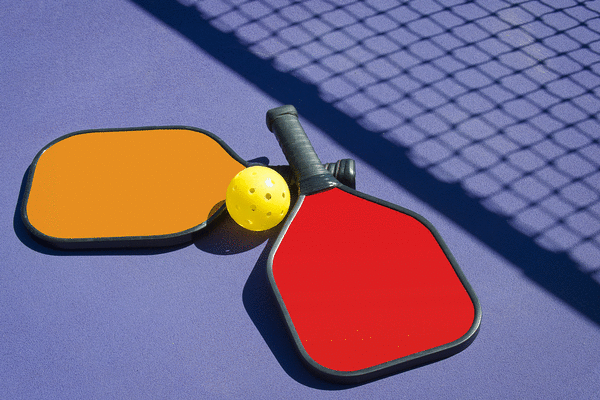
When my husband announced three years ago that he had started playing pickleball, I asked if he was hoping to boost his popularity in a future retirement village.
He took my teasing in stride and informed me that the sport wasn’t just for old people. I knew pickleball had exploded in popularity during the pandemic when people were desperate for outdoor activities, but calling it a “sport” seemed a bridge too far.
My husband, who tore his ACL in his 20s playing a pickup game of basketball, had to get a knee replacement six years ago. He said the smaller pickleball court, less than half the size of a tennis court, made it easier to get around and hit the ball. Plus, he and his friends could banter and trash-talk one another while playing.
This explanation solidified in my mind that this was more like a fun social activity, like shuffleboard, rather than a proper sport. For the uninitiated, pickleball players use a wide paddle similar to a table tennis paddle and a perforated plastic ball, like a Wiffle ball, that they volley over a lowered net.
An estimated 24.3 million Americans played pickleball last year. It’s been the country’s fastest-growing sport for several consecutive years. I’m not an athlete by any stretch, but I’ve been an enthusiastic spectator my entire life, so I think I have a good idea of what counts as a legitimate sport.
If the activity has pickle in its name and requires a Wiffle ball, that seems more like a leisurely pastime than an Olympic event.
Then, I had an unexpected encounter.
During a recent visit to the gym, I met Walter, a pickleball instructor. He persuaded me to try a free private lesson. I persuaded my athletic 20-year-old niece to join me. Walter taught us the rules and practiced the serves before matching us with another newbie pair.
Let’s just say my competitive streak surfaced on the court. We lost — barely.
I posted a selfie and a message in the family group chat: It turns out someone is a natural pickleball talent.
My husband immediately responded: “Someone I know used to ridicule it.”
Touche.
Perhaps the country, and the world at large, would be a better place if more of us can admit when we are wrong. I had made a judgment based on limited information and a preconceived bias. After I met someone who offered me a firsthand encounter, and I had a positive experience, I changed my initial views.
Being told a thing can be a certain way is entirely different from discovering it by one’s self. I suppose that’s why research shows that people who live in more diverse communities exhibit lower levels of implicit racial bias and prejudice compared to those in highly segregated areas.
The contact hypothesis in social psychology suggests that having meaningful, positive interactions with people from different ethnic backgrounds helps to reduce stereotypes and builds mutual understanding.
Now, the stakes are much lower when admitting that I was hasty in my judgment about a sport versus admitting I may harbor other biases. I was curious what the only athlete in our family thought about this issue.
I asked my son, who played varsity tennis throughout high school, if he considered pickleball a sport. He described it as a “fun and good activity,” like a watered-down version of tennis.
“It’s the same way that flag football is a fun activity, but not a sport compared to football,” he explained. Now, this familiar argument, which I may have once agreed with, sounded a little snobby to me.
My husband said he may have given a similar response if I had asked him in his 20s or 30s.
“After 40, I think it’s legit,” he said.
It’s common for one’s beliefs to evolve over time and with age. Maybe it’s maturity. Or maybe it's a degree of empathy we gain as we realize a smaller court doesn’t mean the movements are any less demanding.
Meanwhile, my niece and I bought coordinating outfits and have another lesson scheduled.
I was wrong about you, pickleball.
©2026 STLtoday.com. Distributed by Tribune Content Agency, LLC.

















Comments