Exhibit of paintings features the legacies of the porters and maids who worked the railroads
Published in Lifestyles

CHICAGO — When the painter Shane-Jahi Jackson was researching the employment records of Pullman porters and maids during his time as an artist-in-residence at the Newberry Library, he had no idea he would find a personal connection.
“I got down to the last two boxes, and I came across my family name,” he said. “And I know it was my family name — Vantrece — because it’s a Dutch name and traditionally spelled with an ‘s,’ but ours is spelled with a ‘c.’ The way we got it was through slavery; at some point, the white side of the family started spelling it with an ‘s’ and had us spell it with a ‘c,’ and that’s how I knew it was us.”
Jackson learned that his great-great-grandfather on his maternal side worked as a Pullman Porter from 1945 to 1950.
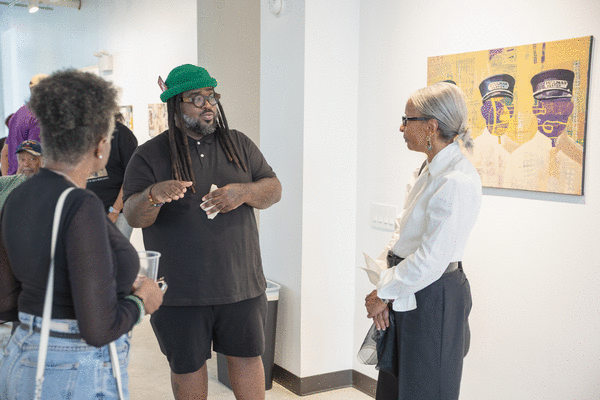
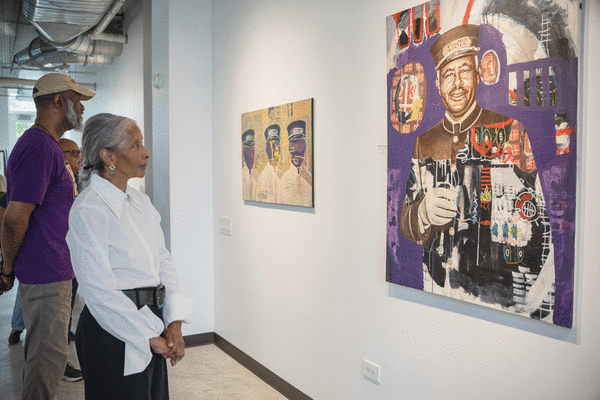
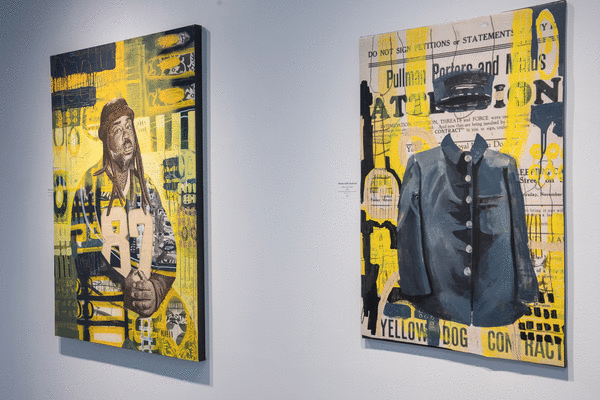
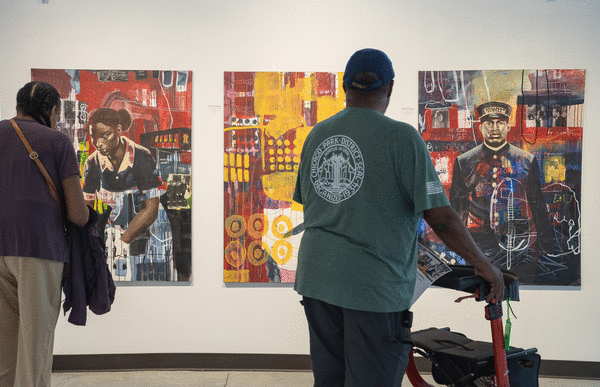
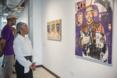
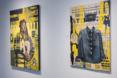
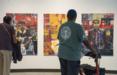
The paintings Jackson ultimately made as a result of his time at the Newberry are on exhibit at Block House Gallery — in Pullman, fittingly — in a show called “Pullman Porters & Maids: Invisible Labor, Visible Legacies.” A mix of portraiture and collage, they restore the humanity of workers who were commonly dehumanized by both employers and passengers alike.
After the Civil War and through the mid-to-late-20th century, Black men were hired as sleeper car porters on the Pullman railroad line to carry luggage, shine shoes and service any other passenger needs. Pay was low. But porters were able to supplement their wages with tips, which helped propel their families toward the middle class.
“When it started, these men were freed slaves and sharecroppers, they never had anything of their own,” said Jackson. “So this was the first time they were able to stand on their own two feet, buy their own house, send their kid to get an education.”
Even though so much of the job entailed the performance of subservience, “at least you were going to get paid for it.”
Jackson began his residency at the Newberry in search of “people who were overlooked. The whole thing with Pullman porters is they weren’t called by their names, they were all called George, so that erases your identity. And what I wanted to do was shed light on the identities of the people who worked for the Pullman Company.”
There’s comparatively less information about Pullman maids, he said, who not only cleaned the train compartments, but provided beauty services and childcare.
“Free babysitting during your train ride.” And yet, most of the records he found pertained to the male employees. “I found maybe six pictures of Pullman maids versus countless Pullman porters. They stood in the shadow of the men who worked there, but they were also present and I wanted to pay homage to them.”
Many of the paintings include a portrait of a Pullman porter or a maid surrounded by splashes of color and fragments of archival documents — newspaper clippings, timesheets, employee records. In one, four porters stand side-by-side, their faces a blur, and a snippet of a newspaper headline reads: “Men want more pay.” The four men are framed by brushstrokes that evoke railroad tracks.
In another, a Pullman maid is bent over, hard at work, with her hair swept back into a ponytail, her gaze pointed downward and focused on the task at hand. To one side are the handwritten words: “For them. For us. For home.”
In yet another, we see a porter’s uniform — jacket and hat — but no person wearing them. The absence is striking. At the bottom, the snippet of a newspaper headline includes the words “yellow dog contract,” referring to the type of now-illegal contract in which a worker agrees to not join or form a union.
“For many years, the stories of Pullman porters and Pullman maids were not given proper due here in the Pullman neighborhood because local historical interpretation was largely focused on the Pullman Company’s factory town and the Pullman strike of 1894, rarely discussing the Black men and women who commuted from elsewhere to work on board Pullman railcars,” said Soren Spicknall, president of Pullman Arts and Block House Gallery.
“It wasn’t until the 1990s that the work of Dr. Lyn Hughes resulted in the opening of the National A. Philip Randolph Pullman Porter Museum, which sought to highlight these latent histories and bring them to proper prominence. Dr. Hughes and Dr. David Peterson Jr. at the APRPPM have worked hard to ensure that the Pullman porters and maids are treated as an essential part of the larger Pullman story, and as a hugely important piece of Black history, labor history and U.S. history.
“Shane-Jahi Jackson’s work responds to many of the same conditions, but through the lens of art.”
Jackson said he “tries to depict the emotions of the person I’m painting. How would their tension show up? Or how would their pride in their job show up? That’s my artistic language with the abstract portions, and then I bring the figure in last, kind of dropping them inside this abstract world I created. I try to give you a buffet to look at. So a lot of what you see is me just trying to convey emotions and words for these people who are silent.”
The story of Pullman porters, he says, is the story of racism in the workplace.
“And being a Black male, I know what the subtle cues are and what certain expressions look like. So I was channeling what I was seeing. I watched maybe 12 documentaries and read the diaries of some Pullman porters and just hearing their frustrations, the blatant disrespect — they would have to grin and bear through it. You were expected to serve these people with a smile. Even if someone were to spit in your face, you couldn’t show that you were upset. So the idea of smiling when you don’t want to smile. Staying composed and poised and denying your feelings. Lying to yourself.”
Because Jackson’s paintings aren’t strictly figurative, how does he know when he’s done? He laughed.
“That’s an ongoing thing with my curator Juelle Daley. She sometimes has to come to the studio and take them from me.”
As he adds more elements, does he ever worry about detracting from what he already has — how does he decide if the painting has become too busy?
“That’s the process. I throw down a lot at one time and then I’ll go back in and take out what doesn’t work. It’s always a give and take. But even with the works that are in the show, I don’t feel like I’m done. It’s very hard for me to say, OK, I like this. And usually if I do feel that way, it’s not a good painting. If I like it, I probably need to work on it more.”
His great-great-grandfather has his own painting, Jackson says.
“This was my way of bringing him into the room. Funny enough, his name was George, so to him that wasn’t a racial slur.”
Jackson noted that his wife pointed out a resemblance Jackson shares with his relative.
“I don’t see it, but she says that. But it felt like I was having a conversation with him in a way, working on that piece.”
As a society, we hold portraiture in high regard. Often, only the most important or the wealthiest among us get their portraits painted. Jackson’s work challenges this notion, giving the Pullman porters and maids their own carefully painted and thought-out portraits.
“I was looking for people who probably wouldn’t be your first pick to paint a portrait of. Just everyday people.”
The story of Pullman porters, he said, is important because “it was an occupation, but it happened during Jim Crow, so it was basically racism in a pretty uniform.”
____
If you go
“Pullman Porters & Maids: Invisible Labor, Visible Legacies” continues through July 11 at the Block House Gallery, 11137 S. Langley Ave.; www.pullmanarts.org
©2026 Chicago Tribune. Visit at chicagotribune.com. Distributed by Tribune Content Agency, LLC.


















Comments