For these controversial influencers, online fame draws fervent love and hate
Published in Lifestyles
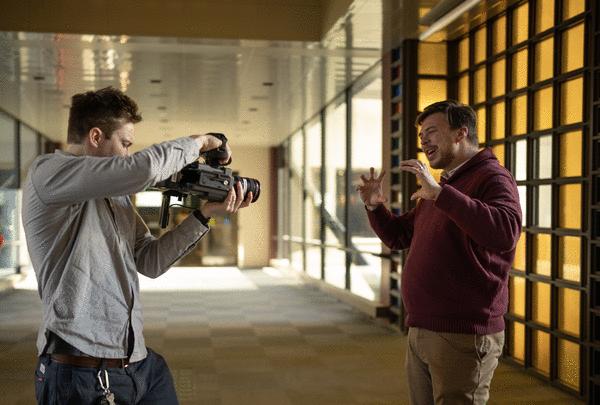
MINNEAPOLIS — Three Minnesota influencers recently experienced the fickle nature of internet fame. One day, they were garnering lots of likes. The next, they were crushed under a digital dogpile.
John O’Sullivan, Josh Liljenquist and so-called “Minnesota Angry Man” Chris Ostroushko each established their fandom in very different ways: as a virtual tour guide, a self-appointed do-gooder and an unlikely anti-ICE activist, respectively.
For O’Sullivan and Liljenquist, social media has become a career; O’Sullivan by hosting “One Minute Tours” of the Twin Cities and Liljenquist by filming himself surprising downtrodden people with free food, supplies and cash. Ostroushko’s internet celebrity was sudden and less calculated, based on the first-time protester’s rant going viral.
But their recent controversial behavior triggered a tsunami of negative attention.
For Ostroushko, a viral video showed him shoving a conservative reporter, which led to assault charges and a lawsuit. O’Sullivan’s misstep was a tone-deaf explanation for why he’d left Minnesota. And Liljenquist’s ethically questionable practice of burnishing his image by filming vulnerable people drew rebuke from St. Paul Parks staff.
To some degree, all three influencers cut through the digital noise and became famous online by distilling complexity and repeating the message, which appeals to our brains’ desire for coherent explanations, said Peter Gregg, associate professor and chair of the Emerging Media department at the University of St. Thomas.
The psychology of followers’ desire to “know” influencers and feel a sense of belonging also underpins our strong sense of connection, he explained.
“We get that little bit of dopamine, that little bit of happy juice that says, ‘Wow, this person’s really doing great stuff. I can’t wait to see what he does next, because I like him.’ Or ‘I feel like he’s one of us.’ Or ‘I would love to be part of his group,’” Gregg said.
But when influencers wade into controversy, he explained, online audiences are often quick to pass judgment based on few clear facts about what transpired. And when audiences think influencers have behaved badly, online algorithms can amplify the animus — even among followers who were once fans.
Love/hate relationships
Information spreads instantaneously across the internet, and controversial opinions or behavior broadcast on social media tend to generate outsize backlash.
Minneapolis attorney Will Stancil knows this phenomenon all too well, as his prolific Twitter/X/Bluesky posts on politics have made him arguably one of the most harassed guys on the internet. His antagonists have posted instructions for raping Stancil gleaned from Elon Musk’s chatbot, Grok. One has gone so far as to create a satirical, racist cartoon series starring Stancil as its pilloried protagonist.
Even though Stancil hardly shares anything personal online, the sheer volume of people paying attention to his posts has created a cohort fixated on defining the persona of someone they’ve never met. This leads to “an inconceivable number of people yelling at you, picking over your life, insulting you in every possible way,” Stancil said when asked to reflect on the negativity.
He said despite knowing a vitriolic critique was not true, it’s hard not to have your self-image impacted by people telling you you’re a terrible human. “It feels like you have lost control of your own identity,” he said. “It can be, frankly, kind of excruciating.”
For more personality-driven influencers, whose faces are a part of every post, fandom and backlash come in a sightly different shade.
One reason these influencers are so alluring, Gregg says, is that our brains respond to a person’s presence on a screen in nearly the same way as they would if they encountered the person in real life.
For most of our species’ existence, seeing another person, or hearing their voice, meant that they were with us. So our brains interpret a virtual face as if it were one we could reach out and touch — especially when influencers address the camera directly and at a close proximity reserved for family and close friends.
This sense of “intimacy at a distance,” Gregg said, leads viewers to form parasocial relationships, a one-sided bond, where audiences feel kinships with public figures they don’t actually know.
We can form strong parasocial connections with public figures, and even movie characters, Gregg said, when we perceive them as similar to us. Sometimes we identify so strongly with someone we’re watching on a screen, that when they emote, our brains can cause us to respond as if the event happened to us, too.
To Pamela Rutledge, director of the Media Psychology Research Center in Newport Beach, Calif., the way many online influencers interface with audiences makes it easy for fans to form parasocial relationships.
Traditional celebrities, such as athletes or musicians, typically present a rare skill to their audience, which observes them at a distance, she wrote in an email. Whereas online influencers tend to emphasize their similarity and accessibility. They invite viewers into shared emotional experience by simulating intimate conversation or orchestrating “come with me” moments to create a vicarious participation.
“It activates empathy and emotional contagion, which deepens attachment,” she wrote.
Haters gonna hate
What happens after a controversy draws a swarm of new antagonists to condemn an influencer, or leads fans to turn on them?
When an influencer you like behaves in a way you don’t condone, your brain tries to resolve the cognitive dissonance, Gregg said. That can mean rationalizing or making an excuse for the behavior, or changing your perception of them, and acknowledging that they weren’t who you thought they were.
Viewers who don’t know these influencers personally are often quick to draw conclusions from incomplete information and pass judgment based more on vibes than facts.
This tendency, Gregg said, again stems from the way social media distorts how we experience reality. Because curated video clips posted online aren’t occurring in real time, and only include the highlights of what happened, that leaves “slippery spaces for our mind to explain, account for, justify the actions that we see,” Gregg said.
When celebrities fall from grace, Rutledge noted, it provides a sense of emotional relief by confirming no one’s perfect and reducing the discomfort of unfavorable social comparison. “We idealize celebrities and take vicarious pleasure in their success,” she explained. “But we simultaneously resent their privileged status, especially when we perceive them as undeserving.”
Rutlege noted that traditional celebrities’ “job” is their performance, and for influencers it’s the active cultivation of followers. So while celebrities’ bad behavior is seen as a disappointing mistake, because influencers feel like “friends,” it can feel more like a personal betrayal.
Amplifying antagonism
Middle-of-the-road opinions are a rarity on the internet, Gregg noted. It’s a forum for making endorsements and airing grievances. “Nobody really goes onto social media to be like, ‘I’m really ambivalent about this,”’ he said. “It takes a particular type of frustration or enthusiasm.”
And algorithms’ design exploits human nature. When people feel angry, upset or threatened by what they watch on social media, they’re more likely to stay on the platform to comment, watch more videos, share videos or even film and post their own response. These behaviors increase companies’ profits, Gregg noted.
“If we stay engaged in social media through those negative feelings, it’s not surprising that it’s a threat to a media personality, and they would be handled with such hostility.”
©2026 The Minnesota Star Tribune. Visit at startribune.com. Distributed by Tribune Content Agency, LLC.


















Comments