The Kid Whisperer: Behavior management must move out of the Dark Ages
Published in Lifestyles
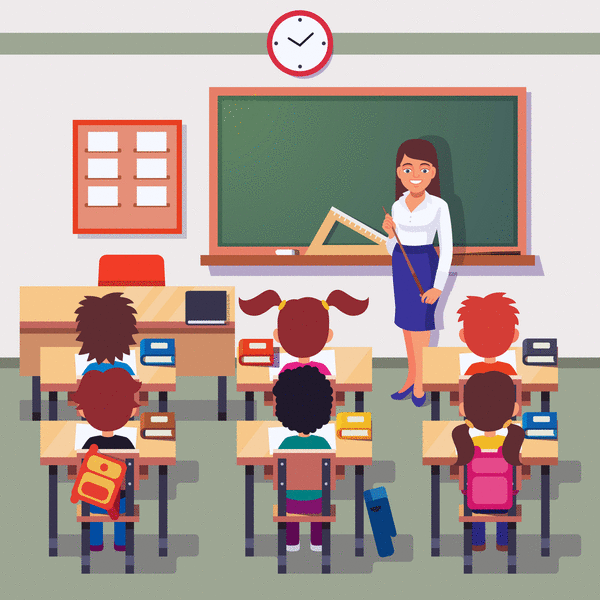
The failure of colleges of education to teach behavior management is creating PK-12 schools that, through no fault of their own, are in chaos. This chaos is leading to schools churning out anti-social people.
Something must be done, and it must be done right now.
Behavior management isn’t something that you can just know about, it’s something you have to be able to do. Teaching is a complicated and difficult profession, but proper behavior management should be seen as more of a trade. Carpentry might be a good analogy. You can’t just know about building a table. To build a table, you must train under a master carpenter who has built many excellent tables. The carpenter shows you the specific and correct ways to build a table, you practice and hone your craft under their tutelage, and eventually you can build a table.
You would not want to learn how to build a table from someone who has merely written a research paper on the effects that nails and screws have on wood, and then have that researcher say to you, “Good luck building a table! You’ll figure it out!”
That would be stupid.
And yet, that’s what we do to teachers when we fail to teach them behavior management in college. Every teacher knows this, and nothing is being done to correct this problem, even though any teacher can tell you that behavior management is the single most important element necessary to teach kids.
To fill this void created by colleges of education, schools have been given the Positive Behavioral Interventions and Supports (PBIS) framework. It is not a program, just a vehicle with the potential for being a fantastic tool for educators to build positive school environments for kids.
Put in the simplest terms, PBIS calls for educators to make sure students who meet expectations get things that other students don’t get. That’s great, because that’s how life works: People who do the right thing and work hard and treat people well and follow the rules do get things that others don’t get.
HOWEVER, that “thing” should not be a reward in the form of a tangible object such as a sticker, a toy or a ticket to be turned in later to get stickers or toys, because that’s NOT how life works.
Giving these rewards is logistically difficult, expensive for the teacher, and insulting for the kid. It also goes against the moral code of a vast majority of teachers. Most teachers believe that kids should not be given tangible prizes for acting like decent people. In addition, it is nearly impossible to hand out enough rewards to create enough reinforcement to correct serious or extremely chronic negative behaviors. Unfortunately, even though most proponents of the PBIS framework (myself included) do not want it to be used this way, this is how PBIS is used in a vast majority of schools and classrooms.
BUT IT DOESN’T NEED TO BE!!!!!
Yes, kids meeting expectations need to get things that others don’t get, but it should not be a tangible reward. They need to “get” what we all get when we do good things: A BETTER LIFE!
The way to do this is for schools to create a constant, unchanging reality whereby kids get what they really want: recognition for positive actions, a feeling of control over their environment, and avoidance of situations that they don’t like. This will vary by grade level, and this list could be nearly endless, but when kids meet expectations, they need to “get”
To line up first
To eat lunch first
To have extra time to socialize
To go to recess first
Verbal recognition (noticed, not praised) at least 100 times per day
To “avoid” their schoolwork by getting it done so that they can do something else that they’d rather do through a procedure called Real-World Workshop
Cool jobs
To do fun activities
To control where they sit
To control who they work with
Doesn’t this all look significantly more reinforcing than just being handed a little piece of paper with a stamp on it? One way looks a lot closer to real life and the other way looks a lot closer to how we train seals.
To create this constant, unchanging reality, teachers need people to show them how to create this who have already created it themselves, the way a carpenter has made many, many tables. Someone who says that they know about behavior management, but who has never done behavior management will not be able to do this.
Educators must be taught how to “do PBIS” in this way with explicit strategy and procedural instruction, taught by master carpenters! Whether or not we can do this will determine whether or not we can produce positive, pro-social citizens who can make our country better instead of worse.
____
©2026 Tribune Content Agency, LLC.

















Comments