Here's How: Gain Storage Space With More Shelving
Dear James: We could use more storage space, so we plan to install shelving on the utility room walls. What are the best types of wood and anchors to use? -- Amber R.
Dear Amber: Selecting the proper anchor is as important as using the proper type of wood or composite shelving materials. To simplify things, you can buy complete kits with the shelving and anchors included, but you still have to determine which is best for your wall type and how much weight they must support.
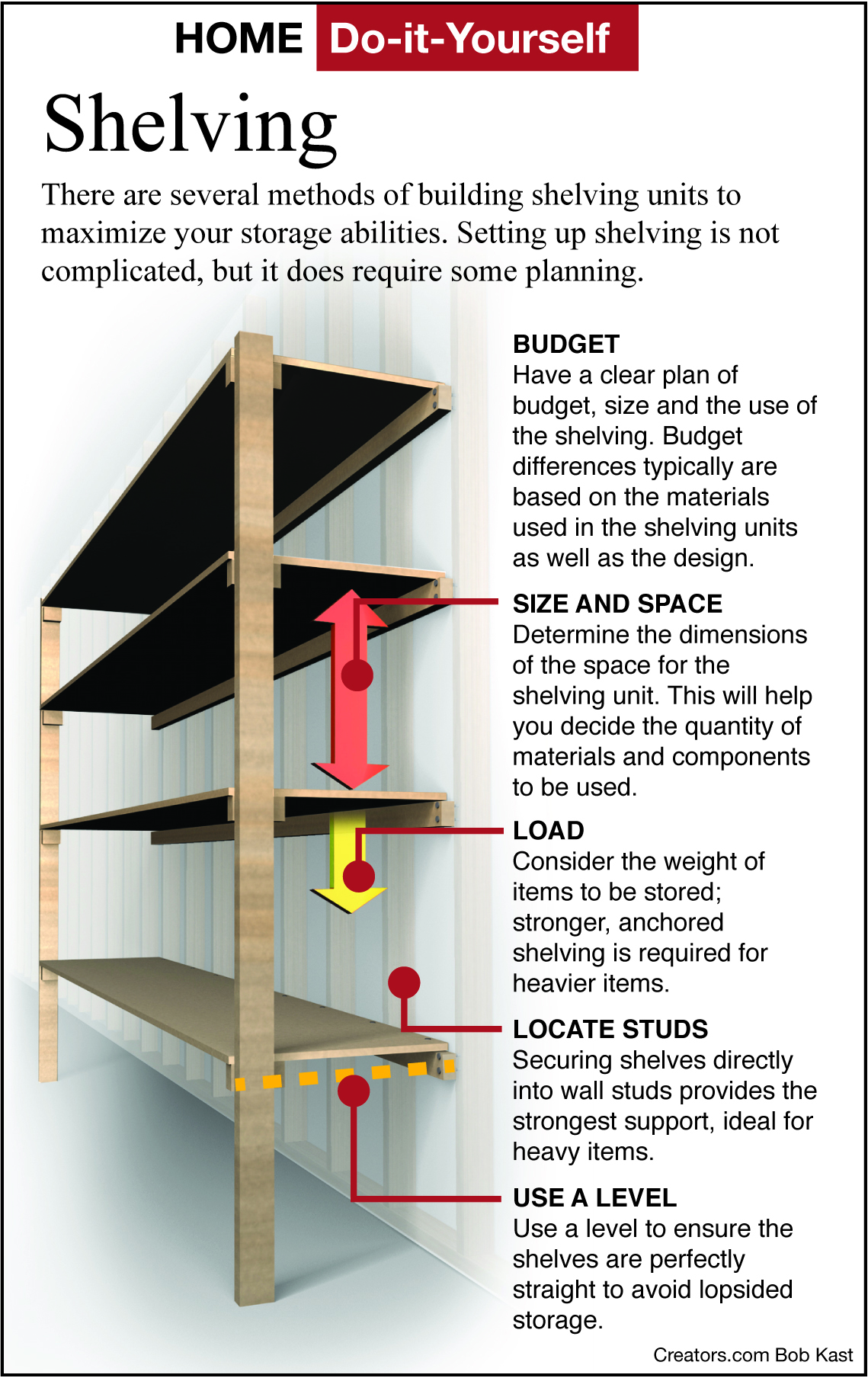
Inspect the utility room wall on which the shelves will be attached. When buying the components individually, there are several factors to consider. The weight of the items to be stored will help you choose the type of shelving, anchors, brackets and fasteners to get, as well as how far apart to install shelf supports. It is generally recommended that supports be installed every 24 inches for heavy loads and 36 inches for lighter loads.
Don't just immediately start drilling holes all over the wall. Take some time to consider what you will store on each shelf and even put some thought in to what you might want to store in the future. Make sure you have a good estimate of the amount of weight that will be stored on each shelf, erring on the heavy side.
Also factor in the type of material the shelf is made of. Oriented strand board or particleboard won't hold up very well in moist conditions, and neither one can handle weight as well as thick plywood can. If you need a material that will perform well in a moist condition, such as a bathroom, choose glass shelves. This type is also fairly easy to keep clean. When using plywood or particleboard shelves, you will probably want to paint them to make them more attractive.
If you are going to install more than one or two shelves, it's a good idea to use vertical tracks. Since the tracks are slotted, you can move the shelves up or down. Many stores sell track systems that will support light, medium and heavy loads. Some light systems are set up to support about 40 pounds per shelf, while a heavy-duty systems can hold hundreds of pounds.
To attach the shelves to drywall, find the studs by using a stud finder or carefully tap the wall with a hammer. You will know you have located a stud when the sound becomes more solid.
If you are installing the shelves on concrete walls, the installation process involves a little more time and work. First, lay out the locations of the holes on the wall, making sure they are level. Having them level will avoid any uneven stress on the shelving system and prevent any items from moving around from simple nearby vibrations.
Drill holes in the wall the same diameter as the anchor; the recommended size can usually be found on the anchor itself. After you have drilled the holes, attach the brackets and put the shelves on.
Hollow concrete walls are much easier to drill and work with. You can use metal shelf anchors for this type of installation. You simply insert the anchor through the hole and tighten it.
========
Send your questions to Here's How, 6906 Royalgreen Dr., Cincinnati, Ohio, 45244 or visit www.dulley.com. To find out more about James Dulley and read features by other Creators Syndicate writers and cartoonists, visit the Creators Syndicate website at www.creators.com.
Copyright 2026 Creators Syndicate Inc.



























Comments