Thousands of miles from the bog: A San Diego researcher's quest for a climate-resilient cranberry
Published in Lifestyles
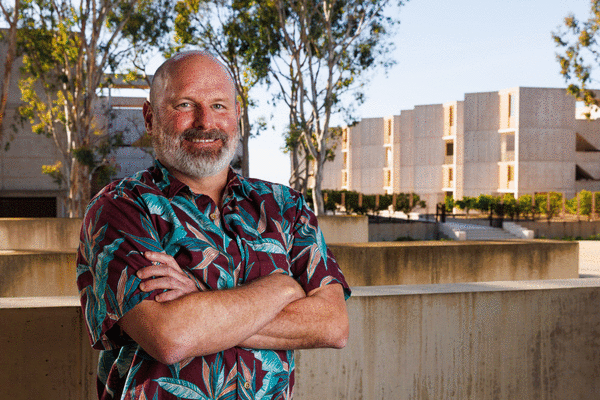
SAN DIEGO -- One of America’s leading experts on cranberries works thousands of miles from the fragile bogs of Wisconsin and New Jersey, in temperate La Jolla. His name is Todd Michael, and for 15 years he has been studying the cranberry.
A few years ago, he asked a question: What if the small but mighty cranberry could be even mightier, resisting the weather variations that are currently harming these plants?
Michael, a research professor at the Salk Institute for Biological Sciences, learned that pests were attacking the fruit and yields were dropping. For years, the cranberry was ranked as America’s second most-produced berry, after the queen of the category, the strawberry, Michael said. Cranberries then dropped to third place, after the blueberry, Michael said. Cranberry production grew between 2001 and 2014 with a two-year dip during the great recession, USDA data shows.
In Wisconsin, growers are facing an unusually small harvest this year, according to Farmer’s Almanac. A USDA report last year showed that production nationwide fluctuated but hovered around an average of almost 8 million barrels.
“It just sort of flattened out,” Michael said, of cranberry production. He suspected this was due to weather changes — both extreme heat and off-season frost — which were disrupting the cranberry’s growth and hurting the plants in the spring, leading to smaller harvests or sickly fruit. This presented a problem he wanted to solve, not just because he loves cranberries and grew up near a cranberry bog, but because he understood how perilous it is for a food source to be vulnerable to climate extremes.
Cranberries are big business, having evolved from a holiday side dish into a year-round ingredient in sweet treats, tart juices and cocktail mixers. Americans consume around 400 million pounds of them a year.
He and a group of colleagues in San Diego and New Jersey set out to try a very old farming technique, but with a cutting-edge twist. Their goal: build a better cranberry.
What’s at stake in their research is not just the future of cranberries, but a deeper understanding of how genetic sequencing and breeding hybrids between cultivated and wild varieties of plants can help farmers build resilient crops of all kinds.
Cranberries part family history
Michael loves eating cranberries, not just studying their genes. He uses their pigment in crafts. And they’re a staple in his kitchen around Thanksgiving.
His interest in the berry started when he was a boy. For at least seven generations, his family has lived in an area in Southern New Jersey laced with cranberry bogs and forests.
“Cranberries were also part of our family history,” he said. “My dad worked as a cranberry picker when he was in high school to earn money, so the crop was connected to both the landscape and the people I grew up around.”
Michael, 53, settled on a career path early. “By seventh grade, I had decided I wanted to sequence plant genomes,” he wrote. Eventually, that brought him to research blueberries and cranberries at nearby Rutgers University. Both fruits are “especially fascinating because they grow in such unusual environments and require very different agricultural practices from most crops,” he wrote.
A conversation with some cranberry breeders opened his eyes to what kinds of problems they were facing and how they were working with wild cranberry relatives to develop heartier plants.
That he ended up working on cranberries from across the U.S. is “a little ironic,” but also “wonderful,” he says. “We can study plants and their evolutionary history from almost anywhere, while working closely with the breeders and growers who know these crops best.”
Combining old with the new
The old farming technique creates a hybrid by crossbreeding a cultivated variety with a wild relative of that plant. The corn Americans consume is based on this technique. So are rice, potatoes, bananas and lettuce, according to the National Institutes of Health. Farmers have long done this to build resilience in their crops. Hybrids pick up useful features from their hearty wild relatives, and genetic variation — drawing DNA from two species instead of just one — helps plants fight diseases and pests.
The cutting-edge twist? Michael and the Salk cranberry team used genetic sequencing.
“Even though people have been using crop wild relatives for millennia, the reality is that it’s only been recently that we can go into these crop wild relatives and actually sequence them to see if they have different genes that might be interesting,” Michael said.
After using genome sequencing to look at the wild cranberry to see if there were genes of interest, they tested the plants — both cultivated and hybrid — by blasting them with hot, cold and hot air and seeing which genes turned on and off. What they found: genes associated with photosynthesis were turned on in the hybrid. Those genes helped boost resistance to cold, and photosynthesis was “enriched” in the hybrids even in cold weather. The hybrids’ photosynthesis was more efficient.
They bred two versions: the mainstream cultivated cranberry and a wild version found in Alaska.
The hybrid was slightly smaller than the cultivated variety and slightly bigger than the wild version. The size is not something people will notice in sauce, juice or in the chewy, scrunched cranberries in their muffins. People who eat them out of the bag or make Christmas tree wreaths might.
While developing hybrids is an old farming tool, Michael said this is the first time an experiment showed that hybrid breeding with a close wild relative, using genetic sequencing as a way to understand the usefulness of specific genes, could work for cranberries.
This doesn’t mean shoppers will see hybrid cranberries in stores next year, he added. It might take 10 to 15 years to develop a hybrid for large-scale agricultural production. On Michael’s to-do list: after deeply studying one wild cranberry, the team is also looking at other wild cranberries to see what kind of hybrid combos could bring out the best genes. And because wild cranberries can have two, four or six genomes, there are many ways to mix and match when breeding two species.
Humans, by the way, have two genomes. Strawberries have eight.
“We hope that we’re sort of up front of the curve of making cranberries for the future,” he said. Maybe they could grow year-round or thrive outside those northern wetlands — in San Diego?
A broader use for this research, Michael said, will be developing more resilient crops overall. Cranberries are just one way to get at that.
“The knowledge of what these wild varieties bring to our table in terms of resilience to new conditions or disease resistance — this is really fundamental to bolster our food system,” he said.
The research team included the Salk Institute, the U.S. Department of Agriculture and the San Diego Botanic Garden. The findings came out earlier this year in Plants People Planet.
©2026 The San Diego Union-Tribune. Visit sandiegouniontribune.com. Distributed by Tribune Content Agency, LLC.























Comments