Immersive theater experience provides Chicagoans with mental-health checkups
Published in Lifestyles


CHICAGO -- Goose Kelly and Grace Hermann sat in a yellow tent squeezed in a hallway.
Hermann, a 27-year-old Wicker Park resident, talked about feeling stressed about her graduate degree and two jobs. And 31-year-old Kelly, of the same neighborhood, said he wanted to stop smoking cigarettes.
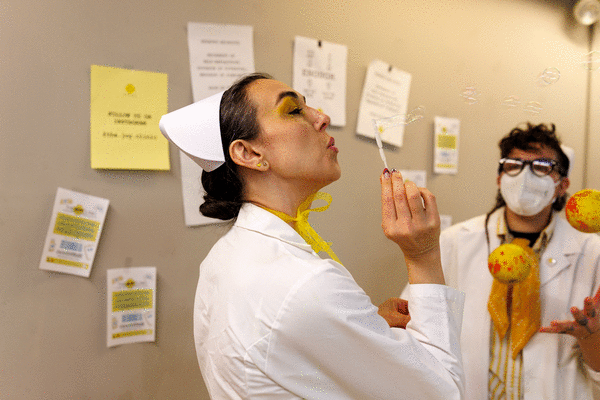
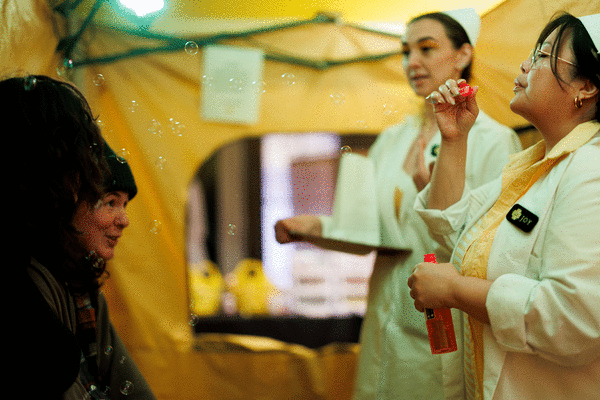
A woman in a nurse’s costume administered their prescriptions. She had the engaged couple read out motivational mantras printed on paper slips and blew bubbles in both of their faces.
“They also gave us a list of resources around the city for mental health care and different things,” Kelly said. “I think at a time like this, where so many people are affected with social media and doomscrolling and everything going on, just having whimsy is important.”
The pair were two of the first participants in Sunday’s “Joy Clinic,” a pop-up art installation that’s been running in Chicago for roughly three years. This time, it was at the Flatiron Arts Building in Wicker Park.
Actors dressed as nurses greeted participants, who filled out forms asking everything from their personal battles to favorite sounds. They then walked to a fabric tent for one-on-one consultations, where the nurses discussed their forms and provided play prescriptions. These included everything from bubble wands to a QR code linking to a recording where Joy Clinic co-creator Nina Castillo-D’Angier narrated a guided meditation.
The last thing attendees received was contact information for mental health resources. While the Joy Clinic’s script was vetted by a licensed clinician, none of the actors were mental health professionals.
“In addition to people coming, just getting a little moment of fun, we also want to make sure that people leave with actual resources,” co-creator Maren Rosenberg said.
Millions of Americans experience seasonal affective disorder, according to the National Institute of Mental Health. Typically surfacing as days get shorter in the late fall, symptoms can include hopeless or anxious feelings, decreased energy and less interest in hobbies.
Roughly 19% of adults in Chicago experience depression, less than the national 22%, according to the Chicago Health Atlas.
Rosenberg and Castillo-D’Angier have been involved in the local immersive theater scene for years. They first put on the Joy Clinic around three years ago after coming up with the idea while out for drinks one night. Since then, they’ve done the clinic across the city, holding an installation at Navy Pier and even getting paid for sessions at Taste of Chicago.
Some of her favorite moments, Rosenberg said, are when people get themselves or others connected with mental health resources after attending the Joy Clinic. She also enjoys seeing how families interact with each other.
“That strong, archetypal, machismo dad is talking about how sometimes, daddy gets scared, too,” Rosenberg said.
The Joy Clinic is free for attendees, receiving funding from the Chicago Department of Cultural Affairs and Special Events and Wicker Park Bucktown Special Service Area #33, a business improvement district.
Castillo-D’Angier said she saw people break into tears while talking about their experiences at the first Joy Clinic. She hopes more people will continue to use the theater experience to gauge whether they could benefit from more extensive mental health treatment. The next session is Nov. 29 at the Flatiron Arts Building, 1579 N. Milwaukee Ave., from 2 p.m. to 4 p.m.
“The whole thing has led, sort of at a surface level, as a pipeline to therapy,” Castillo-D’Angier said. “A lot of people who have come through have never been to a therapist’s office, have never had somebody hold space for you to even be like, ‘Hey, how are you doing?’”
©2026 Chicago Tribune. Visit chicagotribune.com. Distributed by Tribune Content Agency, LLC. ©2026 Chicago Tribune. Visit at chicagotribune.com. Distributed by Tribune Content Agency, LLC.


















Comments