Heidi Stevens: The president doesn't want your pesky questions. But Founders had a different idea for keeping democracy healthy
Published in Lifestyles
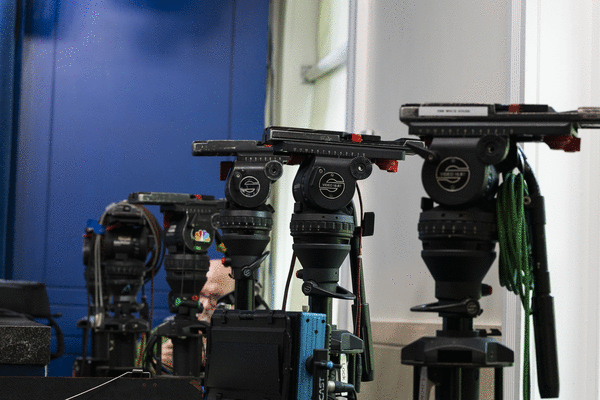
The day after President Donald Trump announced he was banning CNN, Politico and MS Now from the White House, I moderated a panel called “Truth, Trust and Today’s Media,” hosted by the Glenview Public Library and arranged months prior.
The panelists were Brandis Friedman, chief correspondent and anchor of WTTW’s “Chicago Tonight,” and Mark Jacob, former metro editor of the Chicago Tribune and author of Stop the Presses, a weekly newsletter about how the media covers politics. The room was packed with an encouraging mix of folks — high school students on up to retirees — who wanted to talk press freedom, media bias, the newsgathering process and more.
At the end of our 60-minute panel, we held a 30-minute Q&A that could have easily gone longer, had we reserved the space for more time. People were invested in the topic and eager to share their thoughts, and we were eager to hear and discuss them.
In the lobby of Tribune Tower — the former home of the Chicago Tribune newsroom, now home to luxury condos — an Arthur Miller quote sits among the marble wall etchings: “A good newspaper, I suppose, is a nation talking to itself.” Not a bunch of editors talking to themselves. Not a bunch of reporters answering to spinmasters. Not a bunch of columnists monologuing to their readers. A nation. Arguing, problem-solving, gut-checking, fact-checking, talking. To itself.
It was always my favorite of the fancy quotes.
Which brings us back to Glenview. We launched the panel discussion with the news of the White House media ban. I asked Friedman and Jacob what it means for the American public, for American voters, when the press is barred from the White House.
It depends how you view the White House, Jacob said.
If you view it as the people’s house — owned and funded, as it is, by taxpayers, temporarily occupied by the temporary occupant of the Oval Office, a witness and birthplace to American history — then you likely understand the ban to be a violation of your rights. Your right to information, to access, to knowledge, to government transparency, to a truthful reckoning of how your money is being spent and your nation’s power is being wielded.
If, on the other hand, you view the White House as a private club for a specific political party, Jacob said, then you may explain away the ban as a presidential perk. A code of conduct to keep out the riffraff. A secret trapdoor the White House press secretary can trigger when a reporter starts asking meanie-pants questions or refuses to smile. (My words, not Jacob’s.)
“Access to the White House is a privilege — not a right," the Department of Justice argued in response to the lawsuit filed by the three barred media outlets.
Only it is a right, and a constitutionally protected one at that. It’s one of the five core freedoms covered by the First Amendment: freedom of religion, freedom of speech, freedom to assemble, freedom to petition and freedom of the press.
Meaning the press has the right to witness, investigate, criticize, scrutinize and analyze the government’s actions without fear of censorship, retribution or retaliation. Because you have the right to witness, investigate, criticize, scrutinize and analyze the government’s actions without fear of censorship, retribution or retaliation. And the press is you — your eyes, your ears, your questions.
As of this writing, a federal judge blocked the ban and ordered access to be restored for the three outlets. When the Trump administration attempted a similar move in 2018, yanking CNN reporter Jim Acosta’s press credentials, a federal judge also ordered them returned.
Regardless, this is likely not the final salvo in Trump’s attack on press freedoms. He made an estimated $2.2 billion during the first year of his second term, raising questions about how his policies benefit his financial holdings. The Iran war has cost taxpayers $38 billion so far. The Epstein Files are impacting the midterms. Some 27 million Americans don’t have health insurance. The president doesn’t want your eyes, ears or questions anywhere near him, thank you very much.
But the framers had a different approach for keeping democracy alive and well, for the pursuit of life, liberty and happiness. And I think most Americans do too.
The same week I sat in a room full of folks who wanted to talk truth, trust and today’s media, I happened to be part of two more conferences that invited students and writers and educators and innovators and other thought leaders into conversation: The Fast Company Innovation Festival in New York City and, closer to home, an “Emotion and AI” conference sponsored by Northwestern University’s Center for Responsible Tech Policy and Public Dialogue.
The week prior, I was one of thousands of writers and readers who showed up at Printers Row Lit Fest to discuss books and ideas. In between those events, I ran a whole bunch of miles with a whole bunch of runners training for the Chicago Marathon and I dodged a whole bunch of Chicago Bears fans and a whole bunch of Minnesota Vikings fans as they filled my neighborhood’s streets and sidewalks and bars and parking lots for the Bears home opener.
We are a nation that talks to itself. We aren’t going to sit by and let our ideals be usurped, our kids’ world be remade, our own futures be shaped without our input. We gather in conference rooms and classrooms and festivals and stadiums and dive bars and hash stuff out. It’s our nature. It’s our human condition.
At the “Emotion and AI” conference, a student in the audience asked panelist Jonathan Bailey Holland, dean of Northwestern’s Bienen School of Music, how we keep people invested in creating original music when AI can do it so much faster and cheaper than humans can.
Go to a concert, he answered. Go see something live, written by people, performed by people, surrounded by people. It can be a symphony or it can be a sold-out stadium show. The people are the whole point — what they’ve created, what they’re feeling, what they’re witnessing together in that moment. An algorithm can’t do that.
As long as we’re gathering in rooms together, as long as we keep talking to each other, as long as we seek out discourse and dialogue and discord, even, we’re moving in the right direction.
Never in the history of anything has the guy who told you to look away, to mind your own business and let him rule unchecked and unencumbered, been on the right side of humanity.
©2026 Tribune News Service. Distributed by Tribune Content Agency, LLC.


















Comments