Growing smarter farmers: University, neighborhoods localize climate science
Published in Lifestyles
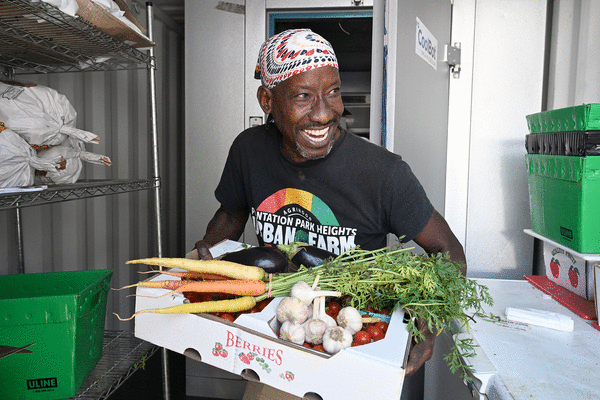
BALTIMORE -- Plantation Park Heights Urban Farm was thriving in Baltimore’s Greenspring neighborhood when researchers from Morgan State University proposed establishing a weather station in its fields.
Farm founder Richard “Farmer Chippy” Francis saw the value of long-term, local weather data. The former biomedical engineer saw a path to improving the farm’s annual crop yield through data-informed farming; yet, his real vision was to grow better young farmers, climate scientists and even entrepreneurs.
“Our mission is to create a new kind of farmer,” Farmer Chippy told The Baltimore Sun. “Now we’ve got children out here doing soil testing, monitoring, accessing the … public server, comparing last year’s rain to this year’s rain so we can plan our planting, rotation and choose our seeds.”
He said growing talent, like crops, takes patience. About 20% of the kids who come to work at Plantation Park Heights stay on, he said, but the results are worth it.
Plantation Park Heights, founded in 2014, is an urban farm sprawling across several blocks in Baltimore’s Greenspring and Central Park Heights neighborhoods, where greenhouses and gardens seem to sprout from every vacant lot. In 2023, it joined researchers from Morgan State, the Johns Hopkins University and five other universities as part of the Baltimore Social-Environmental Collaborative, or BSEC, funded by the U.S. Department of Energy.
Along with other city communities, BSEC helped establish a network of climate stations across historically neglected neighborhoods that are also more heavily impacted by climate change, said James Hunter, associate professor of civil engineering at Morgan State.
“One of the things we understand about Baltimore is, it’s not a homogeneous landscape,” Hunter said. “We certainly have areas that have been impacted by historical redlining. So temperature and climate are felt differently in different neighborhoods.”
Urban heat islands — created by asphalt, dark shingles and impervious surfaces absorbing and holding onto heat from the sun — weigh more heavily on poor neighborhoods with fewer green parks and street trees to provide shade, according to research pioneered by the National Park Service’s Baltimore Field Office.
“In the city, we’re expecting hotter days for a longer stretch of the summer and more heat waves in the future,” Hunter said. “So, how do we get our neighborhoods prepared?”
Giving communities control of their local climate data is part of the answer, he said. It boosts local autonomy and self-reliance while providing researchers a better view of climate’s impacts across the city.
When the project began, researchers found that privately operated weather stations tended to cluster in North Baltimore and southeast of the harbor, while the National Weather Service monitors the region from BWI Marshall Airport.
Since 2023, BSEC institutions have found host communities for 40 small weather stations, mainly in majority-Black neighborhoods in East and West Baltimore.
Each new dot on the map represents a unique collaboration with the local community, said Shamara Collins, a Morgan State research engineer focused on climate science.
While Plantation Park Heights tracks annual rain and weather patterns to increase crop yields, feeding the community directly where supermarkets are scarce, other communities use their weather stations for beekeeping, nonprofit community gardens, or better flood information and prediction.
“We brought in the small businesses that have bees and the weather station scientists to talk about the influence of climate change on their colonies [and] the influence of climate change on your day-to-day life,” Collins said.
Community ownership of the data collection and maintenance of the weather stations is crucial, said Khaliah Young, BSEC community engagement coordinator and a Morgan State alum.
“We brought the researchers together to understand how Baltimore City residents are experiencing climate change. Part of that was understanding their concerns and their experiences,” she said. “What type of opportunities people would want to participate in … and how we could keep them involved throughout the BSEC project.”
Each community nominated a weather champion to take ownership of the weather station and coordinate research and grant projects with the institutions. The champion received extensive training on how to collect, download, analyze and translate weather data, as well as how to turn that information into grant funding opportunities to benefit their community.
At the institutional level, researchers connect the data with city agencies to provide higher-resolution detail on issues like heat, flooding and heat-related health issues.
Temperatures can vary up to 7 degrees between hotter Inner Harbor locations and Baltimore’s cooler outskirts, they found.
Morgan State is also studying how heat affects developing and newborn babies’ weight and health, said Morgan State Ph.D. student DJ Carter.
“There’s also some potential correlation with heat and illicit substance abuse,” Carter said. “The Penn North mass overdose was during a heat wave.”
People are more likely to use illegal drugs and try them for the first time in the summer months, he said. Even prescription medications can raise a person’s core temperature, making them more susceptible to heat waves.
The data is also changing the way researchers look at climate change as well as how they approach community-based research, Carter said.
“This project has given scientists an opportunity of getting reconnected to the communities they work in, he said. “Which I think is something that has been missing from research for a long time.”
Baltimore City uses the data to better coordinate cooling centers, provide services to vulnerable residents and coordinate support for food banks and community gardens, Carter said.
Beyond the city, BSEC is one of four integrated field laboratories established by the Department of Energy to study climate impacts in urban and regional environments, along with Chicago, Southeast Texas and Arizona.
“Baltimore is in a very unique position, being a coastal, urban environment. We relate to a lot of people around the world,” said Samia Kirchner, associate professor of architecture at Morgan State and a BSEC leader. “And so this science, the way that this is being conducted, can now be translated potentially to studying other parts of the planet.”
Back in Greenspring, Farmer Chippy said the improvements they make in their farm improve their neighborhood and Baltimore. Urban farming can turn a dirty, drug-infested neighborhood into a green “agrihood” that not only feeds but can change lives, he said. “Agrihood is a city built on food.”
Providing healthy local produce in an area where so-called “food stores” sell mostly snacks and sugary canned beverages is returning the city to its heritage, he said.
“Baltimore is a farm city. The trees on these streets used to bear fruit,” said farm coworker Tamika Winder, 35, who grew up in the neighborhood. “My great-aunt and great-uncle were one of the first Black families to own their own home on Oswego Avenue in the 1950s. … In the old pictures, there were fruit trees in the median along Park Heights Avenue.”
©2026 The Baltimore Sun. Visit at baltimoresun.com. Distributed by Tribune Content Agency, LLC.
















Comments