Ask Anna: How do I honor my queerness when no one can see it?
Published in Lifestyles
Dear Anna,
I’m a bi/pan woman who’s been married to my husband for 11 years. I’ve always known I wasn’t straight but never explored it much. I had one relationship with a woman early on, and that was it. I’m not looking to open my marriage or date other people. I just want to find ways to honor this part of myself that’s always been there. I’ve come out to my husband and two close friends, but not beyond that. We have kids, complicated family dynamics, and honestly it just feels like more than I want to manage right now. I’ve started reading more queer authors and it’s helped a little. What else can I do? — Quietly Queer
Dear QQ,
Such a good question. I think about a version of it often, though for me it’s less about queerness, even though I am quite straight-passing — my wife and I can be actively making out and people will still ask if we’re sisters. My invisibility is more about being Mexican/Indigenous and white-passing.
The details are different, but the structure is similar: The outside doesn’t match the inside, and you’re the one doing the translation work.
Let me first say the thing that often goes unsaid: bisexual and pansexual people in straight-presenting relationships do invisible labor that most people never have to think about. You don’t get the social recognition. You don’t get the community handed to you. You have to actively seek out and maintain an identity that the world around you is constantly, passively erasing — not out of malice, usually, just out of assumption. It’s exhausting in a specific way, like having to keep explaining yourself to a room that isn’t listening.
And here’s the complicated part. There’s also privilege in that invisibility. People in straight-presenting relationships can often move through the world without facing the same risks or scrutiny that visibly queer people encounter.
Naming that matters. But it doesn’t erase the loss. The privilege and the grief can coexist. Holding such truths side by side is the real work of acceptance.
But it’s not a reason to shrink or feel bad about yourself or guilty for not being “the most gay.” It can, however, be a useful context for why finding your people might take a little more navigation.
So, what you’re feeling isn’t a small thing. It’s not vanity or restlessness. It’s the entirely reasonable desire to be whole in your own life. To be known.
The reading is a great instinct — keep that going. But community is where this really starts to move. Not because you owe anyone a coming-out story, but because being around other queer people, even just as a participant rather than a declared member, has a way of quietly returning you to yourself. Look for bi/pan-specific spaces, online or local — they tend to attract people who understand exactly this flavor of invisibility. You’ll find a lot of people who are partnered, have kids, aren’t out widely and are still figuring out what their queerness means to them in practice.
Beyond that, think about what expression looks like for you specifically, separate from your relationship. Does it live in how you dress? In the art you make or consume? In the conversations you allow yourself to have? In the causes you show up for? Queerness is an identity, not just a behavior, and it gets to take up space in your life in whatever forms feel true.
So if queerness is a part of yourself you want to make room for, what practices help you stay in relationship with that part of yourself?
Some ways you might cultivate that sense of being known:
—Attend queer cultural events even if you don’t feel “queer enough” (I know, it’s awkward, but anything worth doing is initially a little awkward)
—Follow queer creators and writers (This is the part where I awkwardly drop my Insta handle @lezbianna)
—Volunteer with LGBTQ+ organizations
—Build friendships with other queer adults or parents (bonus if it involves a hobby you actually like and would show up for anyway. Pickleball, anyone?)
—Join a queer book club
—Learn about and share queer history
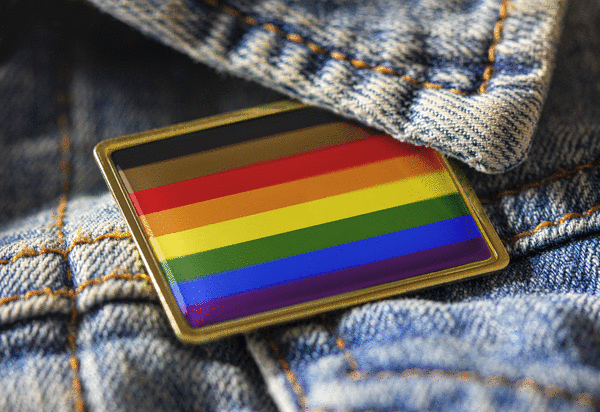
—Display small symbols of your identity if that feels meaningful — a flag, a pin, a sticker, a unicorn journal, etc.
—Talk openly with those you can about this part of yourself (consider how you might discuss this with your kids, too)
—Create rituals around Pride Month — or any time of the year, frankly. Or create your own thing! September is now Bisexuals Ignored Awareness Month (BIAM). We ride at dawn!
—Mentor younger bi/pan people
—Support queer artists (and drop them a nice line if their work impacted you. We always love hearing from you!)
TLDR: You don’t need a megaphone. You don’t need a coming-out party. But you do deserve at least one context — even a small one — where you don’t have to translate. Where you can show up and be understood for a little while.
Find those people.
Some identities are visible whether you tend to them or not. Others require cultivation.
What you’re describing isn’t a desire to become more queer. It’s a desire to make room for a part of yourself that already exists.
That’s a worthy thing to do.
©2026 Tribune Content Agency, LLC.














Comments