Heidi Stevens: Women 'will not be shamed into silent suffering' in this menopause moment. Hallelujah
Published in Lifestyles
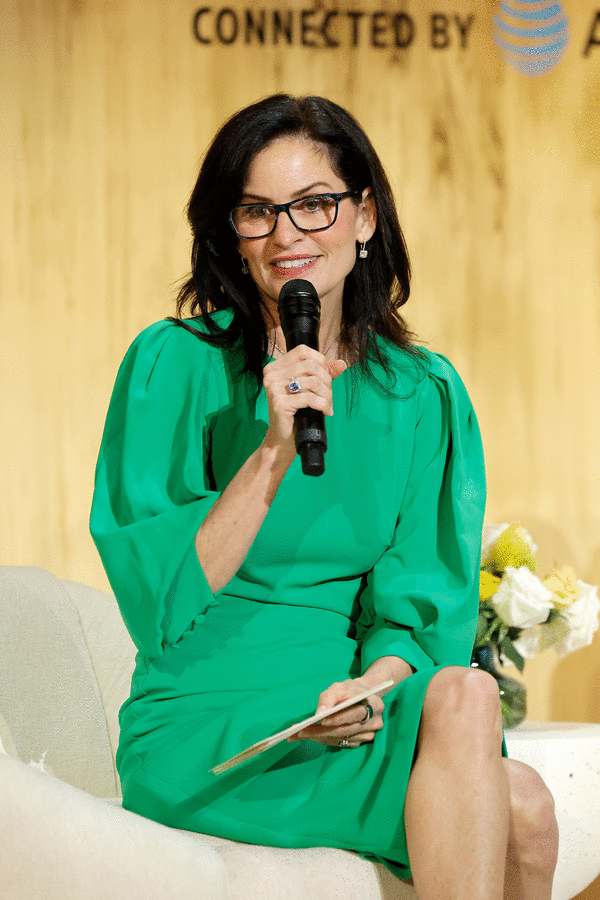
If you’ve stopped by social media lately, there’s a good chance you’ve seen Mary Claire Haver wearing a weighted vest and demystifying menopause for you, particularly if your algorithms have reason to believe you’re interested in that sort of thing.
A board certified obstetrician/gynecologist, Haver has a combined following of more than 7 million people across platforms, with 2.3 million on TikTok alone. (That’s 36 times more followers than Chicago Bears tight end Colston Loveland, for the sake of comparison.) She also has two New York Times bestselling books, including “The New Perimenopause: An Evidence-Based Guide to Surviving the Zone of Chaos and Feeling Like Yourself Again,” which debuted as a No. 2 New York Times bestseller in April.
Part of Haver’s success is that she’s funny, accessible and candid. She’s the friend you can text any question and her answer will be fast, unfazed and evidence-based.
The other part is that women are clearly done being sidelined, shushed, gaslit and otherwise disregarded the moment their bodies pass child-bearing age.
“The modern menopause era is defined by women who will not be shamed into silent suffering,” Haver writes in “The New Perimenopause.”
She calls the landmark study out of the 2002 Women’s Health Initiative — the one that warned against hormone replacement therapy and informed generations of women’s options and decisions around menopause — ”one of the most erroneous misinterpretations of scientific data in history.”
She’s far from alone in that reading. Follow-up research has widely debunked that study heard ’round the world. But it still left a mark — use of hormone replacement therapy dropped by close to 50% within six months of the 2002 study — and a mess of confusion.
Complicating matters is the fact that of the National Institutes of Health’s $50 billion annual budget, less than 10% is dedicated exclusively to women’s health, Haver writes. Menopause, she writes, is estimated to get less than 1% of the women’s health research budget.
So it takes a while to get to the truth. And, she writes, it takes an average of 17 years for new scientific evidence to change clinical practice.
Books like Haver’s help fill the gap.
She’s making the rounds on a national book tour, and I had the opportunity to interview her for a Family Action Network event in Chicago. But for those who won’t make it to a tour stop and are on the fence about reading the book, I want to share a few takeaways.
If you are in or approaching perimenopause or menopause, or if you love someone who is, or if you or a loved one went through it a while back and you still find yourself wondering what the heck happened … you may find some of this useful.
This is a biggie: A woman’s body has estrogen receptors in almost every cell and organ, Haver writes, so when hormone levels begin to change, it affects a whole lot more than just your period. Changes in estrogen can reduce blood flow to the heart, lead to increased bone breakdown, contribute to cognitive decline and more.
Speaking of which, as Haver points out repeatedly: Reproductive hormones are brain hormones. Estrogen, progesterone and testosterone all play a key role in brain health and function. So the sudden confusion, memory loss and mood swings that can accompany perimenopause and menopause are not in your head. (Well, technically they are in your head. But they’re not in your imagination.)
Even if you have no history of depression, perimenopause quadruples your risk of developing a first episode of major depression, Haver writes. If you have a history of depression, perimenopause dramatically increases your risk of relapse. Fluctuating hormones, she explains, disrupt your balance of neurotransmitters like serotonin and dopamine.
Irritability, the punch line of many a perimenopause/menopause-related reel (“Do you need hormone replacement? Or do you just need a divorce? Hahaha.”) is real. Technically defined as “a low threshold for experiencing frustration or anger,” it’s a sign of “neurochemical chaos and altered neurotransmitter function” and is highly prevalent in perimenopause.
“By accepting this reality,” she writes, “we make room for acknowledgment and action.”
Often, she writes, women go to their doctor with a vague list of symptoms, which all add up to a variation of “I just don’t feel like myself.” And often, they’ll be dismissed. Or prescribed an antidepressant.
Her book includes a list of resources, including menopause-trained clinicians, to turn to for help. She also offers scripts for pushing back when you feel your concerns aren’t being taken seriously. For example, “In the past, I have felt dismissed when I brought up my symptoms. I want to make sure I’m heard today.”
If your doctor recommends a hysterectomy? Know this.
“The uterus isn’t disposable,” Haver writes. “It’s not something you remove just because ‘you’re done having kids’ or ‘you don’t need it anymore.’ It’s a complex organ that plays a role beyond reproduction — including structural support in the pelvis and emotional significance for women.
“So if you’re being told you need a hysterectomy and you’re feeling rushed, uncertain, or confused, pause. Ask questions,” she writes. “This is your body, your future, and your decision. We owe it to ourselves — and to one another — to demand care that honors that.”
I could go on, but I’m running out of room. If any of that resonates, read the book. Silent suffering never served anyone. And it’s certainly no way to spend your one wild and precious life, as our patron saint Mary Oliver would remind us.
©2026 Tribune News Service. Distributed by Tribune Content Agency, LLC.




















Comments