Heidi Stevens: 'Dopamine Kids' is a fascinating read -- even if you don't want a yard full of chickens
Published in Lifestyles
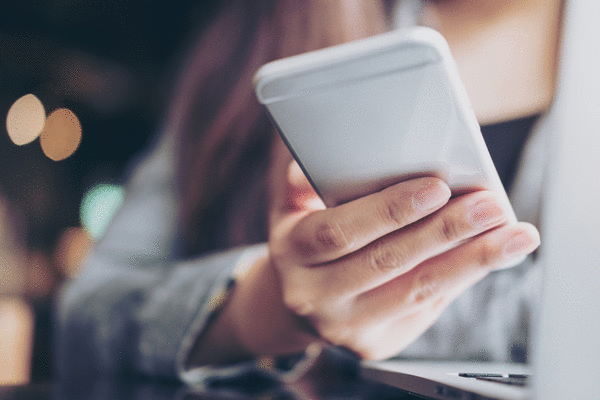
Michaeleen Doucleff set out to examine her family’s relationship to — reliance on, really — screens and junk food.
Why was she checking texts at every stop sign when biking with her daughter, Rosy? Why was she mindlessly devouring Pringles? Why did Rosy impatiently count the minutes to nightly cartoons from the moment she got home? When was the last time they ate a whole food?
At the beginning of her reckoning, Doucleff prepared herself for a lesson in willpower. If she was going to come to terms with how lousy these guilty pleasures were for her and her family, she was also going to have to find ways to forgo them.
“I believed that I had fallen in love with pleasure and that I had too much pleasure in my life,” Doucleff writes in her new book, “Dopamine Kids: A Science-Based Plan to Rewire Your Child’s Brain and Take Back Your Family in the Age of Screens and Ultraprocessed Foods.”
“Therefore, to lift away the gray gloominess that I felt,” Doucleff continues, “I needed to accept less pleasure in life. I needed fewer rewards. And as a parent, I needed to show Rosy how to accept less pleasure as well.”
She had internalized the message that she was, like so many of us, chasing the next dopamine hit.
“According to this theory, when I picked up my phone or bit into a slice of pumpkin bread, it triggered a surge of this tiny molecule inside my brain,” she writes. “And this surge gave me a little bump of pleasure.”
Hence the slavish social media posting, the manic email checking, the constant baked goods craving.
“I was constantly seeking dopamine and the pleasure it provided,” she writes.
What she learned instead — by poring through hundreds of studies, interviewing dozens of neuroscientists, psychiatrists and psychologists, and tuning into her own nervous system — was that the guilty pleasures only brought her guilt (and fatigue, restlessness and melancholy, to name a few feelings). No pleasure.
Because dopamine isn’t actually a burst of pleasure. Dopamine, she learned, sends us on the chase for pleasure. And dopamine magnets (her term for ultraprocessed foods and screens) pull us — often subconsciously — toward them.
“Once we’ve locked into these powerful magnets,” she writes, “they take hold of our attention and throw off our internal compass. They can make us forget about the genuine rewards and pleasures in our life. They make us lose track of what we value and really want out of life.”
Which explains why Doucleff felt anxious, rather than joyful, when she and Rosy spent a phone-free morning building sand castles at the beach. And why sometimes I panic that I can’t find my phone while I’m holding my phone. (That might also be menopause.)
“Dopamine Kids” provides a detailed, five-step process for remodeling our habits and creating boundaries around screens and junk food. Whether you wholeheartedly adopt all five steps or just use the guidance to reorient some of your priorities, it’s a fascinating read.
Starting with the very premise.
“On the surface,” she writes, “screens and ultraprocessed foods don’t appear to have much in common. At first I didn’t see the connection either. But as we'll learn, they’re intimately entwined inside our brains. The neurological pathways that drive our desires for high-fat and high-sugar foods overlap substantially with those driving our consumption of videos, games and social media. Once we understand how one technology works, we understand how the other works.”
She writes about how both tech and ultraprocessed foods arrived in our homes like a tsunami in the last few decades — the latter helped along by tobacco companies who bought up food manufacturers, such as Kraft and Nabisco, when cigarette sales plummeted in the late 1980s.
“In many ways, these foods carry just as much power and influence on our lives as apps and devices.”
Doucleff is trained as a biochemist and spent two years as a postdoctoral fellow at the National Institutes of Health. Now she works as a reporter for National Public Radio, focusing on children’s health.
Shortly after the 2021 publication of her first book, “Hunt, Gather, Parent”— which sold more than 1 million copies— she and her family moved from San Francisco to West Texas.
Now she raises chickens and grinds her own grain. For a while she and her husband ran a home-schooling co-op out of their greenhouse. She encourages us to choose one room at home for our phones and leave them there, plugged into the wall.
Some readers will likely experiment with the five steps and many, I’m sure, will succeed. To me, the book isn’t really about deciding whether to remake our lives to look more like Doucleff’s. (I’m not sure live Christmas trees are allowed in my apartment building. Chickens aren’t happening.)
It’s about understanding the forces at work that shape our habits, our days and, honestly, our family dynamics. For better or worse.
“Scientists now believe that about 40 percent of all our actions occur without much thought or deliberation,” she writes. “We are still conscious of what we’re doing, but we don’t pause and intentionally scrutinize if an action is really worth its costs.”
We ought to, she maintains. And her book explains how.
I’m grateful for any guidance that shakes us out of autopilot in our one wild and precious life. (Hat tip Mary Oliver.) Chickens optional.
©2026 Tribune News Service. Distributed by Tribune Content Agency, LLC.









Comments