Heidi Stevens: 'They're making the "us" bigger.' How one church turned the offering plate into an outpouring of community
Published in Lifestyles
It was 2015 and Pastor Rob Dyer was working on the sermon he would deliver that Sunday to his congregation at First United Presbyterian Church in Belleville, a suburb of St. Louis on the Illinois side of the state line.
The message was about taking care of one another — a seed Dyer has worked hard to plant and grow since leaving his electrical engineering career more than a decade ago to become a Presbyterian minister.
But on this particular week, Dyer wasn’t feeling it.
“It was just lame,” he said. “It just felt like a lot of words and not a lot of action. It needed something real.”
So that Sunday, standing in front of his flock, Dyer made a request: Write down any needs you have on the corner of your worship bulletin, rip off the corner and place it in the offering plate.
“I gave a pretty exhaustive list, ‘Maybe you have a bill you need help with, maybe something in your house needs to be fixed, maybe you need someone to talk to,’” he recalled. “It felt a little raw and a little exciting and, oh my gosh, people really responded to it.”
The following Sunday, Dyer presented a PowerPoint listing all the needs and asked the congregation to write down on the corners of their bulletins if they could help with any. He spent the next two weeks sorting giant piles of ripped bulletin corners into piles of needs and piles of help.
“It ignited something,” Dyer said.
What it ignited has grown, 11 years later, into a full-blown, year-round program called Needs Among Us that Dyer’s church operates with the help of Brightpoint, a social service agency that serves families across Illinois. First United Presbyterian formed a partnership with Brightpoint (formerly Children's Home & Aid) in 2019, looping in the nonprofit's case workers to help execute and expand this thing that began as a humble bid to put words into action.
The church had long sponsored Brightpoint families for Christmas, but often lost contact with the folks they met after the holidays. The church bulletin exercise became a wake-up call on a few fronts: the extent of the needs within their church community, the simultaneous generosity and resourcefulness within their church community, and the reality that needs aren’t limited to the church’s flock or, of course, December.
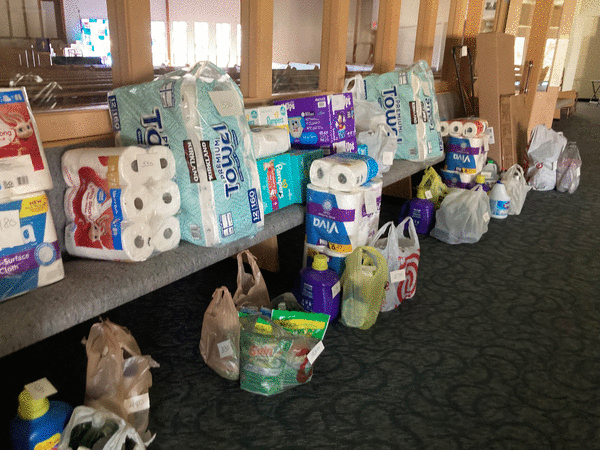
Now four Sundays a year are “Needs Among Us” weeks. The church hands out forms instead of asking folks to write on bulletin corners, but they still compile and share the needs with the congregation the following week. Brightpoint, meanwhile, helps identify local families in crisis, and a team of volunteers coordinates the work of connecting needs to helpers.
“When the needs are presented to the congregation,” Dyer said, “the church doesn’t distinguish between a need from a long-time church member and a need from a Brightpoint family in the community. They simply list all the needs together, operating on the philosophy that they’re making the ‘us’ bigger, rather than creating a ‘needs among them’ program.”
The program started with about 10 to 14 families from Brightpoint, Dyer said, and grew to 25 families the second year. The program now supports up to 50 families at a time, providing everything from school supplies to unpaid tuition to, on occasion, donated cars.
“Some people want church to be like a country club,” Dyer said. “This is messy. We’re trying to do the Jesus stuff of helping people.”
I found out about Dyer from a former colleague who now works at Brightpoint. He thought I’d like the story.
I love the story, and I love the example. I especially love that the program was born in an offering plate, which isn’t where we’re usually invited to place our needs.
Dyer set me straight on that.
“When you ask for help it can feel like you’re sharing a burden,” Dyer said. “But the way we understand service is that you’re offering us an opportunity to do God’s work. You’re offering up vulnerability and trust. You’re offering a chance for someone else to have an impact in the world.”
It makes me think about all the places and ways we could try to weave the program’s model into our own lives. Even if it just means remembering to ask our people what they need.
I asked Dyer what it does to his understanding of humanity, of humans, to watch people, week after week, listen to someone’s bid for help and then find a way to answer.
“It chips away at the idea that there’s not us and them,” he said. “We’re just making us bigger. There’s not a group of precious people and then the people we help. There’s just us.”
Beautiful.
©2026 Tribune News Service. Distributed by Tribune Content Agency, LLC.







Comments