Heidi Stevens: Two summer reads that invite us to glimpse behind the facade of a carefully curated world
Published in Lifestyles
Sometimes when I’m casting around for some logical explanation of how we got here — here being a time when an ex-Olympian finds himself facing felony charges (eventually dropped) over a botched Reflecting Pool job he had nothing to do with, and the president of the United States posts AI-generated images of himself as Elvis, and flaming space debris is hitting Earth at a record pace, and robots are taking all the jobs — I turn to fiction.
Sure, fiction transports you to another place. Sure, it’s an escape hatch. Sure, it casts a dreamy spell that you can slip into for as long as there’s another page to turn, plot to solve, character to love.
But it also invites you to walk in someone else’s shoes and inhabit someone else’s mind and experience someone else’s trials and triumphs. It chips away at your blind spots. It takes someone else’s world — shaped by their wounds, their wisdom, their wonder — and makes it yours for a while. It makes sense of things.
And wow, did I just stumble upon a couple of masterpieces.
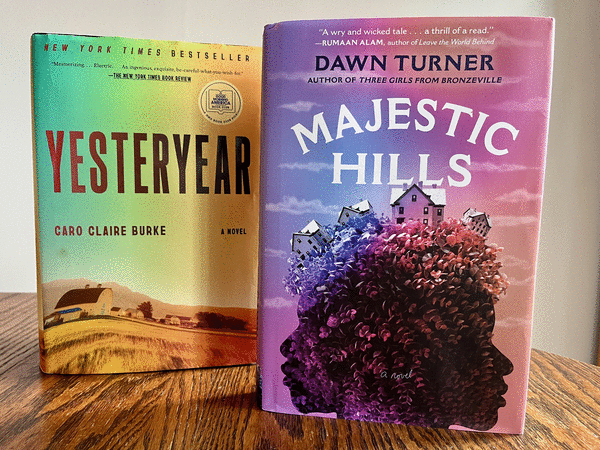
Over the past two weeks, I read “Majestic Hills,” former Chicago Tribune journalist Dawn Turner’s fantastic new book, followed by “Yesteryear,” Caro Claire Burke’s trippy, unhinged novel released in April to huge acclaim — “Good Morning America” chose it as GMA Book Club Pick; Anne Hathaway secured the film rights; it immediately soared to the top of bestseller and library holds lists, where it remains 16 weeks later.
I read them back to back.
“Majestic Hills” tells the story of the Blaques, a Black couple — Langdon is an emergency room doctor; Josephine is a lawyer — who move from their Chicago condo to a tight-knit, predominantly white suburb 50 miles away in search of the tranquility that Langdon craves but Josephine doesn’t quite trust.
On its opening page, before the prologue, before the gorgeous, layered, winding tale unfolds, sits a quote from James Baldwin: “The place in which I’ll fit will not exist until I make it.”
“Yesteryear” takes us into the world of Natalie Heller Mills, an Idaho ranch-dwelling tradwife influencer who sells a pioneer-chic fantasy (along with various kitchenwares) to her millions of social media followers — a mishmash of adoring devotees who approach her with reverence during her very occasional Whole Foods trips and “the Angry Women,” shorthand for her liberal city-dwelling critics who work outside the home, eschew God and, Natalie is certain, subsist mostly on pesticides and rage.
Natalie wakes up one day in actual yesteryear, specifically 1855, and finds it not all what she cracked it up to be — in her mind or on her Instagram feed. The story bounces between the two eras, both of which find Natalie leaning heavily on her mother’s platitudes: “Doubt your doubts before you doubt your faith, sweetheart.” “A man may work from sun to sun, but a woman’s work is never done.” That kind of thing.
The books, like their protagonists, have very little in common. Josephine’s compass is tuned to the truth and doing right by her marriage, her late father, and her convictions. Natalie’s is tuned to a distant, hierarchical afterlife where God’s love is less of an all-encompassing conception and more of an elusive, enviable prize. Like prom queen. Or president.
But both invite us to glimpse behind the facade of what we think we’re witnessing.
In “Majestic Hills,” that means questioning the illusion of safety, interrogating who safety is reserved for, and spanning out to see how one community’s privilege quietly and devastatingly compromises another community’s well-being. Things you don’t see on the marketing brochure.
In “Yesteryear,” it means bumping into what happens off-camera and off-script in some of the roles we’ve grown accustomed to seeing performed online — mother, wife, proselytizer, populist. It means ranch hands and nannies and microwaves and brokenhearted children and studio lighting, all edited out of the frame.
In both, it means getting inside the head of a person you may relate to uncannily. Or not relate to even a smidgen. In both, it means better understanding what made them that way — the grief or the fear or the pride or the devotion or the fabrications played off as destiny.
In both, it means watching what people do when the blinders come off. When their understanding broadens. When their worldview gets complicated by the truth.
In both, it means confronting your own blinders and understanding and worldview.
I can feel myself starting to get vague with these descriptions. I’m cautious about giving away plot points.
But I’ll say this. When you find yourself bewildered by the truth — or what’s passing for it at the moment — the deft and brilliant hand of a fiction-writer can feel like a telescope, revealing whole universes that sharpen and explain the one you find ourselves living in.
Both authors, both stories, delivered. And when you unwrap a gift like that, you find yourself wanting to tell everyone you know: Here. Look at this. You won't believe your eyes.
©2026 Tribune News Service. Distributed by Tribune Content Agency, LLC.










Comments