Florida nonprofit helps disabled adults gain job skills as repair technicians
Published in Lifestyles
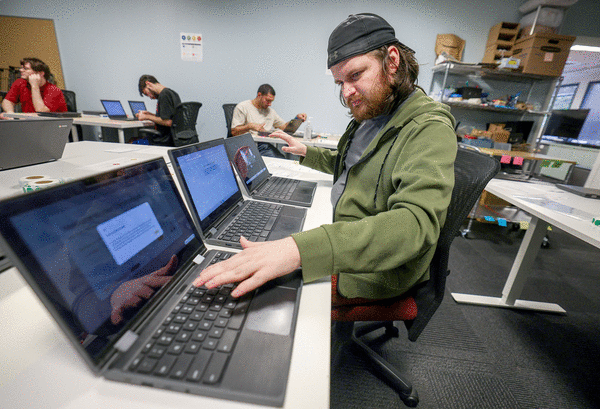
ORLANDO, Fla. -- Isaac Edwards takes pride in his job teaching adults with autism and other disabilities to repair electronic devices.
“Some students are even older than me, and they’ve never had a job before,” said Edwards, 27. “They’ve never even gotten their driver’s license and stuff like that. I feel like they’ve tried everything, and they don’t know what to do.”
Edwards, who worked a series of low-wage jobs before being diagnosed with autism at age 24, can relate.
After his diagnosis, he learned about a Winter Park, Florida, nonprofit that was training people with disabilities to repair cell phones, laptops and other devices in an environment tailored to their special needs. He became one of the initiative’s first apprentices and hasn’t looked back.
“Everyone communicates in their own different way, but we all understand each other and we can move step by step,” said Edwards, a mentor and repair technician at Techtonic Training Lab in Winter Park. “And it’s a fun job.”
Jonathan’s Landing Foundation, a nonprofit that advocates for people with autism, set out in 2024 to arm people with disabilities with employable skills and get them on a career path.
With $1.75 million in state appropriations, the nonprofit launched its Techtonic initiative, creating a curriculum, holding training events across the state and opening an electronics repair hub and training facility in Winter Park. The foundation also purchased an established repair facility in South Florida that now employs people with autism.
The nonprofit, however, suffered a setback earlier this year when Gov. Ron DeSantis vetoed its request for an additional $750,000 in state funding.
“It’s disappointing. It changes the momentum a little bit,” said Kimberly McCarten, CEO of Jonathan’s Landing Foundation, adding that the nonprofit’s growth may slow while the group searches for new funding sources.
Still, McCarten said she is grateful for the money the state provided in 2024 and 2025 as it allowed them to launch the initiative.
“We are a new organization, so most foundation grants and different grants are looking for someone to have like three years under their belt and have all of the evidence,” McCarten said. “So this was an incredible way for us, as a newer organization, to be able to build that momentum up. It was definitely important to us.”
The initiative works to solve an ongoing problem for adults with autism: Many can’t find jobs. About 85% of adults with autism are unemployed and nearly 8% are underemployed, having skills that are higher than their job requires, according to the American Civil Liberties Union.
Techtonic aims to connect those people with more meaningful jobs and give them a chance at independence, McCarten said.
Many parents of children with disabilities worry about who will support their children after they die.
“That’s the thing that used to keep me up at night,” said Jason Eichenholz, the Orlando tech entrepreneur who founded Jonathan’s Landing and named it after his son, Jonathan Eichenholz, who was diagnosed with autism as a young child.
Eichenholz’s vision is to give adults with disabilities skills they can take to other employers while also building a large repair center in Central Florida where they can work, if they want.
Currently, Techtonic operates out of leased space in an office complex in Winter Park. The space is large enough for about 30 employees, with a training room, a shipping room, storage and management offices.
Eichenholz plans to build a larger facility and also housing near that new facility, so that 500 adults with disabilities could live nearby, with profits from the repairs helping to offset the costs. The nonprofit has not yet shared publicly details about the location of the new facility or the housing.
So far, about 1,000 people have attended Techtonic workshops.
Those interested in pursuing a job are invited to the Winter Park training facility for a day, where they take apart and reassemble cellphones and laptops.
Then they are invited to take an online training course and a corresponding exam, an industry-recognized credential that, if they pass, shows they understand essential repair and safety practices. After that, they become apprentices, working on devices and learning requirements of the job. All of the work is tracked and a portfolio is built for each apprentice.
“So we can say, this person has 95 hours in-seat time fixing these types of devices. He has an average repair time of 45 minutes for fixing an iPhone screen,” said Jonathan Maricle, interim acting president for Techtonic. “Plus he’s certified. Plus he knows how to clock time and do everything else.”
All that aims to make the apprentice an attractive potential hire, Maricle said.
There are currently 17 apprentices at the Winter Park facility.
The nonprofit accepts donations of old electronic devices and also purchases devices for their training efforts. Last month, 4,000 Apple Chromebooks bought from a Colorado school district arrived in four-foot-high boxes.
The apprentices worked in an assembly line fashion, taking each computer out of the box and plugging it into a charging station. Once powered up, the apprentice assigned a grade of A to F to each device, depending on its condition. Those not worth fixing are harvested for parts and then recycled. The apprentices will refurbish the rest so they can be sold.
Edwards, who is in charge of shipping the devices to customers, said each time he drops a package off at the post office it puts a smile on his face.
“What I’ve been trying to do is to get as much as I can done for Techtonic. Because if Techtonic succeeds, then Jason’s goal ends up progressing,” Edwards said. “And then parents would get to see that the smile doesn’t fade because it’s not just some program that is just talk, it’s action.”
©2026 Orlando Sentinel. Visit at orlandosentinel.com. Distributed by Tribune Content Agency, LLC.





















Comments