Heidi Stevens: We need empathy more than ever. This would be a terrible time to say goodbye to books
Published in Lifestyles
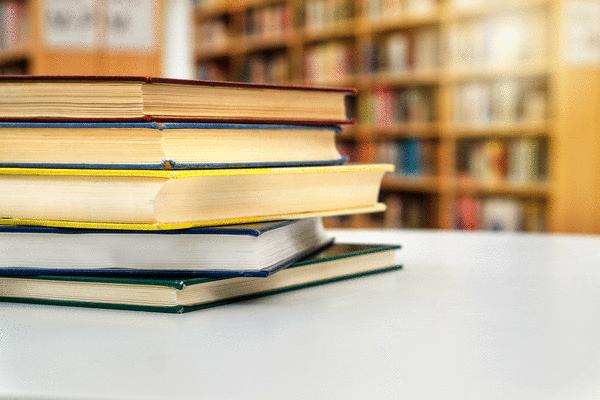
This would be a terrible time for us to abandon books.
Every time I read another story about students asking ChatGPT to summarize a novel or high school reading scores hitting a new low or books disappearing from classrooms, I worry not just for our attention spans and critical thinking skills and ability to keep charming little bookstores open. (Although I worry a lot about those things, especially charming little bookstores.)
I worry most for our empathy.
Books are little empathy gardens, feeding and growing the stuff that makes us feel, makes us care, makes us human.
If you’re a reader, you know this. If you’re not, the science tells us; study after study links fiction-reading to increased empathy and prosocial behaviors.
“The Canadian cognitive psychologist Keith Oatley calls fiction ‘the mind’s flight simulator,’” Claudia Hammond wrote in a BBC article examining how reading changes our brain structure. “Just as pilots can practice flying without leaving the ground, people who read fiction may improve their social skills each time they open a novel.”
And yet. The data consistently points to a decline in reading, especially among young people.
Book sales remained stable in 2025, according to industry data. But young adult fiction sales dropped sharply. In 2024, only 14% of young teens said they read for fun daily, compared with 27% in 2012.
It would be easy — and not inaccurate — to blame AI. Don’t feel like making sense of “Hamlet?” ChatGPT will summarize it for you. Not in the mood to be transported back to Oliver Twist’s orphanage? Claude’s got you.
But blaming AI alone would be missing the roots — and the depth — of the problem.
Books are art. But too often they’re treated like algebra — something to muscle through, regurgitate for a test, move on from.
They’re presented like spinach. But they’re actually dessert.
The list of most-taught books in American high schools has remained almost identical to 35 years ago, according to a nationwide survey of 4,000 English teachers by the National Council of Teachers of English. William Shakespeare’s “Romeo and Juliet” is the most taught text. All of the top 10 were written by white authors (nine of them men) and published more than 60 years ago.
They are gorgeously crafted and rich with historic and cultural significance. They should, to my mind, all be read (or attempted) at some point in life.
I don’t know that they make you fall in love with reading. I don’t know that they inspire a habit of picking up a novel to escape the world and all of its stressors and heartbreak. I don’t know that they open your eyes — when your eyes are still 16 or 17 — to the absolutely mind-blowing realization that libraries and bookstores and maybe even the shelves in their friends’ houses are dripping with stories and voices and characters that will delight and inspire and terrify and change them.
“Beowulf” did not do that for me. “Beowulf” felt like algebra. If ChatGPT existed in 1991, when I was a junior in high school, I’m certain I would have turned to it for help making sense of the Anglo-Saxon verse. Lucky for me, I already loved books by the time “Beowulf” arrived in my life.
To be clear, this is not an English teacher problem. Depending on the district and the state, teachers often have little control over what they can assign. Add standardized testing pressure and ever-increasing book bans and you can understand why that top 10 list isn’t budging. Cuts to library funding further threaten young people’s ability to access books outside their assigned texts — books, maybe, that reflect them, speak to them, excite them.
So AI taking over reading homework? Feels to me like the result of a problem, not the cause of it.
Talk about lousy timing.
Because empathy doesn’t just seem like the best way forward right now. It seems like the only way.
What better way to pivot and heal from a chapter like the one we’re in now, a chapter marked by constant cruelty and chronic chaos? What better way to recoil, reflexively, from the next leader who comes along behaving like the one we have now?
Books help us care what it feels like to walk around the world in someone else’s shoes, in someone else’s skin, in someone else’s country, in someone else’s family. Books teach us how to imagine those things, to conjure and store them in our brains.
Books make us fall in love with places we’ve never been to. And want to protect people we’ve never met. They make us believe in, root for, ache for, relate to someone whose life is completely distinct and disconnected from ours. Someone whose fate doesn’t shape our fate in the least — other than the way caring about anyone’s fate shapes us. Which is to say, completely.
I worry about what happens if they slowly take up less space in our lives.
It’s a small worry, maybe, stacked next to war and the climate and the Epstein files and health care coverage.
But I don’t see how we solve any of those things — any things at all, really — without empathy. And I don’t see how we grow such a precious commodity without books.
©2026 Tribune News Service. Distributed by Tribune Content Agency, LLC.









Comments