Rooster 'epidemic' fueled by backyard coops, sanctuaries say
Published in Lifestyles
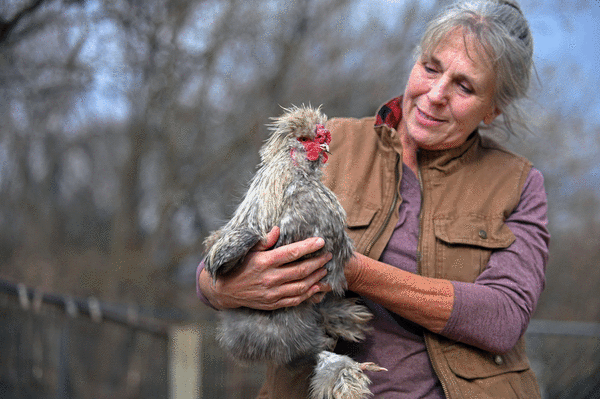
BALTIMORE -- A yearslong surge in displaced roosters is overwhelming animal sanctuaries in Maryland and across the country, fueled by a pandemic-born boom in backyard chicken coops and the noisy realities of owning a male bird.
“All the time — calls, emails, text messages wanting us to take roosters,” said Cathy Rogers, executive director of Flip Flops Animal Sanctuary in Calvert County. “It kills me every time I have to turn them away.”
Maryland has roughly 10,000 registered backyard flocks, according to the state Department of Agriculture. But many new owners don’t learn until weeks after bringing chicks home that they’ve wound up with a rooster. Whatever the reason, be it their frequent crowing, protective behavior or sharp spurs, because roosters are often banned in cities, suburbs and by homeowners’ associations, owners have to make other arrangements quickly.
“By then you’re attached to it,” Rogers said. “You’re not going to just drop it off at some farm to be someone’s meal. So a lot of times, they take them to the shelter, hoping that someone’s going to adopt them, but often times, they just end up being destroyed anyway.”
Sanctuaries at capacity
Flip Flops cares for about 70 animals, including eight roosters, alongside parrots, geese, ducks and even an emu. Rogers said she wants to help more birds but is limited by space and resources.
Sanctuaries nationwide report similar strain. A facility in southern Alabama says rooster calls come in “constantly.” Another near Boston, already housing 70 roosters, wrote in a message that it receives about three surrender requests a day — and sometimes as many as 14.
Star Gazing Farm Animal Sanctuary in Montgomery County now accepts only roosters that are injured, endangered or have special needs. Founder Anne Shroeder said most calls come from people who bought chicks from farm-supply stores and later discovered their hens weren’t hens at all.
Shroeder currently cares for two roosters — Samson, rescued in West Virginia, and Belinda, trapped by neighbors in Silver Spring who were worried about predators. They had also mistaken Belinda for a hen, thus the name.
Otherwise, both she and Rogers said they direct callers to local shelters, which “try really hard to place them” in a sanctuary or sustainable home.
“But at some point, they get overrun,” Rogers said of shelters. “So, you know, do the math.”
‘Not just the warm and fuzzy’
Keeping chickens on your property is no small task, especially if there are multiple roosters competing for the top spot of the flock.
Samson and Belinda are the only chickens at Star Gazing Farm right now, although Shroeder said she had many more at one time. So many, in fact, that they formed three “gangs:” one in the front yard, one in the back and another in a side pasture. They didn’t mix well, she explained, but without hens to tussle over, the bachelor flocks could stick together.
But there are several factors outside a coop’s social life that owners need to consider, as well. Whereas cities, counties and municipalities regulate backyard birds, the state’s role, largely, is to ensure safety information is disseminated at the household level and maintained at the production level — including on the Eastern Shore, where poultry giants Perdue Farms, Tyson Foods and Mountaire Farms all have facilities.
Maryland’s state veterinarian, Dr. Jennifer Trout, with the Department of Agriculture, said monitoring and efforts to prevent bird flu are vital at both levels. The department stresses the need for owners to set aside clothing specifically for interacting with a flock. The amount of fecal matter that could fit on the face of a dime could be enough to infect one million birds, she said, explaining a stroll by a pond with geese or ducks could become cataclysmic if the same shoes are worn in a coop.
Trout said in an interview that getting a chicken is not a decision that should be taken lightly.
“If you’ve got the space, the time, the means and are willing to have the commitment, then great,” she said. “But if you get to the store, and you’re thinking about it, you really need to do some long-term thinking. Is this something that I’m going to be able to handle … because if it’s not, then I shouldn’t go down this path.”
Shroeder said people thinking about taking in a chick should stop and “really consider if this is what they want to do.” Even if they’re easier to find or cheaper to buy, she said owning a chicken is “just like getting a dog or cat.”
“It’s a commitment to a life,” Shroeder said. “People think, ‘oh, it’s just a chicken,’ ‘oh, they just cost 50 cents,’ which is really sad, but it is a life, and you should commit to it.”
Trout similarly said the “rooster epidemic,” as Shroeder called it, must be addressed proactively.
Staring at the goldfish her daughter won at a nearby carnival but whose bowl she now cleans, the state vet told The Baltimore Sun that owning a chicken is “not just the warm and fuzzy of the moment” when you take it home.
“You’ve got to understand that, so to speak, the novelty may wear off,” she said.
©2025 The Baltimore Sun. Visit at baltimoresun.com. Distributed by Tribune Content Agency, LLC.























Comments