Did Marijuana Play A Part In Cigarette Smokings HUGE Decline
Published in Cannabis Daily
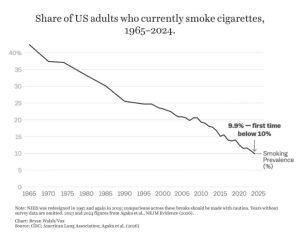
Did marijuana play a part in cigarette smoking’s huge decline as U.S. adult rates fall below 10 percent? The United States has achieved one of the most significant public health turnarounds in modern history: a dramatic and sustained decline in cigarette smoking. According to data published by the Centers for Disease Control and Prevention(CDC) and supported by peer-reviewed research in journals such as JAMA, adult smoking rates have fallen from more than 40 percent in the mid-1960s to 9.9% – a record low. This milestone reflects decades of coordinated scientific, regulatory, and cultural change. But did marijuana play a part in cigarette smokings HUGE decline. To understand the magnitude of this shift, it is important to revisit the cultural landscape before 1964. Smoking was not just common—it was embedded in everyday life. People smoked on airplanes, in grocery stores, in offices, and even in hospitals. Cigarettes were advertised widely, including by physicians in some campaigns, and were often portrayed as symbols of sophistication and relaxation. This began to change when the Surge was released. The report definitively linked cigarette smoking to lung cancer and other serious diseases, marking a turning point in public awareness. The scale of the decline is staggering. In 1965, roughly 42 percent of U.S. adults smoked. By 2000, the number had dropped significantly, and today it sits just under 10 percent. What was once ubiquitous—featured in movies, offices, and airplanes—is now increasingly rare in everyday life. However, the story is not as simple as a straight-line victory. While cigarette use has plummeted, nicotine consumption has not disappeared. The rise of e-cigarettes and vaping has reshaped the landscape, particularly among younger adults. Public health experts remain divided: some view vaping as a harm-reduction tool helping smokers quit, while others warn it introduces a new generation to nicotine addiction.
This is where cannabis enters the conversation. As legalization spreads across the U.S., cannabis has increasingly been positioned—rightly or wrongly—as an alternative to tobacco. Some consumers report substituting cannabis for cigarettes, particularly in states where recreational use is legal. Additionally, the cultural normalization of cannabis has paralleled the denormalization of tobacco. Smoking a cigarette today often carries more stigma than consuming cannabis in many social circles. There is also a behavioral shift at play. Modern consumers are more health-conscious and more willing to explore alternatives, whether it means vaping, nicotine pouches, or cannabis products. While cannabis is not risk-free, it is often perceived as less harmful than combustible tobacco, influencing consumer choices and potentially accelerating the decline in cigarette use. Yet even as cigarette consumption drops, the tobacco industry remains highly profitable. Major tobacco companies have adapted rather than disappeared. They continue to generate billions in annual revenue, leveraging price increases, global markets, and new product categories like e-cigarettes and smokeless nicotine. Declining smoking rates in the U.S. have been offset by growth in developing markets and diversification into alternative nicotine products. In other words, while fewer Americans are lighting up, the business of nicotine is far from extinguished. Tobacco companies are evolving alongside consumer behavior—ensuring even as traditional smoking declines, profitability endures. The result is a paradox: a historic public health success unfolding alongside a resilient, highly profitable industry still shaping the future of consumption.
The Fresh Toast is a daily lifestyle platform with a side of cannabis. For more information, visit www.thefreshtoast.com.






















Comments