
A Former Slave Told Us the Value of July 4


It is unfortunate but also ironically appropriate that national efforts to celebrate the nation’s birth have been rattled by internal disputes over how that birth should be celebrated.
"Who controls the past controls the future,” wrote George Orwell in 1984. “Who controls the present controls the past."
By altering history to make the ruling party look great, in other words, leaders can more easily justify their current actions in ways that help them hold power.
With that maxim in mind, one can easily see why the current administration takes such a big interest in history, when they’re not just staging commemorative stunts such as cage fighting on the White House grounds.
For example, President Trump's administration has been involved in a legal battle regarding historical sites and slavery in Philadelphia, under an executive order aimed at removing content that allegedly disparages America, in the administration’s view.
Under that order, the National Park Service recently removed panels at the President's House Site detailing the people George Washington held in slavery.
The City of Philadelphia sued the park service over the removals and a federal judge initially ordered the displays to be restored. In June, however, a federal appeals court vacated that injunction, allowing the administration to remove and replace the exhibit.
That’s disappointing. Yet there’s only so much the Trump administration can do to burnish the image of slavery, and I'm not sure why they're trying, but make no mistake that they are.
Concerns over potential reforms at the Smithsonian — often called “the nation’s attic,” as a repository of history — have arisen since Trump signed a March 27 executive order titled “Restoring Truth and Sanity to American History.”
The order argued that the Smithsonian had in recent years “come under the influence of a divisive, race-centered ideology” and said the institution has “promoted narratives that portray American and Western values as inherently harmful and oppressive.”
That depends on how you view history, of course. In a free society, historical inquiry is always going to raise inconvenient truths and challenge patriotic orthodoxies and hagiographies. As painful as that can be, in the long run it's good for the body politic.
The executive order designated Vice President JD Vance and Lindsey Halligan, a senior White House aide, “to remove improper ideology” from the Smithsonian Institution, which includes dozens of museums, libraries, research centers, historical sites and the National Zoo.
Alas, “improper” is in the eye of the beholder.
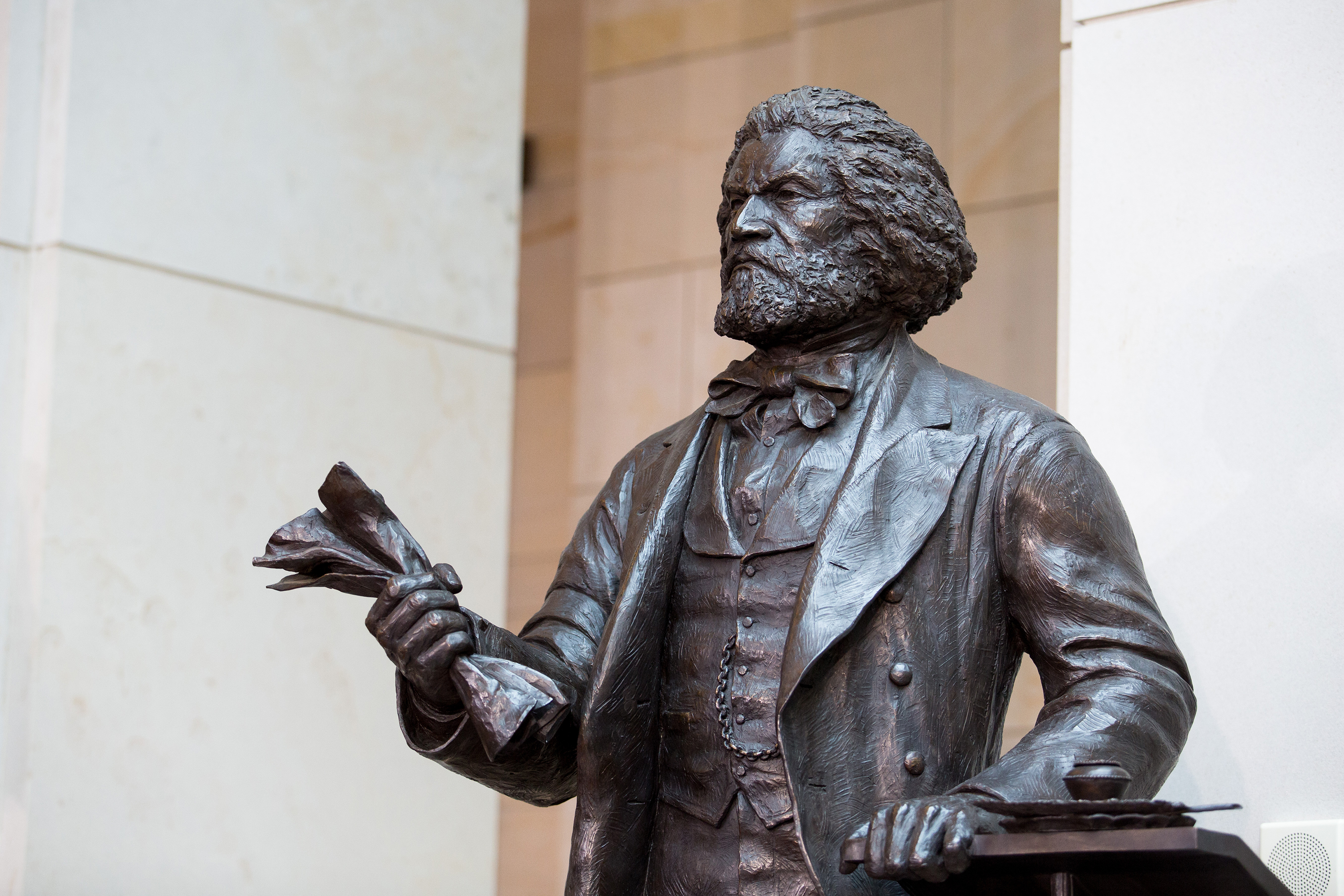
This point was made with scathing precision by Frederick Douglass in an oration on July 5, 1852. Douglass, an abolitionist and former slave, addressed the Rochester (N.Y.) Ladies' Anti-Slavery Society on the topic "What to the Slave Is the Fourth of July?"
Douglass, only a few years before the Civil War erupted, argued that the celebration of American independence is a painful mockery to the enslaved Black American. It "reveals to him, more than all other days in the year, the gross injustice and cruelty to which he is the constant victim."
To Douglass, it was glaring hypocrisy for a nation to proclaim its liberty and equality while legally practicing human bondage.
"The existence of slavery in this country," he thundered, "brands your republicanism a sham, your humanity a base pretense, and your Christianity a lie."
Less than five years later, Supreme Court Chief Justice Roger B. Taney wrote the majority opinion in Dred Scott v. Sandford, which returned Scott, the enslaved plaintiff, to the man who claimed ownership over him, who had brought Scott to "free" territory and leased out his labor, thus importing enslaved labor to U.S. territory where slavery was illegal.
In his infamous opinion, Taney argued that, at the time of the Declaration of Independence, "civilized and enlightened" opinion held Black people as "beings of an inferior order," who had “no rights that the white man was bound to respect.”
Douglass did not try to sugarcoat his descriptions of the brutality of slavery or those who actively or passively tried to defend the "peculiar institution,” in the euphemism popularized by Southern politician John C. Calhoun in the 1830s.
Yet Douglass placed his hope in the nation’s founding documents, arguing in his Rochester speech that the U.S. Constitution, if interpreted correctly, was actually a "glorious liberty document."
Indeed, his reaction to the Dred Scott decision, which he called an "open, glaring, and scandalous tissue of lies," was hope. The promise of the Constitution was on an inevitable collision course with the infamy of slavery.
As a patriotic American who served in the Army and who loves his country with a desire to improve it, I celebrate the Fourth of July in the way that Martin Luther King did in his historic 1964 “I Have a Dream” speech, with an aspirational vision for our country’s improvement.
I believe, as Douglass did, that our Constitution continues to be a glorious document, although the arguments over how it can be made more “glorious” never end.
Evidence of that was offered last week by the Supreme Court’s reengaging the age-old argument about birthright citizenship, which dates back to the ratification of the 14th Amendment, which granted the citizenship that Taney's court had denied to enslaved Black Americans.
Like many others, I thought the argument over the citizenship of children born in this country was settled long ago. Yet the high court ended up only one vote short of getting rid of birthright citizenship, a move promoted mainly by people who call themselves conservative.
Yes, in pursuit of a “perfect union,” there always will be some people who want to make it “more perfect” even when they express what sounds to me like “improper ideology.”
========
(E-mail Clarence Page at clarence47page@gmail.com.)
©2026 Tribune Content Agency. Distributed by Tribune Content Agency, LLC.
(c) 2026 CLARENCE PAGE DISTRIBUTED BY TRIBUNE MEDIA SERVICES, INC.




















Comments