The Shared Language of Play: Why All Mammals Learn Through Games
Published in Cats & Dogs News
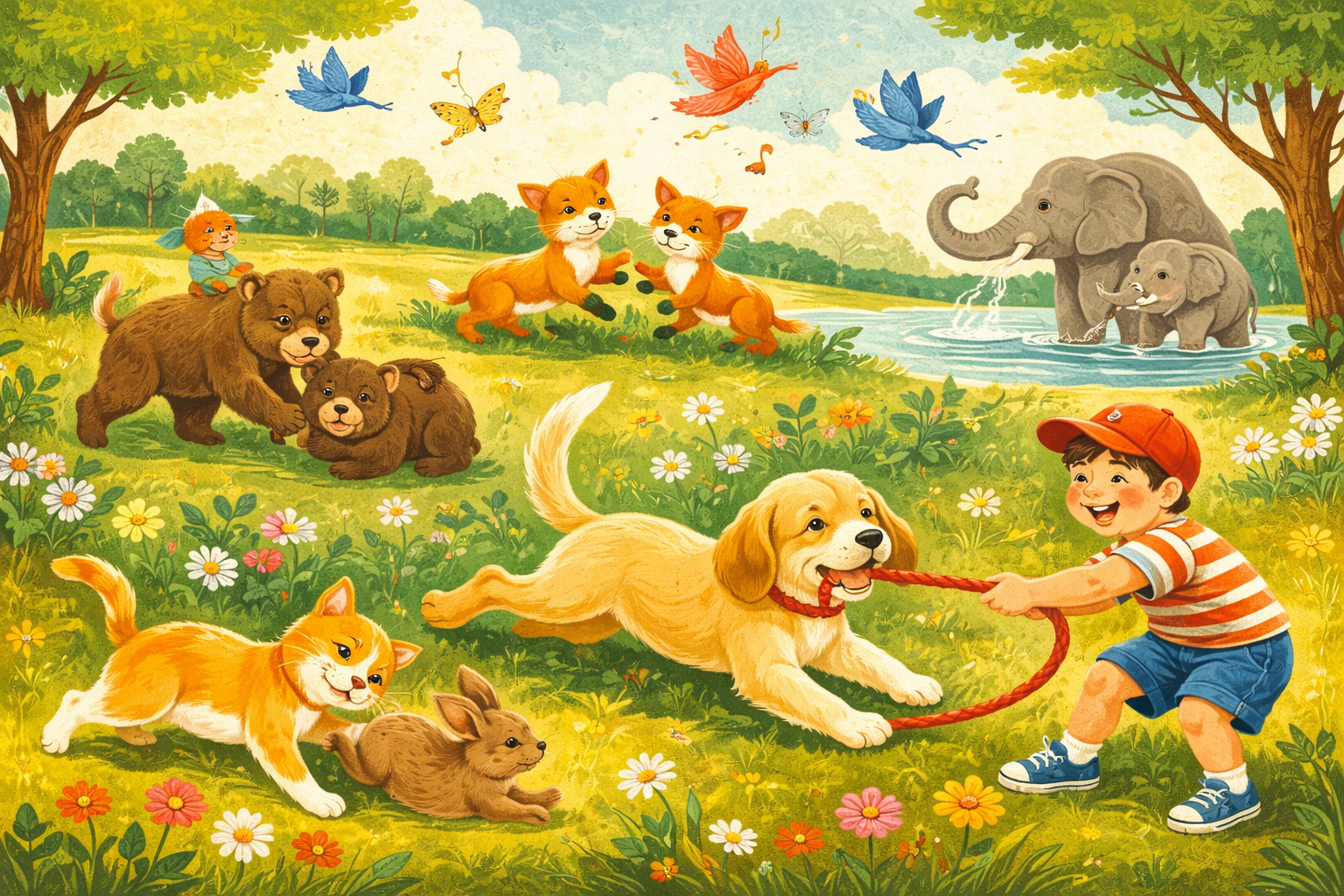
Across cultures, climates, and species, young mammals engage in a remarkably similar activity. They chase, wrestle, tumble, stalk, and retreat in patterns that resemble conflict but lack real danger. Puppies pounce on littermates. Kittens ambush imaginary prey. Young primates swing and spar. Even human children invent games built around pursuit and cooperation. These behaviors are not random. They are the biological foundation of learning.
Play is one of evolution’s most efficient teaching tools. It allows animals to practice survival skills in low-risk environments. Instead of learning through costly mistakes, young mammals rehearse important behaviors in controlled, flexible settings. Through play, they gain physical coordination, social awareness, and emotional regulation.
Neuroscience helps explain why play is so powerful. During playful activity, the brain releases dopamine, endorphins, and oxytocin. These chemicals reinforce learning by linking pleasure to practice. When an animal enjoys an activity, it repeats it. Repetition strengthens neural pathways. Over time, skills become automatic.
In physical terms, play develops motor systems. Chasing improves cardiovascular endurance. Wrestling strengthens muscles and balance. Leaping refines spatial judgment. These abilities later translate into hunting, foraging, escape, and navigation. Play is exercise with purpose.
Social play teaches even more. When animals engage in mock fighting, they learn restraint. Bites are inhibited. Claws are softened. Dominance is negotiated without injury. These interactions establish boundaries and prevent future conflicts from escalating.
Studies of wolves, lions, and domestic dogs show that individuals who play more as juveniles tend to exhibit better social skills as adults. They read signals more accurately, respond more flexibly, and recover from stress more quickly. Play builds emotional intelligence.
Role-switching is another key feature. In healthy play, stronger animals often allow weaker partners to “win.” A larger puppy may roll onto its back. A dominant kitten may retreat briefly. These reversals teach empathy and cooperation. They reinforce group cohesion.
Human children follow similar patterns. Games of tag, hide-and-seek, and pretend combat mirror mammalian play structures. They involve pursuit, evasion, negotiation, and rule creation. Through play, children learn fairness, leadership, compromise, and resilience.
Play also serves as a stress regulator. Engaging in playful behavior lowers baseline anxiety and improves emotional recovery. Animals deprived of play opportunities often show higher levels of fear, aggression, and compulsive behavior. The same is true for humans.
Interestingly, play continues into adulthood in many species. Adult dogs initiate games. Dolphins surf waves. Elephants engage in mock chases. These behaviors maintain cognitive flexibility and social bonds. They prevent behavioral stagnation.
In evolutionary terms, play functions as a testing laboratory. It allows individuals to explore “what if” scenarios. What if I run faster. What if I push harder. What if I retreat sooner. Each experiment yields information without catastrophic cost.
Environmental richness influences play patterns. Animals raised in stimulating environments develop more complex play behaviors. Those in impoverished settings show reduced creativity and adaptability. Play thrives where curiosity is supported.
Technology has altered human play, but not eliminated its function. Digital games, sports, and collaborative challenges still activate learning systems rooted in mammalian biology. The medium changes. The mechanism remains.
For pets, play is essential communication. Tug-of-war, fetch, and chase are not frivolous. They reinforce trust, clarify roles, and maintain emotional balance. When owners play with animals, they participate in an ancient biological dialogue.
Play also strengthens interspecies relationships. Shared games create mutual predictability. They build confidence. They establish emotional safety. In effect, play becomes a shared language.
One of the most remarkable aspects of mammalian play is its universality. Species separated by millions of years of evolution converge on similar patterns. This suggests that play is not an optional feature. It is a core operating system.
When play is absent, development suffers. Animals raised without opportunities to play show deficits in problem-solving, impulse control, and social engagement. Humans display similar outcomes. Play deprivation limits potential.
Seen through this lens, play is not leisure. It is education. It is emotional training. It is relationship-building.
It is how mammals prepare for life.
And long after survival skills are mastered, it remains how they remember how to live together.
========
Maribel Hartwick is a freelance science and culture writer who focuses on animal cognition, evolutionary psychology, and human–animal relationships. This article was written, in part, utilizing AI tools.







Comments